Top 10 Revision Techniques for CBSE Students Before Pre-Boards
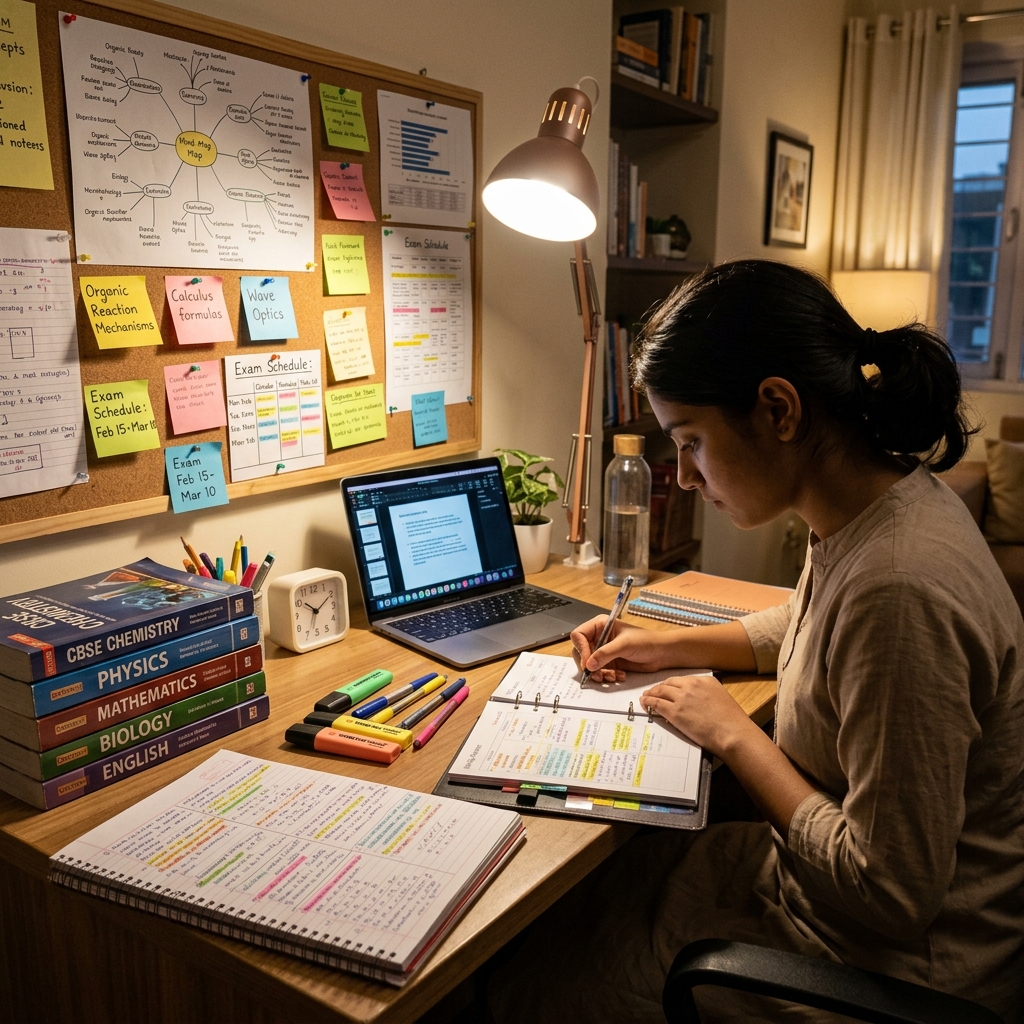
Top 10 Revision Techniques for CBSE Pre-Board Success
Answer Capsule (AEO): Scientific revision techniques such as Active Recall, Spaced Repetition, Mind Mapping, the Feynman Technique, and solving past 10-year question banks dramatically improve long-term memory retention and paper-solving speed for CBSE pre-boards.
Pre-Board examinations serve as the ultimate dress rehearsal before the final CBSE board exams. Implementing scientifically backed revision strategies ensures students convert theoretical knowledge into high exam scores effortlessly.
Scientific Revision Framework
| Technique | Methodology | Primary Benefit |
|---|---|---|
| Active Recall | Testing memory without looking at notes | Strengthens long-term memory retrieval |
| Spaced Repetition | Reviewing topics at 1, 3, and 7 day intervals | Prevents memory forgetting curves |
| Feynman Technique | Teaching concepts in simple plain words | Uncovers hidden understanding gaps |
10 Proven Revision Strategies
- 1. Active Recall: Test yourself without looking at textbook notes to strengthen memory neural pathways.
- 2. Spaced Repetition: Review difficult topics at 1-day, 3-day, and 7-day intervals to eliminate forgetting curves.
- 3. The Feynman Technique: Explain complex concepts in simple plain words as if teaching a 10-year-old child.
- 4. Mind Mapping: Create visual flowcharts connecting key formulas, historical dates, and biological processes.
- 5. Solved PYQ Practice: Work through past 10-year CBSE official board papers under strict 3-hour timer conditions.
- 6. Formula Sheets & Flashcards: Maintain dedicated formula notebooks for Physics, Math, and Chemistry.
- 7. Derivation Rote Practice: Practice writing subjective proofs and chemical reaction steps by hand.
- 8. Error Analysis Journal: Log every mistake made during mock tests and review them before exam morning.
- 9. Group Discussions: Teach peers complex topics to uncover personal knowledge gaps.
- 10. Mock Test Analytics: Use digital progress trackers at DX Coaching to identify weak chapters.
In addition to foundational conceptual clarity, mastering Scientific Memory Strategies requires rigorous problem solving and time-tested academic discipline. According to recent educational surveys conducted across CBSE affiliated institutions in India, students who maintain a structured study calendar score significantly higher in board examinations compared to those relying on last-minute preparation.
Combine Active Recall with 3-hour timed sample paper practice twice a week to build cognitive stamina.
Educational experts at DextroCampus emphasize that consistent practice, systematic revision, and mental well-being form the three pillars of academic excellence. Students are encouraged to use active recall techniques, create visual mind maps, and practice writing step-by-step answers under realistic exam conditions.
Frequently Asked Questions (FAQ)
Q1: What is the best revision method for CBSE Pre-Board Exams?
Active Recall and Spaced Repetition combined with solving 3-hour timed sample papers are the most effective revision methods for CBSE pre-boards.
Q2: How many times should a student revise NCERT before board exams?
A minimum of 3 complete revisions of NCERT textbooks is recommended for 90%+ scores.
Q3: How to revise heavy theory subjects like Social Science & Biology?
Use visual mind maps, bulleted notes, flashcards for dates/diagrams, and practice writing 5-mark subjective answers by hand.
Q4: Where can students find online mock test analysis tools?
Students can access mock test analytics and topper revision notes at DX Coaching and DextroCampus.
Sharpen Your Exam Readiness with DX Coaching
Get access to solved PYQs, mock tests, and topper notes. Visit DextroCampus today!
Tags:
Get Weekly Insights
Join 10k+ parents getting smarter about education.