
Beyond the Report Card: Why Your Child’s ‘Mind Health’ is the New GPA in 2026
The Hidden Score Every Parent is Missing
Did you know that in 2026, a young Indian’s mental well-being is statistically at its lowest point in decades? According to the Global Mind Health Report 2026, young adults in India now rank 60th out of 84 nations in mental resilience. While we have spent years perfecting our children's math scores and science projects, a new "silent curriculum" has emerged as the most critical factor for success: Emotional Intelligence.
The landscape of Indian education changed significantly this year. With the CBSE’s April 2026 Mental Health Mandate, schools are no longer just places of academic instruction; they are being transformed into wellness hubs. But as a parent, how do you navigate this shift?
Understanding the "2026 Mind Health" Shift
For years, well-being was an afterthought—a "moral science" class once a week. Today, it is a survival skill. The modern Indian student faces a unique "Digital-Academic" double burden. Between high-stakes entrance exams and the relentless comparison engine of social media, the pressure to be "perfect" is at an all-time high.
Schools featured on DextroCampus (dextrocampus.com) are increasingly adopting Social Emotional Learning (SEL). This isn't just a buzzword; it’s a framework that teaches children how to:
- Navigate complex friendships without losing self-esteem.
- Recover from a "bad" mock test score without spiraling.
- Manage digital burnout in an age of 24/7 connectivity.
3 Red Flags Every Indian Parent Should Watch For
Often, we mistake emotional distress for "laziness" or "attitude issues." In the current 2026 academic cycle, look for these subtle signs that your child’s well-being needs an intervention:
- The "Success-Anxiety" Loop: If your child refuses to sleep or eat until a project is "perfect," they aren't just hardworking—they are likely suffering from performance-based anxiety.
- Social Withdrawal: Is your child spending more time behind a closed door, even when they aren't studying? A sudden drop in face-to-face social interaction is a major 2026 red flag.
- Physical Pains with No Cause: Frequent headaches or stomach aches on Monday mornings or before "unit tests" are often physical manifestations of bottled-up stress.
How to Build Resilience at Home
As the 2026 board exams and entrance cycles reach their peak, your home environment must be the "de-compression chamber."
- Normalize Failure: Share your own professional setbacks. Let them know that a grade is a data point, not a definition of their worth.
- The 20-Minute Digital Detox: Encourage a "no-screen" window right before bed to combat the "Mind Health" decline linked to early smartphone exposure.
- Seek Structured Growth: Sometimes, the school classroom isn't enough to build the confidence a student needs. For students who feel overwhelmed by their syllabus, DX Coaching (dx-coaching.web.app) provides structured, guided online courses that break down complex topics into manageable wins, helping rebuild academic self-esteem.
Choosing the Right Environment
Not all schools are created equal when it comes to well-being. When you use DextroCampus (dextrocampus.com) to compare institutions, don't just look at the "Toppers' List." Look for the Student-Teacher ratio and whether the school has a full-time, on-campus counselor—a mandatory requirement in 2026 that some schools implement better than others.
A child who feels safe will always out-learn a child who feels pressured. By prioritizing "Mind Health" over the traditional GPA, you aren't just helping them pass an exam—you are helping them master life.
Parent Tip: Check your school’s 2026 "Wellness Intervention Record." Under the new CBSE guidelines, schools must now maintain anonymous records of how they are supporting student mental health.
Ready to find a school that values your child's happiness as much as their grades? Visit DextroCampus.com today to explore top-rated schools with the best student-support ecosystems.
🧠 STEP A — EXTRACT THE SOUL OF THE BLOG
1. THE SCENE — PICK FROM SCENE ACTION LIBRARY
- Library Letter: [L] — The Parent-Teacher Meet
- Why: It perfectly captures the moment of transition where a parent moves from discussing marks to discussing the child’s actual well-being, reflecting the 2026 advisory.
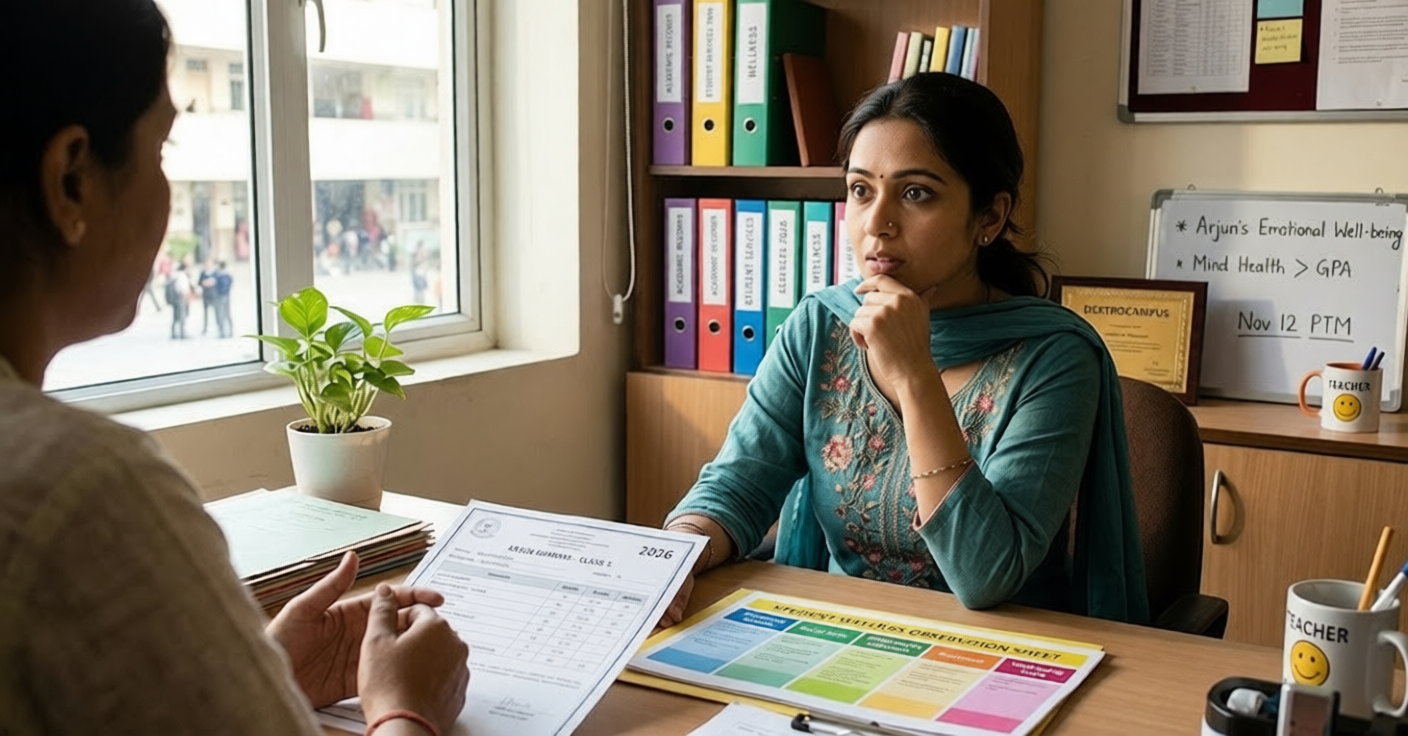
- The Specific Moment: A mother and a female teacher sitting at a desk, the teacher gently pushing aside a marks-heavy report card to point at a "Social-Emotional" observation sheet, while the mother leans in with an expression of sudden realization.
2. WHO — FACE DIVERSITY MANDATE
- Face Letter: [G] — Mother in her late 20s (young parent profile)
- Description: Mother | 29 years old | Wheatish skin | Slender build | Long loose hair with a small bindi.
3. WHERE — TOPIC-MATCHED LOCATION
- Location: School Counselor/Teacher’s Office.
- 3 Objects: A "Wellness Corner" poster (visual only), a small green desk plant, and a stack of colorful student folders.
4. CLOTHING — MANDATORY ROTATION
- Rotation Letter: [B] — Deep teal salwar kameez with delicate floral embroidery + white cotton dupatta with border.
5. EXACT EXPRESSION — SURGICAL PRECISION
- Anatomical Expression: Eyes slightly wide with eyebrows arched toward the center—the "Aha!" moment of realization. Lips slightly parted as if about to ask a question.
- Body Position: Leaning forward significantly, one elbow on the desk, hand supporting her chin, focusing intently on the teacher's gesture rather than the report card.
Tags:
Get Weekly Insights
Join 10k+ parents getting smarter about education.