
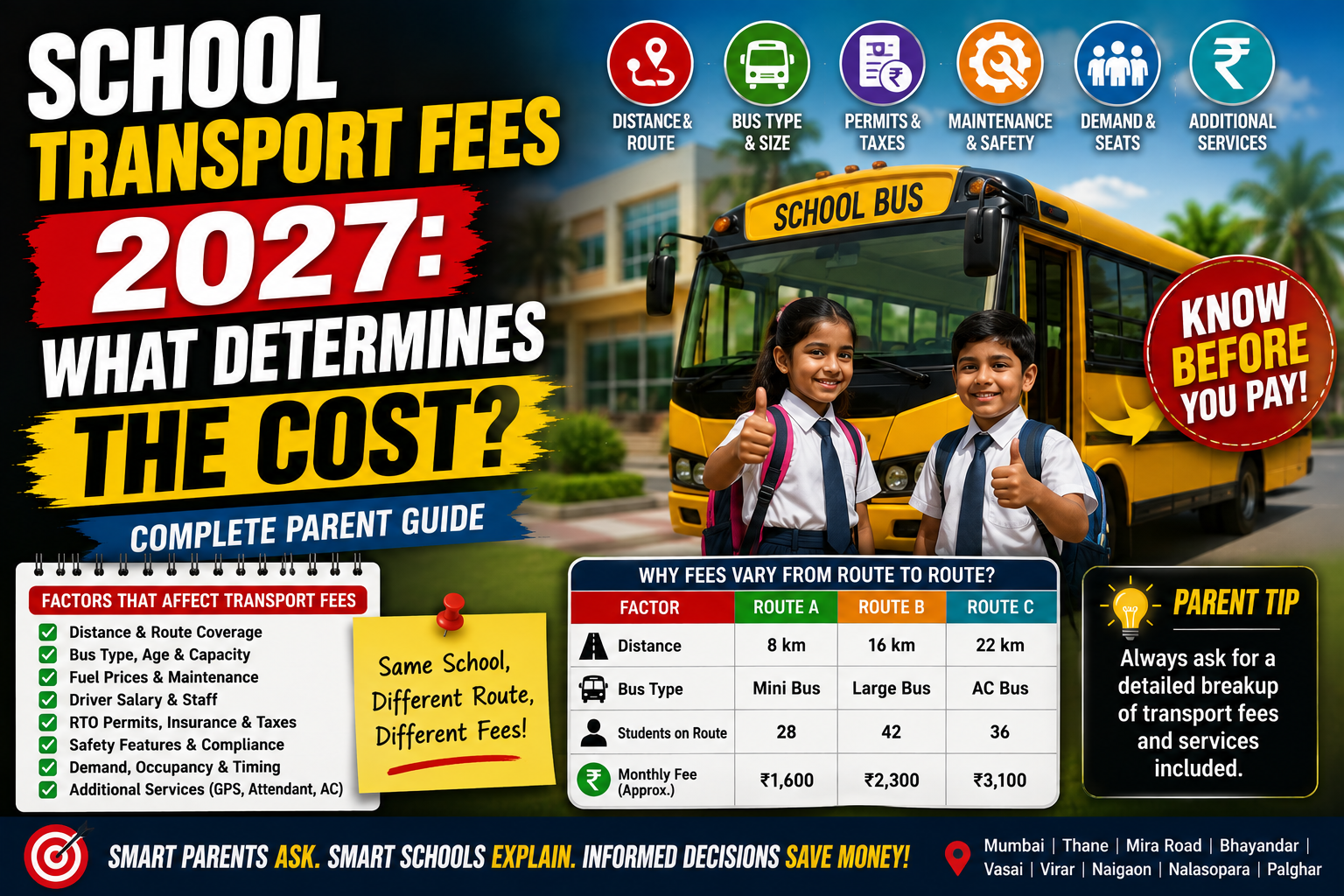
School Transport Fees 2027: What Determines the Cost? A Complete Parent Guide
For many parents, school transport begins with a simple question:
"How much is the school bus fee?"
But there is rarely one universal answer.
A child travelling a short distance may have a different transport charge from a child travelling across several neighbourhoods. A route with fewer students may have a different cost structure from a heavily used route. Vehicle type, operating costs, staffing, safety requirements and route design can also influence the amount charged.
For parents comparing schools in Mumbai, Thane, Mira Road, Bhayandar, Vasai, Naigaon, Nalasopara, Virar and Palghar, transport can sometimes become a major recurring expense.
The right approach is not to ask only whether the bus fee is "high" or "low".
Instead ask:
"What is included in the transport fee, how is the route priced, and is the service safe and practical for my child?"
1. Why Do School Transport Fees Differ?
School transport is an operational service, not simply a bus ride.
A transport system can involve:
- Vehicle purchase or lease
- Fuel
- Maintenance
- Driver wages
- Attendant or support staff
- Insurance
- Permits and taxes
- Vehicle fitness and compliance
- Route planning
- Safety equipment
- Administration
- Tracking or communication systems
- Cleaning and upkeep
The Maharashtra Motor Vehicle Department publishes tax information for school buses and school transport vehicles, showing that different categories of school-use vehicles can have different tax treatment.
Therefore, parents should not assume that two schools charging different transport fees are necessarily charging arbitrarily.
At the same time, a higher fee should still be transparent and understandable.
2. Distance Is One of the Biggest Factors
The first factor parents should check is the distance between:
Home → School
and, more importantly:
The complete route operated by the bus.
A bus travelling a longer route generally has greater operating requirements than a short local route.
Transport fees may therefore vary according to:
- Distance from school
- Route length
- Number of stops
- Number of neighbourhoods covered
- Travel time
- Traffic conditions
- Route complexity
Example
Consider three hypothetical routes:
| Route | ||
| Route A | Short | Lower operating requirement |
| Route B | Medium | Moderate operating requirement |
| Route C | Long | Higher operating requirement |
These are illustrative examples only, not actual school transport rates.
Parents should always check the school's current route-wise fee.
3. Your Home Address Can Affect the Fee
Two children attending the same school may pay different transport fees because they live in different areas.
For example, a school serving families across:
- Vasai
- Nalasopara
- Naigaon
- Virar
- Mira Road
- Bhayandar
may operate several routes with different distances and operating requirements.
Parents should therefore ask:
"Is the transport fee based on my pickup location or route?"
Also ask:
"Can the fee change if the pickup point changes?"
This becomes particularly important when families move house during the academic year.
4. Route Length Is Not the Same as Straight-Line Distance
A common mistake is to calculate transport cost simply by looking at the distance on a map.
The actual school-bus route may be longer.
A bus may need to:
- Enter residential areas
- Pick up multiple children
- Avoid restricted roads
- Follow designated roads
- Handle traffic restrictions
- Make multiple stops
Therefore:
Home-to-school distance ≠ Actual bus route distance
Parents should ask the school for the designated pickup point and route information rather than estimating the cost only from Google Maps or a similar map service.
5. Number of Students on the Route Can Matter
Transport economics are also influenced by how many students use a route.
A bus carrying many students may spread some operating costs across more users.
A route with fewer students may have a different cost structure.
However, parents should not assume that:
More students = automatically lower fee.
The school may use different vehicles, route structures or pricing policies.
Ask:
- How many students are currently assigned to this route?
- Is the fee route-based?
- Is there a minimum number of students required?
- Can the route be changed during the academic year?
- What happens if student numbers increase or decrease?
6. Vehicle Type Can Influence Transport Costs
Not all school transport vehicles are identical.
Schools may use:
- Buses
- Mini-buses
- Vans
- Contracted vehicles
- Other permitted student-transport vehicles
The cost of operating and maintaining each type can differ.
Vehicle capacity can also affect route planning.
Parents should ask:
"What type of vehicle will my child travel in?"
and:
"Is the same vehicle used throughout the academic year?"
Do not assume that a school offering "bus transport" operates only one type of vehicle.
7. Fuel and Maintenance Costs Matter
Fuel is an obvious operating cost, but it is not the only one.
Transport operators also need to account for:
- Routine servicing
- Tyres
- Repairs
- Cleaning
- Replacement parts
- Battery maintenance
- Safety equipment
- Vehicle inspections
These costs can influence the overall price of operating school transport.
Parents do not need to calculate the school's maintenance bill themselves.
Instead, understand that transport pricing is based on ongoing operating costs, not simply the amount of fuel used on one journey.
8. Driver and Attendant Costs Are Part of the Service
A school transport system may involve:
- Driver
- Bus attendant
- Transport coordinator
- Administrative support
Staffing is therefore another component of the operating cost.
More importantly, parents should evaluate staffing from a safety perspective, not just a pricing perspective.
CBSE's school safety requirements state that affiliated schools must follow applicable state government, municipal and transport-department prescriptions concerning transport precautions.
CBSE's published school-transport guidance also addresses issues such as trained drivers, attendants, emergency communication and safe boarding and disembarking procedures.
Parent Question
"Who is responsible for supervising children during the journey?"
This is more important than simply asking whether the bus fee is cheap.
9. Safety Features Can Affect the Cost of Transport
Parents should not choose school transport solely on price.
Ask about:
- Vehicle fitness
- Emergency procedures
- Driver verification
- Attendant availability
- First-aid arrangements
- Emergency communication
- Student boarding procedures
- Drop-off procedures
- Route monitoring
- Vehicle maintenance
- Safety checks
CBSE requires affiliated schools to observe applicable transport precautions and other safety requirements prescribed by the relevant authorities.
Maharashtra's Transport Department also lists school-bus-related compliance items in its published offence information, including requirements relating to school-bus markings, child lists, attendants, steps, mirrors, warning lights and window protection.
Important
Parents should verify the current applicable transport rules and compliance status with the school or relevant authority rather than relying on an old checklist.
10. Permits, Taxes and Compliance Add to Operating Costs
School transport vehicles operate within the motor-vehicle regulatory system.
Costs can include matters relating to:
- Registration
- Permits
- Vehicle tax
- Insurance
- Fitness certification
- Compliance requirements
The Maharashtra Motor Vehicle Department publishes specific tax treatment for school buses and vehicles used for transporting students.
This does not mean that every regulatory expense is directly passed through to parents as a separate fee.
Rather, these are examples of costs that can form part of the overall economics of operating a compliant school-transport system.
11. Why AC and Non-AC Transport Can Differ
Some schools may offer different vehicle options.
For example:
- Standard bus
- Air-conditioned bus
- Premium transport service
If an upgraded service is offered, parents should ask:
- Is it optional?
- Is there an additional fee?
- Is the same route available without the upgrade?
- What exactly does the additional payment provide?
Never assume that an "AC bus" automatically represents better overall value.
The child's:
- Safety
- Travel time
- Comfort
- Route
- Supervision
may be more important than the vehicle's premium features.
12. GPS Tracking and Digital Transport Systems
Modern school transport may include technology such as:
- GPS tracking
- Parent notifications
- Route alerts
- Digital attendance
- Bus tracking applications
- Emergency communication
These systems can provide practical value.
But parents should ask:
"Is GPS tracking included in the transport fee?"
Also ask:
"Is there an additional annual technology charge?"
If a school advertises real-time tracking, parents should understand how the system works rather than assuming that the presence of an app guarantees effective supervision.
13. One-Way vs Two-Way Transport
Some schools may structure transport as:
- Two-way pickup and drop
- One-way service
- Morning-only service
- Afternoon-only service
The availability and pricing depend on the school's transport policy.
A CBSE school example published through the CBSE SARAS platform describes its transport as a two-way facility and specifies designated stops and route procedures.
However, this is an example of one school's policy, not a universal CBSE rule.
Parents should therefore ask their own school:
"Is one-way transport available?"
and:
"If available, how is the fee calculated?"
14. Pickup and Drop-Off Points Matter
Parents sometimes assume that the bus will stop directly outside their home.
That may not be the case.
Schools may designate:
- Main-road stops
- Society entrances
- Junctions
- Fixed pickup points
- Specific route stops
Ask before paying:
- Where is the pickup point?
- Where is the drop-off point?
- How far does the child need to walk?
- Can the stop change?
- Who is responsible for the child between the bus stop and home?
This is particularly important for younger children.
15. Travel Time Is Part of the Value
Transport should not be evaluated only by cost.
A cheaper route that keeps a child inside the bus for a very long time may not be the better option.
Parents should ask:
- What is the expected morning journey?
- What is the expected afternoon journey?
- How many stops are on the route?
- Does the route change frequently?
- How does traffic affect the journey?
- Is the route different during monsoon conditions?
Parent Rule
Compare cost + safety + reliability + travel time.
Not cost alone.
16. School Transport Fee vs Private Transport Cost
This is an important comparison.
Suppose a school bus costs a certain amount annually.
A parent might think:
"I can save money by dropping my child myself."
But personal transport can involve:
- Fuel
- Parking
- Vehicle maintenance
- Tolls, where applicable
- Time
- Work disruption
- Return travel
A private cab or van can also become expensive over an entire academic year.
Better Formula
School Bus Cost
vs.
Private Travel Cost + Parent Time + Vehicle Cost
The cheapest-looking option may not actually be the lowest-cost option for the family.
17. Why Transport Fees May Change
Parents should ask how transport fees are revised.
Potential cost pressures can include:
- Fuel prices
- Maintenance costs
- Staffing costs
- Insurance
- Taxes
- Route changes
- Vehicle replacement
- Safety upgrades
- Changes in student numbers
The Maharashtra Educational Institutions (Regulation of Fee) Act provides a framework for regulation and determination of fees for covered educational institutions.
However, parents should not assume that every transport charge is governed identically to every tuition or school-fee component.
The exact treatment depends on the school, its fee structure and the applicable regulatory framework.
If a transport fee appears unexpectedly or is unclear, ask the school for the basis and current applicable fee details.
18. Is School Transport Fee Included in School Fees?
Usually, parents should check this explicitly.
A school's published fee structure may show transport separately.
Other schools may present different categories or bundled services.
Ask:
"Is transportation included in the annual school fee?"
Then ask:
"If not, what is the separate annual transport fee?"
And finally:
"Are there any additional transport charges?"
Never assume that the amount paid during admission includes the complete transport cost.
19. What Additional Transport Charges Should Parents Ask About?
Ask whether there are separate charges for:
- Route changes
- New pickup points
- Special routes
- One-way transport
- AC transport
- GPS services
- Late registration
- Mid-year joining
- Replacement transport cards
- Special transport arrangements
Not every school will have these charges.
The purpose of the checklist is simply to help parents ask before they pay.
20. The Complete School Transport Fee Comparison
Use this table when comparing schools.
| Annual transport fee | ₹ | ₹ | ₹ |
| Monthly equivalent | ₹ | ₹ | ₹ |
| Distance/route | |||
| Vehicle type | |||
| Pickup point | |||
| Drop-off point | |||
| Estimated travel time | |||
| Driver + attendant arrangement | |||
| GPS/communication | |||
| Safety provisions | |||
| One-way option | |||
| Additional charges | |||
| Refund/withdrawal terms | |||
| Overall value |
Do not fill in numbers unless you have verified them directly with the school.
21. The 12 Questions Every Parent Should Ask
Before registering for school transport, ask:
- What is the annual transport fee?
- Is the fee route-based?
- What is the designated pickup point?
- What is the designated drop-off point?
- Is one-way transport available?
- What vehicle will be used?
- Is an attendant present?
- Is GPS tracking available?
- How is emergency communication handled?
- What happens if the child stops using transport?
- Are there refunds or adjustments?
- Are there any additional transport charges?
Keep the answers in writing where possible.
22. Red Flags in School Transport
Parents should investigate further if:
🚩 The Route Is Unclear
You are asked to pay before knowing the pickup point.
🚩 The Fee Is Not Explained
Nobody can tell you whether the fee is monthly, term-wise or annual.
🚩 Safety Information Is Vague
The school cannot explain basic transport supervision procedures.
🚩 Different Staff Quote Different Amounts
Accounts and admissions teams give inconsistent information.
🚩 Sudden Additional Charges
A new charge appears after transport registration without clear explanation.
🚩 Excessive Travel Time
The child may spend an unreasonable amount of time commuting every day.
These are reasons to ask questions and verify, not automatic proof of wrongdoing.
23. School Bus Safety Should Come Before Price
A low transport fee is not necessarily a good deal.
Before choosing transport, parents should check whether the school has appropriate arrangements for:
- Driver selection
- Driver verification
- Attendant supervision
- Vehicle maintenance
- Emergency communication
- Safe boarding
- Safe drop-off
- Route management
CBSE's school-safety framework explicitly connects affiliated schools with applicable state, municipal and transport-department requirements concerning transport precautions.
The CBSE school-transport guidance also addresses driver training, attendants and emergency communication.
Golden Rule
Never trade a meaningful safety requirement for a lower transport fee.
24. Transport for Younger Children Needs Extra Attention
For Nursery, KG and primary-school children, parents should look carefully at:
- Walking distance to pickup point
- Attendant availability
- Boarding procedure
- Drop-off verification
- Route duration
- Child supervision
- Emergency contact process
A five-minute difference in walking distance can matter much more for a four-year-old than for a teenager.
Transport decisions should therefore be age-appropriate.
25. Local Perspective: Mumbai, Thane and Vasai-Virar
For families in Mumbai, Thane, Mira Road, Bhayandar, Vasai, Naigaon, Nalasopara, Virar and Palghar, school transport can be particularly important because the practical school commute may involve:
- Dense traffic
- Longer suburban routes
- Multiple pickup points
- Railway-crossing delays
- Monsoon disruptions
- Different travel times during peak hours
Parents should compare the real daily commute, not simply the distance shown on a map.
A school that is academically excellent but requires an exhausting daily commute may not be the best practical choice for every child.
26. How to Decide: School Bus or Self-Transport?
Use this simple matrix.
| Factor | ||
| Predictable routine | Usually useful | Depends on family |
| Parent time | Lower daily involvement | Higher |
| Cost | Fixed school transport fee | Fuel/cab/vehicle costs |
| Flexibility | Route-based | Higher |
| Child independence | Can increase gradually | Depends |
| Supervision | School transport system | Parent/private provider |
| Traffic exposure | Route dependent | Route dependent |
| Emergency arrangements | Ask school | Family responsibility |
There is no universal winner.
The right option depends on:
Cost + safety + convenience + child age + family schedule.
27. The Parent Transport Budget Formula
For an accurate annual estimate:
Annual Transport Cost = Applicable Transport Fee × Number of Paid Periods
Then add any applicable:
- Registration charges
- Route charges
- Special-service charges
- Additional transport services
Do not multiply a monthly fee by 12 automatically unless the school confirms that transport is billed for all 12 months.
Some schools may charge transport according to the academic calendar or a different schedule.
28. What Parents Should Verify Before 2027 Admission
Because transport policies can change, parents should verify the 2027 applicable information directly with the school before admission.
Check:
- Current route list
- Current fee schedule
- Pickup points
- Drop-off points
- Vehicle type
- Transport availability
- Safety procedures
- Payment schedule
- Refund rules
- Additional charges
Do not rely on a fee figure posted for an earlier academic year.
29. Parent School Transport Checklist
- I know the current annual transport fee.
- I know how the fee is calculated.
- I know the pickup point.
- I know the drop-off point.
- I know the expected travel time.
- I know the vehicle type.
- I know whether an attendant is present.
- I know whether GPS tracking is available.
- I understand the safety arrangements.
- I know whether one-way transport is available.
- I know the cancellation/refund terms.
- I know whether route changes cost extra.
- I have checked for additional charges.
- I have compared school transport with alternatives.
- I have considered the child's age and comfort.
- I have verified the current information with the school.
30. Final Decision Matrix
Before registering for school transport, score each option from 1 to 5.
| Factor | |||
| Annual cost | /5 | /5 | /5 |
| Route convenience | /5 | /5 | /5 |
| Travel time | /5 | /5 | /5 |
| Safety arrangements | /5 | /5 | /5 |
| Driver/attendant system | /5 | /5 | /5 |
| Pickup convenience | /5 | /5 | /5 |
| Drop-off convenience | /5 | /5 | /5 |
| Communication/GPS | /5 | /5 | /5 |
| Refund flexibility | /5 | /5 | /5 |
| Overall child comfort | /5 | /5 | /5 |
This is a parent decision framework, not an official transport-rating system.
Frequently Asked Questions (FAQs)
1. What determines school transport fees?
Transport fees can be influenced by route distance, number of stops, vehicle type, operating costs, staffing, maintenance, regulatory costs, safety requirements and services such as GPS tracking. The exact pricing method varies by school.
2. Is school transport fee based on distance?
It may be. Some schools may use route or distance-based pricing, while others may use their own transport-fee structure. Parents should ask the school how the current fee is calculated.
3. Is school transport included in tuition?
Not necessarily. Parents should check whether transport is included in the published school fee or charged separately.
4. Can school transport fees change?
They can change depending on the school's applicable fee and transport structure. Parents should check the current fee schedule and ask how revisions are handled rather than assuming that today's transport fee will remain unchanged.
5. What should parents check before choosing a school bus?
Parents should check the route, pickup and drop-off points, travel time, vehicle type, driver and attendant arrangements, emergency communication, safety procedures, tracking systems and the complete transport fee.
6. Is the cheapest school transport option always the best?
No. Parents should compare cost with safety, reliability, travel time, supervision and convenience. A slightly higher cost may be worthwhile if it provides a safer and more practical service, but parents should verify exactly what additional value is provided.
Conclusion & Parent Checklist
School transport is much more than a monthly bus payment.
The final cost can reflect route distance, vehicle type, fuel and maintenance, staff, regulatory requirements, safety systems, route demand and additional services.
For parents in Mumbai, Thane, Mira Road, Bhayandar, Vasai, Naigaon, Nalasopara, Virar and Palghar, transport can become a significant part of the overall school budget because the daily commute itself can vary substantially between schools.
Before paying for transport in 2027, ask for the current fee structure and confirm:
Where will my child be picked up?
Where will my child be dropped?
How long will the journey take?
Who supervises the children?
What safety systems are in place?
What exactly is included in the transport fee?
And finally:
"What is the complete annual cost of this transport service?"
Do not choose a school bus simply because it is cheap.
Do not choose one simply because it has an impressive app.
Choose the option that provides a safe, practical, reliable and financially manageable daily journey for your child.
Smart parents do not ask only, "How much is the bus fee?" They ask, "What exactly am I getting for it?"
Tags:
Get Weekly Insights
Join 10k+ parents getting smarter about education.