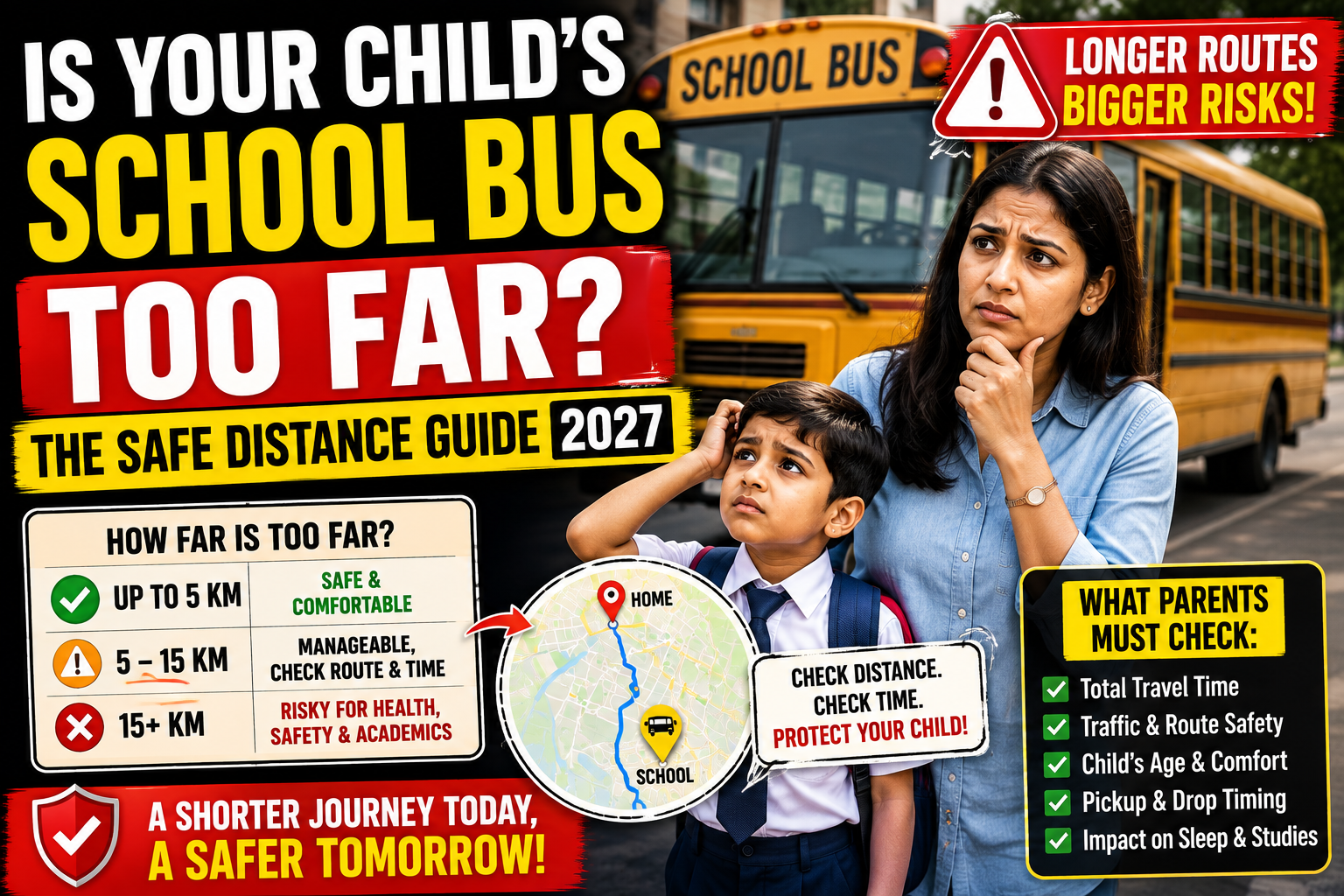
School Transport Distance: How Far Is Too Far for a Child? 2027 Parent Guide
When choosing a school, parents often compare fees, board, academic results, facilities and distance from home.
But one question deserves much more attention:
How long will my child actually spend travelling every school day?
A school may appear to be only 8 or 10 kilometres away on a map, yet the actual school-bus journey could take much longer because of traffic, multiple pickup points, railway crossings, narrow roads or a long route through several residential areas.
This is particularly relevant for families across Mumbai, Thane, Mira Road, Bhayandar, Vasai, Nalasopara, Naigaon, Virar and Palghar, where road congestion can make a relatively short geographical distance translate into a much longer daily commute.
There is also an important distinction between distance and journey burden.
A child travelling 12 kilometres on a relatively predictable route may have a better experience than a child travelling 6 kilometres through heavy congestion with frequent stops.
The Maharashtra Highway Traffic Police places responsibility on parents to ensure that the mode of transport arranged for children is safe and encourages parents to remain vigilant about school-journey safety.
For 2027 school selection, parents should therefore ask:
“Is this school journey reasonable for my child's age, routine and wellbeing?”
rather than relying on kilometres alone.
Is There a Maximum Safe Distance for School?
No universal distance threshold should be presented as a guaranteed safe limit for every child.
The practical issue is that distance does not determine journey quality by itself.
Two children could travel the same distance but have completely different experiences because of:
- Traffic
- Number of stops
- Road conditions
- Bus speed
- Route design
- Weather
- Pickup arrangements
- School timings
- Vehicle occupancy
- Child's age
- Total daily travel time
Therefore, parents should avoid rules such as:
“Anything above X kilometres is unsafe.”
Instead, evaluate the complete journey.
A better formula
School Transport Burden = Distance + Journey Time + Traffic + Stops + Child's Age + Daily Schedule
This is not an official government formula. It is a practical framework for parents comparing schools.
Distance vs Travel Time: Which Matters More?
For most parents, travel time is more useful than distance alone.
Imagine two schools:
| Factor School A & School B | ||
| Approx. distance | 5 km | 10 km |
| Traffic | Heavy | Moderate |
| Pickup stops | Many | Few |
| Estimated journey | 50 minutes | 35 minutes |
| Route predictability | Low | High |
| Daily burden | Higher | Potentially lower |
Although School B is geographically farther away, the child may spend less time travelling.
This is why parents should test the actual route rather than simply checking Google Maps distance.
Why Long School Journeys Can Become a Problem
A long commute does not automatically harm a child.
However, a consistently demanding journey can affect the child's daily routine.
1. Earlier Wake-Up Time
If the bus arrives very early, the child may need to wake up significantly earlier than classmates who live closer to school.
For younger children, this can make maintaining a healthy daily routine more difficult.
2. Less Time at Home
Long morning and afternoon journeys reduce the amount of time available for:
- Family interaction
- Homework
- Play
- Reading
- Hobbies
- Rest
- Extracurricular activities
3. Greater Fatigue
A child spending a substantial part of the day travelling may arrive home tired.
This can be especially noticeable when the journey involves:
- Heavy traffic
- Frequent stops
- Crowded roads
- Long waiting periods
- Uncomfortable seating
- Very early departures
4. Reduced Flexibility
A long bus route can make it harder to participate in:
- After-school activities
- Sports
- Music classes
- School clubs
- Tuition
- Family commitments
5. More Exposure to Traffic
The longer the journey, the more time the child spends on the road.
That does not mean every long route is unsafe. It simply means parents should examine route quality and transport management carefully.
Maharashtra Highway Traffic Police specifically advises parents to ensure that children's transport is safe and to teach children how to board and alight from buses safely.
School Transport Distance by Child's Age
The same journey can feel very different depending on the child's age.
Nursery and Kindergarten
Parents should be especially cautious about long and complicated routes.
Younger children may need:
- More sleep
- Closer adult supervision
- Predictable routines
- Simple pickup arrangements
- Shorter waiting periods
- Reliable child handover
A long journey with multiple stops may be considerably more demanding for a preschool child than for a teenager.
Primary School
Primary-school children can generally manage structured school transport, but parents should still evaluate the total journey time and its effect on sleep, meals, homework and play.
CBSE's transport guidance emphasises safe boarding and deboarding arrangements, designated stops, child supervision and transport management.
Middle and Secondary School
Older students may tolerate longer journeys better, but academic workload and extracurricular commitments become increasingly important.
A route that was manageable in Class 5 may become inconvenient in Class 9 if it leaves the child with insufficient time for study, sport or rest.
The 7 Factors Parents Should Check Before Accepting a Long Route
1. Total Daily Travel Time
Do not ask only:
“How far is the school?”
Ask:
“How many minutes will my child spend travelling each way?”
Then calculate the weekly impact.
For example, a 45-minute journey each way means approximately:
- 90 minutes per school day
- 7.5 hours per five-day week
- About 30 hours over four weeks
That is a substantial amount of time.
2. Number of Pickup Stops
A bus route with many stops can take much longer than expected.
Ask:
- How many students are picked up before my child's stop?
- How many stops are there?
- Is the route fixed?
- Does the school change routes frequently?
- Can new admissions significantly increase journey time?
3. Traffic Conditions
A route that looks short at 6:30 AM may be very different during school-opening hours.
Test the route during the actual school commute.
For families around the Mumbai Metropolitan Region, this is especially important.
4. Pickup and Drop-Off Timing
Ask for realistic timings rather than approximate marketing information.
For example:
- What time does the bus normally arrive?
- What time does the child reach school?
- What time does the child usually leave school?
- What time does the child reach home?
The afternoon journey can be particularly different from the morning journey because of traffic.
5. Route Safety
Parents should examine:
- Busy intersections
- Narrow roads
- Railway crossings
- High-speed stretches
- Construction zones
- Poorly lit areas
- Unsafe pickup points
- Areas where children need to cross roads
Maharashtra Highway Traffic Police advises children to use footpaths where available, avoid running across roads and use appropriate crossing points.
6. Vehicle and Staff Safety
A longer journey makes transport quality even more important.
Parents should ask whether the bus has:
- Qualified driver
- Attendant/conductor
- Emergency communication
- First-aid provision
- Fire-safety equipment
- Properly maintained doors
- Appropriate speed controls
- GPS/CCTV where applicable
CBSE transport precautions include requirements and recommendations covering vehicle safety, qualified attendants, designated transport management, first aid and speed-control devices.
7. Your Child's Reaction
Never ignore the child's experience.
Ask:
- “Are you comfortable on the bus?”
- “Do you feel tired after school?”
- “Do you get enough time to play?”
- “Is the bus too crowded?”
- “Do you enjoy the journey?”
- “Are you getting enough sleep?”
A practical school decision should include the child's experience, not just the parent's calculation.
A Simple School Transport Distance Decision Matrix
Use this framework when comparing schools.
| Factor | Green | Amber | Red |
| Journey time | Comfortable for child's routine | Requires monitoring | Regularly exhausting |
| Traffic | Predictable | Variable | Severe congestion |
| Route | Safe and organised | Some concerns | Multiple significant risks |
| Pickup timing | Convenient | Very early/late | Disrupts routine |
| Stops | Limited/manageable | Several | Excessive |
| Vehicle | Well managed | Some questions | Safety concerns |
| Child comfort | Comfortable | Occasional fatigue | Regular distress/fatigue |
| Effect on studies | Minimal | Some adjustment needed | Significant impact |
This is a parent decision framework, not an official safety classification.
How to Calculate the Real Cost of a Long School Journey
Parents usually calculate school fees.
They should also calculate time cost.
Suppose a child spends:
40 minutes going to school + 50 minutes returning = 90 minutes daily.
Over 200 school days, that becomes approximately:
18,000 minutes = 300 hours per academic year.
That is equivalent to more than 12 full days spent travelling.
This does not mean the school is a poor choice.
It simply demonstrates why transport time deserves consideration alongside fees.
Should Parents Choose the Closest School?
Not necessarily.
The closest school is not automatically the best school.
A nearby school may have:
- Less suitable curriculum
- Limited facilities
- Less convenient timings
- Different academic priorities
- Fewer extracurricular opportunities
Meanwhile, a slightly farther school might offer a better overall fit.
The objective should therefore be:
Find the school that offers the right balance between educational fit and daily travel burden.
Parents should avoid sacrificing a strong school choice solely because it is a few kilometres farther away—but they should also avoid choosing a distant school simply because of reputation.
When a Longer School Journey May Be Reasonable
A longer commute may be reasonable when:
- The school is a strong educational fit.
- The route is safe and predictable.
- The child remains comfortable.
- The journey does not significantly reduce sleep.
- The transport system is professionally managed.
- The bus is not excessively crowded.
- Pickup and drop-off are well organised.
- The child still has sufficient time for study, play and family life.
A longer distance is therefore a trade-off, not automatically a red flag.
Warning Signs That the Route May Be Too Demanding
Parents should reconsider the transport arrangement if they regularly notice:
- Child is constantly exhausted after school
- Very early wake-up times
- Persistent late arrival home
- Insufficient sleep
- No time for homework
- No time for physical activity
- Frequent motion sickness
- Child strongly dislikes the journey
- Excessive waiting at pickup points
- Very long delays during ordinary school days
- Unsafe or confusing pickup locations
- Repeated transport complaints
One difficult day does not necessarily indicate a problem.
A persistent pattern is more meaningful.
School Transport Distance in Mumbai, Thane and Palghar
For parents in Mumbai, Thane and the wider Palghar region, school distance needs to be considered alongside the area's transport patterns.
A school located in another part of the metropolitan region may appear accessible geographically but create a long daily commute.
This is especially relevant when comparing schools across:
- Vasai
- Nalasopara
- Naigaon
- Virar
- Mira Road
- Bhayandar
- Thane
- Mumbai
- Palghar
Parents should calculate the journey from their actual home location, not from the centre of the locality.
A school advertised as being “near Vasai” or “near Virar” may still be inconvenient from a particular residential complex.
Local parent test
Before finalising admission:
- Put your actual home address into the route planner.
- Check the route during school hours.
- Ask the school for its actual bus route.
- Ask for approximate pickup and drop-off times.
- Test the route on a working day.
- Compare at least two alternative schools.
Questions to Ask the School Transport Coordinator
Before paying transport fees, ask:
Route
- What is the exact pickup point?
- What is the approximate journey time?
- How many stops are on the route?
- Is the route fixed?
Safety
- Who supervises children?
- Is there a qualified attendant?
- How are boarding and deboarding managed?
- What emergency procedures are followed?
Technology
- Is GPS tracking available?
- Is CCTV available?
- Can parents receive delay notifications?
Timing
- What is the normal morning pickup time?
- What is the normal afternoon drop-off time?
- How are delays communicated?
Child welfare
- How are younger children supervised?
- What happens if a child becomes unwell?
- What happens if an authorised adult is not present at drop-off?
Parents should request clarification whenever the answers are vague.
What About School Bus GPS?
GPS tracking can help parents understand the bus journey, but it does not solve every transport problem.
Parents may benefit from:
- Live vehicle location
- Estimated arrival
- Delay notifications
- Route visibility
However, GPS does not replace:
- Safe driving
- Adult supervision
- Safe boarding
- Proper vehicle maintenance
- Emergency procedures
- Authorised child handover
CBSE's transport guidance includes GPS and other safety measures within the broader school transport framework.
The right question is therefore not:
“Does the bus have GPS?”
It is:
“Is the entire transport system safe and well managed?”
A 10-Minute Parent Route Audit
Before accepting a school transport route, parents can conduct a quick audit.
Step 1: Check the distance
Use your actual home address.
Step 2: Check the journey during school hours
Do not rely only on off-peak travel time.
Step 3: Identify major traffic points
Look for:
- Junctions
- Railway crossings
- Narrow roads
- Highway sections
- School-zone congestion
Step 4: Ask the school about actual bus timing
Compare the school's estimate with your own observations.
Step 5: Check your child's daily schedule
Work backwards from:
- Wake-up
- Breakfast
- Bus pickup
- School
- Bus drop-off
- Homework
- Play
- Dinner
- Bedtime
If the transport schedule leaves almost no room for sleep, rest or family time, reconsider the arrangement.
Parent Checklist Before Choosing a Distant School
- Check actual home-to-school distance.
- Check morning and afternoon journey times.
- Test the route during school hours.
- Ask about the number of bus stops.
- Ask for realistic pickup and drop-off timings.
- Check the safety of the pickup point.
- Ask about driver and attendant arrangements.
- Check whether GPS is available.
- Ask about emergency communication.
- Understand child handover procedures.
- Observe your child's comfort.
- Protect adequate sleep.
- Protect time for homework and play.
- Compare the route with at least one closer school.
- Verify transport arrangements directly with the school.
Expert Takeaways
Takeaway 1: Distance is not the same as burden
A 10-kilometre journey can be easier than a 6-kilometre journey if traffic and stops are very different.
Takeaway 2: Journey time matters
Calculate the total daily time your child spends travelling.
Takeaway 3: Age changes the equation
Younger children generally require greater attention to sleep, supervision, comfort and predictable routines.
Takeaway 4: Safety comes before convenience
A short route with poor pickup arrangements is not automatically preferable.
Takeaway 5: Ask the school for actual data
Do not rely only on phrases such as “nearby,” “easy connectivity” or “convenient transport.”
Takeaway 6: Reassess after admission
A transport route that looks acceptable during admission may feel different once the child experiences it every day.
Frequently Asked Questions (FAQs)
1. How far is too far for a child to travel to school?
There is no universal kilometre limit that applies to every child. Parents should consider total journey time, traffic, route safety, number of stops, child's age, comfort, sleep and impact on daily activities.
2. Is a 10-kilometre school journey too far?
Not necessarily. A 10-kilometre route may be manageable if the journey is reasonably short, safe, predictable and comfortable. Parents should evaluate actual travel time rather than distance alone.
3. Should parents choose the school closest to home?
Not always. The closest school may not be the best educational fit. Parents should balance school quality, curriculum, fees, transport safety and the child's daily travel burden.
4. How much school-bus travel time is acceptable?
There is no universal official time limit that can be applied to every child and route. Parents should judge whether the journey regularly interferes with sleep, meals, study, play, extracurricular activities or the child's wellbeing.
5. Does a longer school journey affect studies?
It can if the journey consistently reduces sleep, rest, homework time or participation in other activities. The impact depends on the child's schedule and the actual daily travel burden.
6. What should parents check before accepting a long school-bus route?
Parents should check actual journey time, number of stops, traffic, route safety, pickup and drop-off timings, vehicle condition, driver and attendant arrangements, emergency communication and the child's comfort.
Conclusion & Parent Checklist
The question “How far is too far for school?” does not have one simple kilometre-based answer.
For parents, the better question is:
“Is this daily school journey safe, manageable and healthy for my child?”
A school that is slightly farther away may still be the right choice if the transport route is safe, predictable and comfortable.
On the other hand, a geographically close school may become a poor practical choice if traffic turns a short distance into a very long daily commute.
For families in Vasai, Virar, Nalasopara, Naigaon, Mira Road, Bhayandar, Thane, Mumbai and Palghar, parents should test the actual route before making the final admission decision.
Final Parent Checklist
- Measure the actual distance from home.
- Measure the journey during school hours.
- Calculate total daily travel time.
- Check traffic and route conditions.
- Count approximate pickup stops.
- Ask about bus timings.
- Check driver and attendant arrangements.
- Ask about GPS and communication.
- Evaluate pickup and drop-off safety.
- Check whether your child gets enough sleep.
- Protect time for study, play and family.
- Ask your child how they feel about the journey.
- Compare the route with other suitable schools.
- Verify transport details directly with the school.
The best school is not necessarily the closest one or the most famous one. It is the one that provides the right educational environment without creating an unreasonable daily burden for the child.
Tags:
Get Weekly Insights
Join 10k+ parents getting smarter about education.