
RANKING VS SCHOOL QUALITY — THE TRUTH PARENTS MUST KNOW!
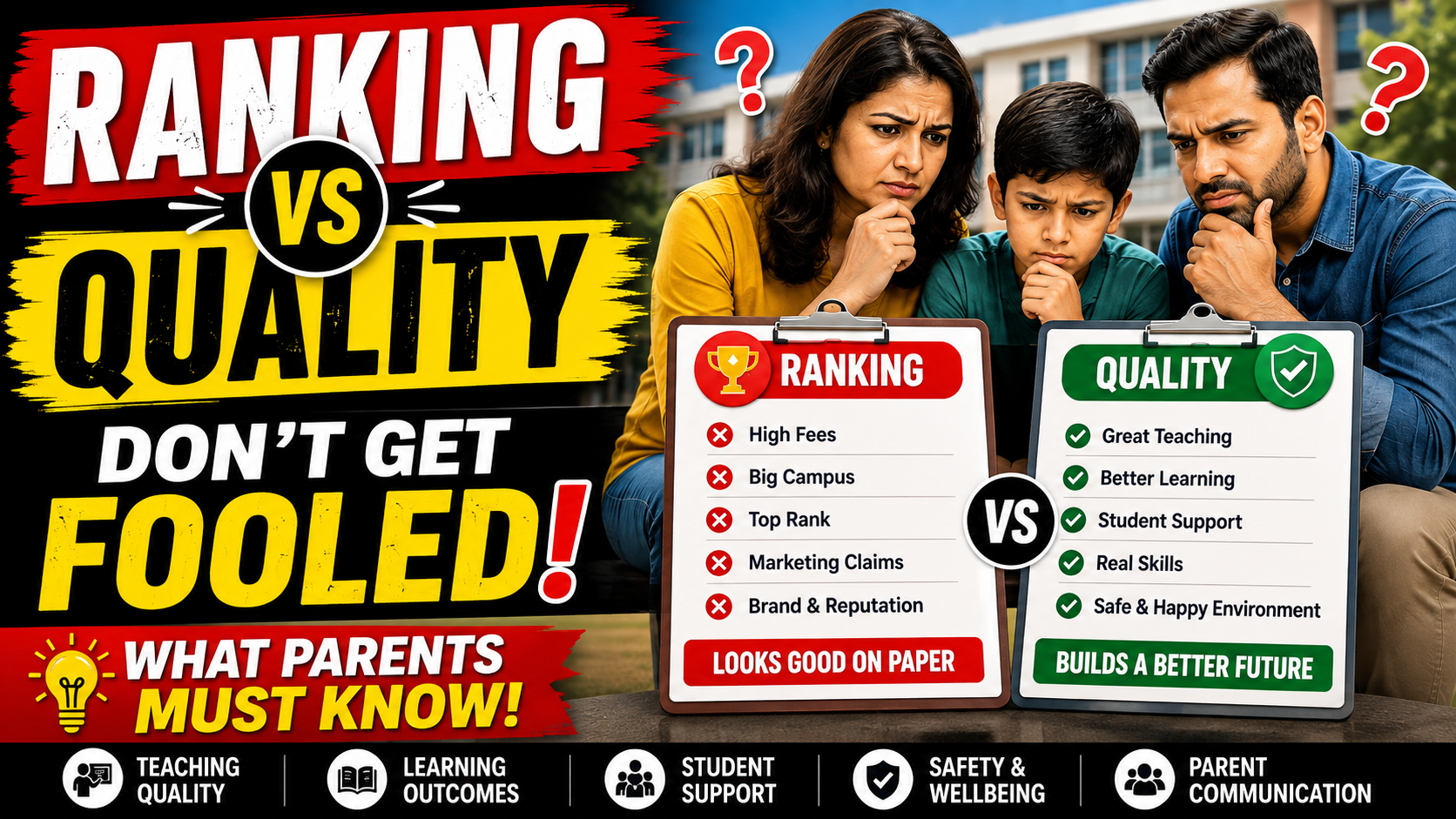
Every admission season, parents search for phrases such as “top schools,” “best schools,” “highest-ranked schools” and “best school near me.”
A ranking can make the decision appear simple.
If a school is ranked highly, it must be better. Right?
Not necessarily.
School rankings and school quality are related, but they are not the same thing.
A ranking usually represents how a school performs against a particular set of criteria selected by the organisation producing the ranking. Those criteria may include academic performance, infrastructure, reputation, facilities, faculty, achievements or other measurable factors.
But parents are not choosing a ranking.
They are choosing an everyday learning environment for their child.
That distinction becomes particularly important for families comparing schools across Mumbai, Thane, Vasai, Virar, Mira Road, Bhayandar, Nalasopara, Naigaon, Palghar and other parts of Maharashtra.
The school with the highest ranking may not automatically be the school that best fits your child's personality, learning needs, commute, interests or family priorities.
What Is a School Ranking?
A school ranking is an evaluation or ordering of schools according to selected criteria.
Different ranking systems may use different methodologies.
For example, a ranking may consider:
- Academic performance
- Examination results
- Faculty qualifications
- Infrastructure
- Facilities
- Reputation
- Awards
- Extracurricular achievements
- Competitions
- Student participation
- Parent or expert perceptions
This means there is no single universal definition of “the best school.”
A school can perform strongly under one ranking methodology and differently under another.
Therefore, parents should always ask:
“What exactly does this ranking measure?”
School Ranking vs School Quality: The Key Difference
| Main purpose | Compare schools | Understand the child's learning environment |
| Based on | Selected ranking criteria | Broader educational experience |
| Changes | May change from year to year | Should be assessed over time |
| Focus | School-level performance | Child-level experience and development |
| Academic results | Often important | Important but not the only factor |
| Teaching quality | May be included | Central consideration |
| Student support | May receive limited attention | Very important |
| School culture | Difficult to capture fully | Important |
| Child-school fit | Usually not measured | Extremely important |
| Best use | Initial shortlisting | Final decision-making |
The simplest way to remember the difference is:
Ranking tells you how a school compares under a particular measurement system. Quality asks how well that school serves your child.
Why Parents Should Not Choose a School Based Only on Ranking
Imagine two schools.
School A
- Excellent ranking
- Large campus
- Strong reputation
- Impressive facilities
- High visibility
School B
- Lower ranking
- Smaller campus
- Strong teacher-student interaction
- Good academic support
- Supportive classroom environment
- Convenient location
- Better fit for your child
If School A is ranked higher, does that automatically make it the better choice?
No.
For one child, School A may be ideal.
For another child, School B may be considerably better.
This is why school selection must ultimately be child-centric.
What Actually Defines School Quality?
1. Teaching Quality
Teachers have a direct influence on the daily learning experience.
Parents should look for teachers who:
- Explain concepts clearly
- Encourage students to ask questions
- Check whether students understand
- Give useful feedback
- Encourage participation
- Support students who struggle
- Challenge students who are ready for more
- Connect learning with practical situations
A beautiful campus cannot compensate for weak classroom teaching.
2. Actual Learning Outcomes
The important question is not simply:
“How many marks do students get?”
Ask:
“What can students actually understand and do?”
Strong learning may include:
- Conceptual understanding
- Problem-solving
- Communication
- Critical thinking
- Application of knowledge
- Creativity
- Collaboration
- Independent learning
Parents should therefore connect this article with the previous Day 4 topic, How to Compare Schools Based on Actual Learning Outcomes, rather than treating rankings as the final answer. The supplied content plan intentionally places these two comparison topics together.
3. Student Support
A quality school should have systems to identify and support students who need additional help.
Ask:
- How are learning gaps identified?
- What happens when a student falls behind?
- Is remedial support available?
- How are parents informed?
- How are advanced students challenged?
- How frequently is student progress reviewed?
A school should not measure its success only through its highest achievers.
The support provided to the average and struggling student also matters.
4. Safe and Positive Environment
School quality also includes the environment in which children spend their day.
Parents should consider:
- Physical safety
- Student supervision
- Cleanliness
- Classroom environment
- Student behaviour
- Anti-bullying practices
- Emergency preparedness
- Emotional support
- Respectful communication
A school may have excellent academic results, but parents should still evaluate whether the environment feels safe and appropriate for their child.
5. Communication With Parents
Parents should understand how a school communicates about their child's progress.
Look for:
- Regular progress updates
- Parent-teacher meetings
- Clear academic feedback
- Communication channels
- Timely updates
- Opportunities to discuss concerns
Good parent-school communication can help identify problems before they become major issues.
6. School Culture and Values
School culture is difficult to express through a ranking number.
Yet it can influence a child's everyday experience.
Parents should observe:
- How teachers speak to students
- Whether children are encouraged to ask questions
- How mistakes are handled
- Whether students are treated respectfully
- Whether cooperation is encouraged
- Whether academic pressure appears excessive
- Whether students have opportunities to express themselves
During a campus visit, these observations can be more revealing than promotional material.
7. Opportunities Beyond Textbooks
A quality school should provide appropriate opportunities for students to develop broader skills.
Depending on the child's age and interests, these may include:
- Sports
- Art
- Music
- Theatre
- Public speaking
- Clubs
- Projects
- Competitions
- Leadership opportunities
- Community activities
The objective is not to select the school with the longest activity list.
Instead, ask:
Are students actually participating and learning through these opportunities?
8. Individual Fit
This is the factor rankings struggle most to measure.
Consider your child's:
- Age
- Personality
- Learning style
- Academic strengths
- Areas needing support
- Interests
- Confidence level
- Social needs
- Travel tolerance
- Extracurricular interests
A school may be excellent overall but unsuitable for a particular child.
That does not make the school bad.
It simply means school quality must be considered alongside school fit.
What a School Ranking Can Tell You
Rankings can still be useful.
They may help parents:
Discover schools
A ranking can introduce parents to schools they may not have considered.
Create an initial shortlist
Instead of researching hundreds of schools, parents can begin with a smaller group.
Identify areas for investigation
If a school consistently performs well in a particular category, parents can investigate why.
Start conversations
A ranking can provide a useful starting point for asking questions.
But the ranking should be treated as one piece of evidence—not the final verdict.
What a Ranking Cannot Tell You
A ranking may not fully reveal:
- Whether your child will feel comfortable
- How a particular teacher interacts with students
- How teachers respond to learning difficulties
- Whether your child will receive individual attention
- How students behave during ordinary school days
- The quality of parent communication
- Your child's daily commute
- Whether academic pressure suits your child
- Whether your child's interests are supported
- The actual classroom atmosphere
These factors require direct investigation.
The 10-Point Parent School Quality Test
Before finalising a school, score each shortlisted school from 1 to 10 on:
| Quality Factor | Score / 10 |
| Teaching quality | |
| Conceptual learning | |
| Student support | |
| Assessment and feedback | |
| Safety | |
| School culture | |
| Parent communication | |
| Extracurricular opportunities | |
| Child comfort and fit | |
| Location and daily convenience |
Add the scores only as a decision aid.
Do not treat the result as an official school rating.
The purpose is to force parents to examine several dimensions instead of allowing one impressive ranking number to dominate the decision.
A Better School Research Process for Parents
Step 1: Use Rankings for Discovery
Search rankings can help identify schools worth researching.
Do not immediately decide.
Step 2: Check the Methodology
Ask:
- Who created the ranking?
- What criteria were used?
- Is the methodology clearly explained?
- Is the information current?
- Does the ranking measure factors important to your family?
If the methodology is unclear, give the ranking less weight.
Step 3: Visit the School
If possible, visit the campus.
Observe:
- Classrooms
- Student interaction
- Teacher behaviour
- Cleanliness
- Safety arrangements
- Learning resources
- General atmosphere
Step 4: Ask Teachers Specific Questions
Avoid only asking:
“Is your school good?”
Instead ask:
“What do you do when a student is struggling with a concept?”
“How do you measure student progress?”
“How do you encourage students who are performing above grade expectations?”
Specific questions produce more useful answers.
Step 5: Speak With Parents and Students Carefully
Parent experiences can be valuable, but individual experiences differ.
Do not treat one review—positive or negative—as universal proof.
Look for repeated patterns.
Parents should verify important claims directly with the school management or relevant official authority.
Ranking vs Quality: Common Mistakes
Mistake 1: Assuming #1 Means Best for Every Child
A ranking position is not a personalised recommendation.
Mistake 2: Confusing Facilities With Learning
A large campus and modern facilities can support education, but they do not automatically guarantee better teaching.
Mistake 3: Looking Only at Board Results
Academic results matter, but parents should also examine student development and support.
Mistake 4: Ignoring Commute
A long daily journey can affect a child's routine, energy and available time.
Mistake 5: Following Other Parents Blindly
A school that works brilliantly for one child may not suit another.
Mistake 6: Believing Marketing Language Without Evidence
Terms such as “world-class,” “future-ready” and “holistic” should be followed by practical questions.
School Ranking vs School Quality: Decision Matrix
| If You Want To... | Use Ranking For... | Then Check... |
| Find schools | Initial discovery | Location and eligibility |
| Compare academics | Initial benchmark | Teaching and learning outcomes |
| Evaluate facilities | Identify strong infrastructure | Actual use of facilities |
| Check reputation | Understand market perception | Parent/student experience |
| Choose final school | Do not rely on ranking alone | Overall child-school fit |
| Compare local schools | Shortlist | Visit and evaluate personally |
Maharashtra Parent Perspective: What Should You Prioritise?
For parents searching across Mumbai, Thane, Vasai, Virar, Mira Road, Bhayandar, Nalasopara, Naigaon and Palghar, the practical decision may involve more than school reputation.
Consider:
- Daily travel time
- Transport availability
- School timings
- Board and curriculum
- Academic support
- Safety
- Fees and additional costs
- Child's comfort
- Teaching approach
- Extracurricular opportunities
A highly ranked school that requires an exhausting commute may not necessarily be the strongest practical choice for your family.
Similarly, a less prominent school closer to home may provide a better balance of education, routine and family life.
Smart Parent Checklist
Before paying an admission fee, ask yourself:
- Did I check how the ranking was calculated?
- Did I compare more than one source of information?
- Did I look beyond examination results?
- Did I evaluate teaching quality?
- Did I ask how the school supports struggling students?
- Did I understand how student progress is assessed?
- Did I consider school safety?
- Did I evaluate parent-school communication?
- Did I consider school culture?
- Did I consider my child's personality and learning needs?
- Did I calculate the practical impact of daily travel?
- Did I visit the school where possible?
- Did I verify important claims with the school or official authority?
Frequently Asked Questions
1. Is a highly ranked school always the best school?
No. Rankings measure selected criteria and should be used as one source of information. Parents should also evaluate teaching quality, learning outcomes, student support, safety, culture and child-school fit.
2. Should parents ignore school rankings?
No. Rankings can be useful for discovering and shortlisting schools. The mistake is treating a ranking as the final decision-making tool.
3. What is more important than school ranking?
Teaching quality, actual learning, student progress, safety, support systems, school culture, communication and the suitability of the environment for your child are all important.
4. How can parents check school quality?
Visit the school, observe the environment, ask teachers specific questions, understand assessment methods, examine learning opportunities and speak to parents or students where appropriate.
5. Does a bigger school campus mean better school quality?
Not necessarily. Infrastructure can support education, but campus size alone does not establish teaching quality or learning effectiveness.
6. How should I choose between two similarly ranked schools?
Compare the two schools using the same criteria: teaching, learning outcomes, student support, safety, communication, activities, commute, cost and your child's individual needs.
Conclusion & Parent Checklist
A school ranking can catch your attention.
School quality should earn your trust.
Parents should therefore use rankings as a starting point rather than a final verdict.
The right school is not necessarily the school with the highest position on a list. It is the school that provides a strong learning environment, supports students when they struggle, encourages growth, communicates with parents and fits the child's individual needs.
Before making the final admission decision, remember:
Rankings compare schools. Parents must compare schools against their child's needs.
That is the difference between choosing a school because it looks impressive on paper and choosing one where your child has a genuine opportunity to learn, grow and thrive.
Expert Takeaway
Use rankings to shortlist. Use evidence to evaluate. Use your child's needs to decide.
That three-step approach is far more useful than asking only:
“Which school is ranked number one?”
The better question is:
“Which school is the right learning environment for my child?”
Tags:
Get Weekly Insights
Join 10k+ parents getting smarter about education.