
School Pickup & Drop-Off Safety Checklist for Parents 2027
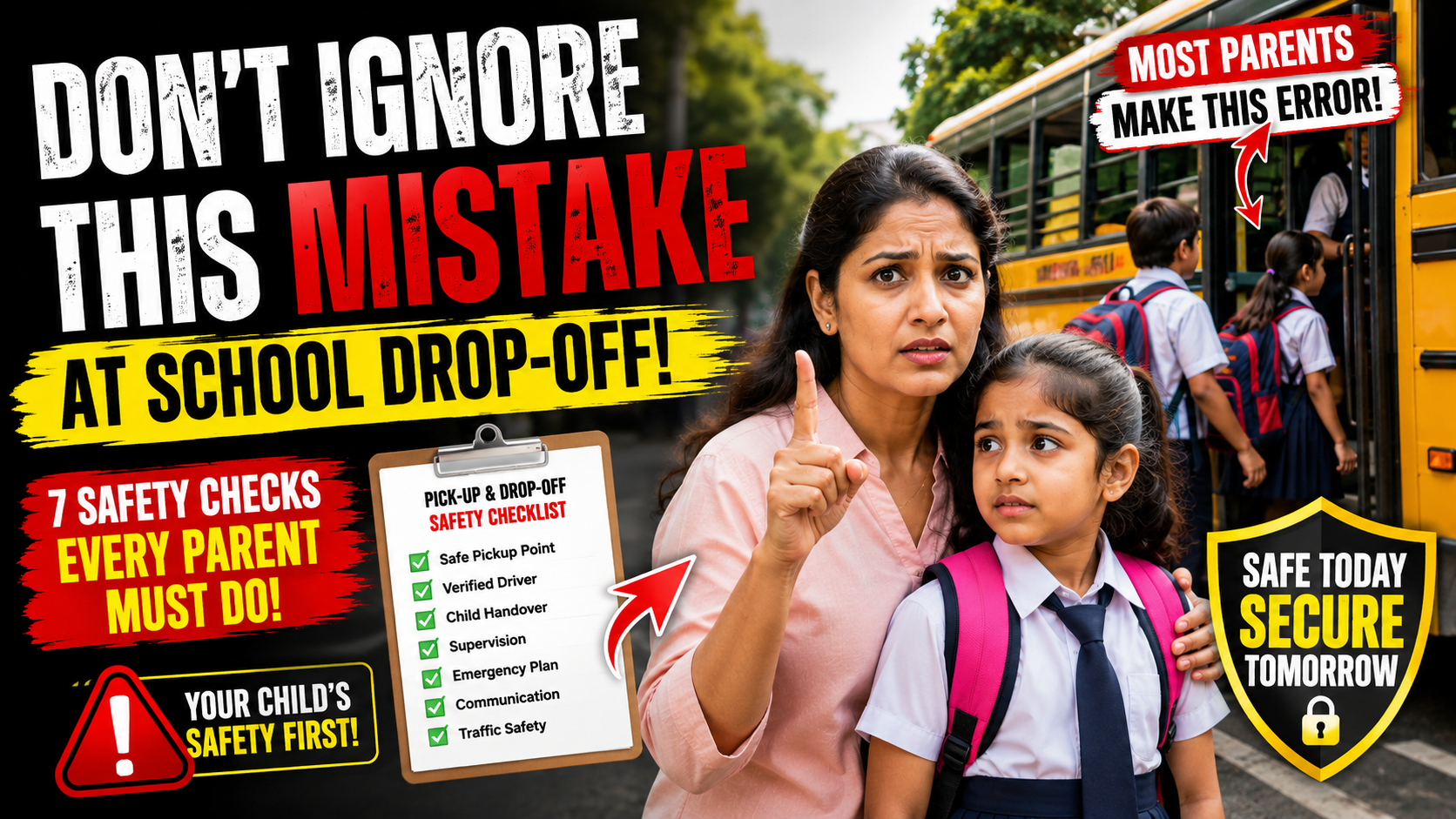
For many parents, the school journey begins and ends outside the classroom.
The few minutes when a child gets into a school bus, walks from a car to the school gate, or waits at a designated pickup point can involve traffic, crowded roads, hurried drivers and confusion between multiple vehicles.
This is why school pickup and drop-off safety deserves as much attention as classroom facilities, teaching quality and school fees.
The Central Board of Secondary Education (CBSE) requires affiliated schools to follow applicable school safety and transport precautions, including directions from the relevant State Government, Municipal Authority and Transport Department. CBSE also identifies transportation as part of the wider responsibility of keeping children safe on their journey between home and school.
The Maharashtra Highway Traffic Police similarly advises parents to ensure that the mode of transport arranged for their children is safe and encourages parents to observe and report violations.
For parents selecting a school for 2027, the right question is therefore not simply, "Does the school provide transport?"
It is:
"How safely does the school manage the complete pickup and drop-off process?"
Why Pickup and Drop-Off Safety Matters
School transport safety is broader than the condition of a bus.
A child can face risks:
- While waiting for the vehicle
- While crossing a road to reach the vehicle
- While boarding or leaving the bus
- When several vehicles stop together
- During school-gate congestion
- When an unauthorised person attempts to collect a child
- When a child is accidentally left behind
- When parents and transport staff do not communicate clearly
A good school therefore needs a system, not just a vehicle.
What parents should evaluate
| Safety area. &. What parents should look for | |
| Pickup point | Safe, visible and reasonably separated from moving traffic |
| School gate | Controlled entry and exit |
| Bus boarding | Adult supervision and orderly boarding |
| Child handover | Clear procedure for authorised pickup |
| Vehicle | Properly maintained and compliant transport |
| Driver | Appropriate licence, training and responsible driving |
| Attendant | Responsible adult supervision where applicable |
| Communication | Reliable school-parent communication |
| Emergency response | Clearly defined procedure |
| Route management | Sensible routes and manageable journey times |
School Pickup & Drop-Off Safety Checklist
1. Check Where Your Child Will Be Picked Up
Do not evaluate the transport service only by looking at the bus.
Ask where your child will actually wait.
A good pickup location should ideally be:
- Away from fast-moving traffic
- Easy for a child to identify
- Well supervised
- Clearly communicated to parents
- Accessible without requiring unsafe road crossing
- Suitable for the child's age
This becomes especially important in busy urban areas such as Virar, Vasai, Nalasopara, Naigaon, Mira Road and Bhayandar, where morning traffic can become concentrated around residential complexes and school zones.
2. Ask How Children Board the School Bus
Children should not be expected to manage a crowded boarding process independently.
Parents should ask:
- Who supervises boarding?
- Does the bus attendant assist younger children?
- Are children instructed to wait until the bus has stopped?
- Is there a clear queue or boarding procedure?
- Are children discouraged from running towards the vehicle?
- Is the driver expected to keep the vehicle stationary until children are safely seated?
CBSE's transport precautions include provisions relating to safe boarding, trained personnel and student orderliness.
3. Understand the Child Handover Process
This is one of the most important questions for parents of younger children.
Ask the school:
"What happens if the usual parent is not available to receive my child?"
A responsible system should have a clearly communicated process for:
- Authorised pickup persons
- Changes in pickup arrangements
- Unexpected delays
- A child not being collected
- Emergency contacts
- Communication between transport staff and school authorities
Parents should provide updated contact information and inform the school before making any change to the regular arrangement.
4. Check School-Gate Traffic Management
Even when the school bus itself is safe, the area outside the school can become hazardous.
Look for:
- Separate entry and exit arrangements where practical
- Staff managing vehicle movement
- Clearly defined waiting areas
- Pedestrian movement that does not unnecessarily conflict with vehicles
- No chaotic stopping directly in front of the gate
- Adequate visibility for children and drivers
CBSE safety guidance recognises the need for schools to observe transport precautions prescribed by the relevant authorities.
5. Teach Your Child Safe Boarding Behaviour
Parents should not assume that transport safety is entirely the school's responsibility.
Teach children to:
- Wait away from moving traffic.
- Never run towards a moving bus.
- Wait until the bus has stopped completely.
- Board one at a time.
- Hold the handrail where provided.
- Sit down promptly.
- Keep hands, arms and head inside the vehicle.
- Avoid distracting the driver.
- Remain seated until the vehicle stops.
- Follow the attendant's instructions.
The Maharashtra Highway Traffic Police specifically advises parents to teach children how to walk safely, cross roads and board or alight from buses.
What to Check About the School Bus
If your child uses school transport, ask the school about the vehicle itself.
CBSE's published transport precautions include several features parents can use as questions when evaluating a school bus. These include clear school identification, emergency equipment, reliable doors, first-aid provisions and speed-control requirements.
School bus inspection checklist
- School bus is clearly identifiable.
- School/contact information is displayed as required.
- Vehicle appears properly maintained.
- Doors and safety mechanisms function properly.
- Emergency equipment is available.
- First-aid facilities are provided.
- Children have appropriate seating arrangements.
- School bags can be stored safely.
- Driver is appropriately licensed.
- An attendant or responsible adult is provided where required.
- Parents know whom to contact during a transport emergency.
Parents should remember that exact requirements can depend on the applicable transport authority and vehicle category. Parents should verify this directly with the school management or official authority.
Driver and Attendant Safety
The people operating and supervising the school vehicle are as important as the vehicle itself.
Ask the school:
- How are school bus drivers selected?
- Are licences and required documents verified?
- Is driver fitness checked?
- Is there a regular training or review process?
- Who supervises children during the journey?
- Who is responsible if a child becomes unwell?
- Is there a designated transport coordinator?
Older CBSE transport guidance includes driver licensing, training, medical fitness and a designated transport-management responsibility among the areas schools should address.
What Parents Should Ask Before Paying School Transport Fees
Before selecting transport, ask these questions in writing if possible:
Route and timing
- What is the estimated journey time?
- What is the pickup point?
- Can the pickup point change?
- How are delays communicated?
- What happens during heavy traffic?
Safety
- Who supervises children?
- What emergency procedures are followed?
- How are transport-related complaints handled?
- What happens if a child misses the bus?
- What happens if the regular pickup person is unavailable?
Communication
- Is there a transport helpline or designated school contact?
- How are route changes communicated?
- How quickly are parents informed about significant delays?
Vehicle
- Is the transport school-owned or contracted?
- How frequently is the vehicle inspected and maintained?
- What emergency equipment is carried?
- What safety procedures apply to contracted vehicles?
Do not assume that a school's marketing material provides the complete answer.
If a school gives unclear or inconsistent answers, ask for clarification before paying transport charges.
School Bus vs Parent Pickup
Neither option is automatically safest for every family.
| Factor | School Bus | Parent/Guardian Pickup |
| Supervision | Usually organised by school | Depends on family |
| Traffic exposure | Depends on route and pickup point | Depends on local traffic |
| Convenience | Often high | Requires parent availability |
| Communication | School-managed | Parent-managed |
| Schedule | Fixed | More flexible |
| Younger children | Requires strong supervision | Can provide direct handover |
| Working parents | Often more practical | May be difficult |
The best choice depends on the child's age, route, family schedule, traffic conditions and quality of the school's transport system.
A Simple Parent Decision Matrix
Use this five-question test before choosing school transport.
| Question | Yes | No |
| Is the pickup point reasonably safe? | ✓ | ⚠ |
| Is boarding and alighting supervised? | ✓ | ⚠ |
| Is there a clear child handover procedure? | ✓ | ⚠ |
| Can parents reliably contact the school/transport team? | ✓ | ⚠ |
| Does the school explain its emergency process clearly? | ✓ | ⚠ |
4–5 Yes answers: The transport system deserves closer consideration.
2–3 Yes answers: Ask more questions before deciding.
0–1 Yes answers: Treat the transport arrangement as a significant concern and seek clarification.
This matrix is a parent decision tool, not an official safety certification.
Special Considerations for Younger Children
Children in Nursery, Junior KG, Senior KG and early primary classes may require closer supervision than older students.
Parents should pay particular attention to:
- Direct adult supervision
- Safe handover
- Correct identification of the child
- Clear emergency contacts
- Whether the child understands their pickup routine
- Whether the child can recognise the bus attendant
- What happens if the child falls asleep or misses the intended stop
The younger the child, the more important a predictable and supervised routine becomes.
What Parents Should Do During the First Week
Do not wait for a problem before checking the transport routine.
During the first few days:
Before pickup
- Confirm the exact pickup location.
- Confirm the expected time.
- Ensure your child knows the routine.
- Keep emergency contacts accessible.
During boarding
- Observe whether the child is supervised.
- Check whether children wait safely.
- Watch whether the vehicle moves only after boarding is complete.
During drop-off
- Confirm who receives the child.
- Check whether the child has to cross a busy road.
- Confirm what happens if nobody is available.
After the first week
Ask your child:
- Was the bus crowded?
- Did you feel safe?
- Did anyone push while boarding?
- Did the driver drive too fast?
- Did you know where to sit?
- Could you easily ask the attendant for help?
Children may notice practical problems that parents do not see.
What Parents Should Do If They Notice a Safety Violation
Do not ignore repeated safety concerns.
Record:
- Date and approximate time
- Vehicle or route details
- Nature of the concern
- Whether children were affected
- Any response received from the school
Raise the issue with the school management or transport coordinator first, where appropriate.
For serious or repeated violations, parents should approach the relevant transport or local authority. Maharashtra Highway Traffic Police advises parents to remain vigilant, note violations and report them to the authorities.
School Transport Safety in Maharashtra: What Parents Should Remember
Families in Maharashtra may use a mixture of school buses, contracted vehicles, vans, private cars and other transport arrangements.
The exact legal and operational requirements can vary according to the vehicle, school, local authority and applicable rules.
CBSE-affiliated schools are required to observe relevant State Government, Municipal Authority and Transport Department requirements concerning transport precautions.
Therefore, parents in Mumbai, Thane, Palghar, Vasai, Virar, Nalasopara, Naigaon, Mira Road and Bhayandar should avoid relying on generic social-media checklists alone.
For any specific compliance question, parents should verify this directly with the school management or official authority.
Expert Takeaways for Parents
A safe school transport system should demonstrate five qualities:
- Supervision — Children are not left to manage traffic and boarding alone.
- Predictability — Pickup, drop-off and handover procedures are clearly defined.
- Communication — Parents know whom to contact when something changes.
- Vehicle readiness — The transport vehicle has appropriate safety provisions and is properly maintained.
- Accountability — The school has a process for handling complaints and emergencies.
The strongest school choice is not necessarily the one with the newest bus or the shortest route.
It is the one with a clear, consistently managed safety process.
Frequently Asked Questions (FAQs)
1. What should parents check at school pickup and drop-off?
Parents should check traffic conditions, supervision, boarding and alighting procedures, child handover arrangements, emergency communication and the safety of the pickup location.
2. What should I ask a school before using its bus service?
Ask about the vehicle, driver, attendant, route, pickup timing, emergency procedures, parent communication and what happens if the authorised pickup person is unavailable.
3. Is school bus transport safer than private pickup?
There is no universal answer. A well-managed school bus can provide organised supervision, but the safest option depends on the child's age, route, traffic conditions, family arrangements and quality of transport management.
4. How can I teach my child to use a school bus safely?
Teach your child to wait away from traffic, board only after the bus stops, use the handrail, sit properly, keep body parts inside the vehicle and follow the driver's or attendant's instructions.
5. What should parents do if they observe unsafe school bus behaviour?
Document the concern and raise it with the school's transport coordinator or management. For serious or repeated violations, parents can approach the relevant authority. Maharashtra Highway Traffic Police specifically encourages parents to remain vigilant and report violations.
6. Does CBSE have school transport safety requirements?
Yes. CBSE requires affiliated schools to follow applicable safety guidelines and relevant State Government, Municipal Authority and Transport Department prescriptions concerning transportation. CBSE also publishes specific transport precautions for school buses.
Conclusion & Parent Checklist
School pickup and drop-off should never be treated as a routine detail of admission.
For a child, the school journey is part of the school experience—and safety needs to be built into every stage, from the moment the child leaves home to the moment they are safely handed back to a parent or authorised adult.
Before choosing a school transport service for 2027, parents should evaluate the pickup point, vehicle, driver, attendant, supervision, communication system, emergency procedures and child handover process.
Final Parent Checklist
- Visit the pickup/drop-off location.
- Ask how children are supervised.
- Understand the authorised pickup procedure.
- Check how transport delays are communicated.
- Ask about emergency procedures.
- Check the condition and identification of the vehicle.
- Understand the driver's and attendant's responsibilities.
- Teach your child basic bus and road safety.
- Ask how complaints are handled.
- Verify transport requirements with the school or relevant authority.
A good school does not simply get children from home to campus. It builds a transport system in which parents can understand the process, children know what to do, and staff know who is responsible at every stage.
Tags:
Get Weekly Insights
Join 10k+ parents getting smarter about education.