
5 School Features Parents Overlook During Campus Visits in 2027
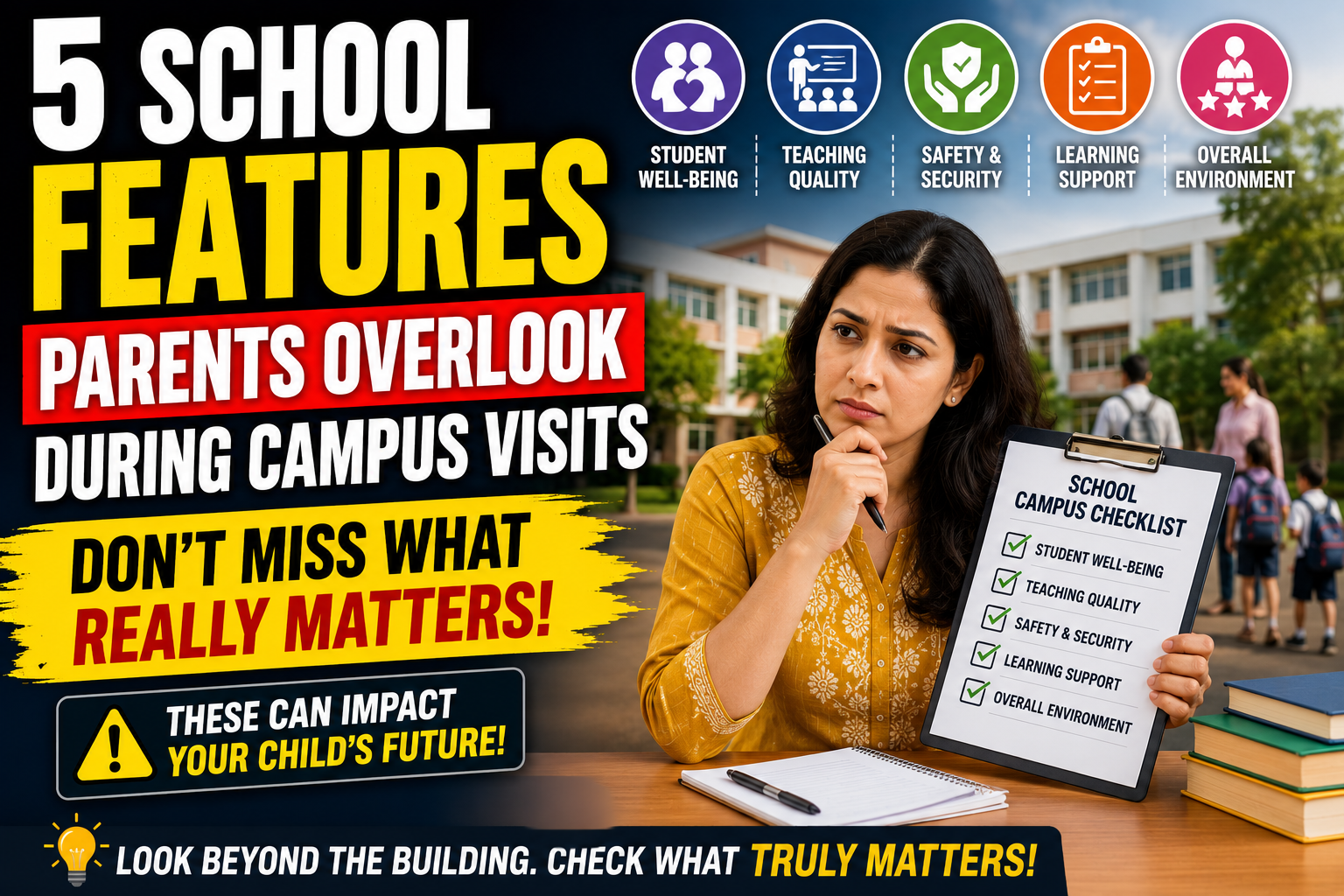
A school campus visit can be exciting.
Parents walk through bright classrooms, look at laboratories, inspect playgrounds and ask about fees, transport and admission dates. Schools naturally want to present their strongest features, and parents understandably notice what is easiest to see.
But there is a problem.
Some of the most important indicators of school quality are not immediately visible.
A beautiful building does not tell you how teachers interact with students. A large playground does not tell you whether children actually get enough opportunities to use it. A modern classroom does not automatically mean that learning is effective.
For parents preparing for school admission in 2027, the campus visit should therefore be treated as an investigation—not simply a tour.
This matters particularly for families comparing schools across Mumbai, Thane, Mira Road, Bhayandar, Vasai, Naigaon, Nalasopara, Virar and Palghar, where several schools may appear attractive on paper.
Government school-quality frameworks also look beyond appearance. The PM SHRI School Quality Assessment Framework includes areas such as curriculum and pedagogy, infrastructure and safety, human resources, inclusive practices, management and governance.
Here are five features parents should deliberately look for during their next school visit.
1. How Teachers Actually Interact With Students
Parents often ask:
"Are the teachers qualified?"
That is an important question.
But there is another question that can be even more revealing:
"How do teachers behave with students?"
A campus visit may provide small clues.
Observe:
- Whether teachers listen to students.
- Whether students are comfortable asking questions.
- Whether teachers speak respectfully.
- Whether classroom interactions appear one-way or interactive.
- Whether students seem engaged.
- Whether teachers appear approachable.
- Whether classroom discipline is based only on control or also on guidance.
NEP 2020 places emphasis on learning that goes beyond simple information delivery, including experiential, inquiry-based, project-based and collaborative learning.
What Parents Can Ask
Instead of asking only:
"How many teachers do you have?"
ask:
- How do teachers support students who learn at different speeds?
- How are students encouraged to ask questions?
- How does the school identify learning gaps?
- How do teachers communicate progress to parents?
Why This Matters
A child spends a significant portion of the school day interacting with teachers.
The quality of those interactions can influence:
- Confidence
- Participation
- Curiosity
- Motivation
- Classroom behaviour
- Learning habits
A school may have excellent infrastructure, but the daily teacher-student relationship remains central to the learning experience.
2. Student Well-Being: The Atmosphere You Cannot See in a Brochure
Parents usually inspect physical safety.
But emotional and social safety can be much harder to notice.
During a campus visit, observe the children.
Do they appear:
- Comfortable?
- Confident?
- Engaged?
- Frightened?
- Overly anxious?
- Free to interact?
- Supported by teachers?
You cannot determine a school's entire well-being culture from a 30-minute visit, but you can identify questions worth asking.
Ask the School
- How does the school handle bullying?
- Who can a student approach if they have a problem?
- How does the school support students experiencing stress?
- What happens when a child is struggling socially?
- How are parents informed when concerns arise?
The Ministry of Education has highlighted the importance of creating safe, engaging and positive learning environments and involving parents in children's holistic development.
A Useful Observation
Look at how adults speak to children outside formal classrooms.
A teacher calmly helping a child, a staff member listening patiently or students comfortably approaching an adult can provide useful clues about the school culture.
3. Safety Systems Beyond the Security Gate
Most parents notice the security guard immediately.
But school safety is much broader than the main entrance.
CBSE's safety requirements refer to areas including child protection, fire safety, building safety, transportation and other aspects of school safety. A 2025 CBSE notification also describes school safety as including physical, emotional, transport, disaster and other risks.
During your campus visit, look for evidence of practical safety systems.
Check These Areas
Entry and exit
- Who is allowed onto campus?
- How are visitors managed?
- How are children released at dismissal?
Fire and emergency preparedness
- Are emergency exits clearly identifiable?
- Are fire-safety arrangements visible?
- Does the school explain its emergency procedures?
Transport
- How are school buses monitored?
- What happens during pickup and drop-off?
- Who supervises younger children?
Campus movement
- Are stairways and corridors appropriately supervised?
- Are high-risk areas controlled?
- Is the campus reasonably secure?
Child protection
- What is the school's procedure when a child reports a concern?
- Who is responsible for handling such complaints?
CBSE's published standards also refer to requirements involving health and hygiene, drinking water, fire safety, building safety and transport precautions.
Important Point
Do not judge safety by the number of cameras alone.
A school may have extensive CCTV coverage, but parents should also understand the systems, people and procedures behind the equipment.
4. Learning Support for Children Who Do Not Fit the "Average Student"
This is one of the most overlooked questions during school visits.
Parents often ask:
"How good are your top students?"
A more useful question may be:
"What happens when a student struggles?"
Every classroom contains students with different learning speeds, interests and strengths.
Ask whether the school has systems for:
- Identifying learning gaps.
- Providing additional academic support.
- Supporting different learning needs.
- Communicating concerns with parents.
- Tracking student progress.
- Adjusting teaching strategies where appropriate.
The PM SHRI School Quality Assessment Framework includes human resources and inclusive practices as part of its quality framework.
CBSE affiliation requirements also refer to qualified staff, infrastructure, safety provisions and facilities supporting students, including provisions related to inclusion.
Ask This Directly
"If my child falls behind in mathematics or reading, what happens next?"
The quality of the answer can tell you much more than a brochure.
5. The Everyday Environment: What Happens Between the Big Facilities?
Parents naturally focus on:
- Auditorium
- Swimming pool
- Smart classrooms
- Laboratories
- Sports ground
- Computer rooms
These can all be valuable.
But what about the spaces children use every day?
Look at:
- Classrooms
- Corridors
- Washrooms
- Drinking-water areas
- Lunch areas
- Waiting areas
- Staircases
- Playground access
- Library
- Student noticeboards
- Common areas
CBSE's infrastructure standards refer to classrooms, laboratories, libraries, playgrounds, hygiene, drinking water and accessibility—not simply the appearance of the main building.
Ask Yourself
Does the campus feel functional for children, or is it mainly impressive for visitors?
That distinction matters.
A school can have a spectacular entrance but poorly maintained everyday facilities.
Conversely, a less glamorous-looking school may have an extremely well-managed daily learning environment.
5 Overlooked Features at a Glance
| Teaching quality | Teacher qualifications | Teacher-student interaction |
| Student well-being | General discipline | Emotional and social support |
| Safety | Security gate/CCTV | Emergency, transport and child-protection systems |
| Learning support | Top academic results | Help for students who struggle |
| Daily environment | Main building | Classrooms, hygiene and everyday functionality |
What Parents Should Observe During a 30-Minute Visit
You do not need to spend an entire day at every school.
Use a focused observation strategy.
First 5 Minutes: Entrance
Observe:
- Security
- Visitor management
- Student movement
- Pickup/drop-off arrangements
Next 10 Minutes: Learning Spaces
Look at:
- Classrooms
- Teacher-student interactions
- Learning displays
- Student participation
- Cleanliness
Next 5 Minutes: Student Facilities
Check:
- Washrooms
- Drinking water
- Playground
- Library
- Common areas
Next 5 Minutes: Ask Questions
Ask about:
- Learning support
- Safety
- Teacher communication
- Student well-being
- Activities
Final 5 Minutes: Step Back
Ask yourself:
"Would my child feel comfortable spending most weekdays here?"
This final question is often more useful than asking whether the building looks impressive.
10 Questions Parents Should Ask During a Campus Visit
- How does the school identify students who need additional academic support?
- How do teachers communicate a child's progress to parents?
- What systems are in place for student safety?
- How does the school handle bullying or student complaints?
- What happens during a medical or other emergency?
- How are school buses and pickup/drop-off managed?
- How does the school support different learning needs?
- How much time do students receive for sports and activities?
- How are parents expected to communicate with teachers?
- What would you say is the school's biggest area for improvement?
That last question can be particularly revealing.
A school that can discuss areas for improvement honestly may demonstrate a more realistic approach than one that presents itself as perfect.
Red Flags Parents Should Notice
A campus visit should not become an exercise in finding faults.
But some observations deserve follow-up.
Red Flag 1: Everything Sounds Perfect
If every question receives an answer such as "We have no problems," ask for examples.
No organisation is perfect.
Red Flag 2: Staff Avoid Specific Answers
If parents ask about safety, fees, learning support or teacher communication and receive only vague responses, request clearer information.
Red Flag 3: The Tour Shows Only Showcase Areas
Ask to see everyday spaces as well as premium facilities.
Red Flag 4: Children Appear Consistently Uncomfortable
One moment is not enough to judge a school, but repeated observations during a visit should prompt questions.
Red Flag 5: Important Information Is Not Verifiable
For board affiliation, recognition, fee structures or other important claims, verify information with the school and relevant official authority.
Parents should not make a major admission decision based solely on an unverified brochure, social-media claim or verbal statement.
Do Not Confuse "Modern" With "Good"
A modern school may have advanced technology and impressive architecture.
That is not a problem.
The mistake is assuming that modern automatically means better.
The PM SHRI quality framework itself combines infrastructure with curriculum, pedagogy, human resources, inclusive practices, management and governance.
So parents should evaluate the complete ecosystem.
A Better Formula
Good School = Learning + Teachers + Safety + Well-Being + Support + Functional Infrastructure + Communication
Not:
Good School = Expensive Building + Smart Classroom + Large Campus
School Campus Visit Scorecard
Take this simple scorecard with you.
| Category | Score 1–5 | Notes |
| Teacher-student interaction | /5 | |
| Student well-being | /5 | |
| Safety systems | /5 | |
| Learning support | /5 | |
| Classroom environment | /5 | |
| Cleanliness & hygiene | /5 | |
| Sports & activities | /5 | |
| Parent communication | /5 | |
| Accessibility & inclusion | /5 | |
| Overall comfort | /5 |
Do not score based purely on appearance.
Write a short note explaining every score.
That will make it much easier to compare schools after visiting three or four campuses.
Local Perspective: Mumbai, Thane and Vasai-Virar
For parents in Mumbai, Thane, Mira Road, Bhayandar, Vasai, Naigaon, Nalasopara, Virar and Palghar, campus visits are especially valuable because schools can differ significantly in daily operations even when their websites make similar claims.
Consider practical factors such as:
- Traffic around school hours
- School bus movement
- Entry and exit congestion
- Monsoon conditions
- Availability of public transport
- Distance from home
- Distance from parents' workplaces
- Time required for daily travel
A school that looks excellent but creates an exhausting daily routine may not be the best fit.
The right decision should combine school quality with family practicality.
Parent Campus Visit Checklist
- Observe the entrance and visitor management.
- Look at actual classrooms, not only showcase rooms.
- Observe teacher-student interactions.
- Ask how learning gaps are identified.
- Ask how additional academic support works.
- Ask about bullying and student complaints.
- Understand emergency procedures.
- Check transport safety arrangements.
- Inspect washrooms and drinking-water facilities.
- Look at playground and activity access.
- Ask about parent-teacher communication.
- Consider accessibility and inclusion.
- Check the daily commute during school hours.
- Record observations immediately after the visit.
- Compare the school against your other shortlisted options.
Frequently Asked Questions (FAQs)
1. What should parents look for during a school campus visit?
Parents should examine more than classrooms and buildings. They should observe teacher-student interaction, student well-being, safety systems, learning support, hygiene, everyday facilities and the overall school environment.
2. What is the most overlooked feature during a school visit?
Learning support is often overlooked. Parents should ask what happens when a child struggles academically, socially or with a particular subject.
3. Should parents inspect school washrooms during a campus visit?
Yes. Washrooms, drinking-water facilities and other everyday spaces can provide useful information about maintenance, hygiene and how the campus functions for students.
4. How can parents judge teaching quality during a short visit?
Parents cannot fully evaluate teaching quality in one visit, but they can observe teacher-student interactions and ask specific questions about assessment, learning gaps, teacher development and parent communication.
5. Is CCTV enough to prove that a school is safe?
No. CCTV is only one component. Parents should ask about visitor management, emergency procedures, fire safety, transport safety, child protection and how concerns are reported and handled. CBSE safety requirements cover multiple dimensions of school safety.
6. What should parents ask if their child falls behind academically?
Ask how the school identifies learning gaps, what additional support is provided, how progress is monitored and how parents are informed. This can reveal more about the school's student-support system than asking only about its highest exam scores.
Conclusion & Parent Checklist
A school campus visit should be much more than a tour of impressive buildings.
The five features parents should deliberately investigate are teacher-student interaction, student well-being, safety systems, learning support and the everyday school environment.
These areas may not appear prominently in a school brochure, but they can strongly influence your child's daily experience.
For 2027 admissions, take notes, ask specific questions and compare schools using the same scorecard.
Most importantly, do not allow a beautiful campus to make the entire decision for you.
Look beyond the building. Look at the people, systems and environment your child will experience every school day.
A successful school choice is not about finding the most impressive campus.
It is about finding a place where your child can learn, feel safe, receive support and grow with confidence.
Tags:
Get Weekly Insights
Join 10k+ parents getting smarter about education.