
School Bus Safety Rules 2027: 15 Things Every Parent Must Check Before Sending a Child
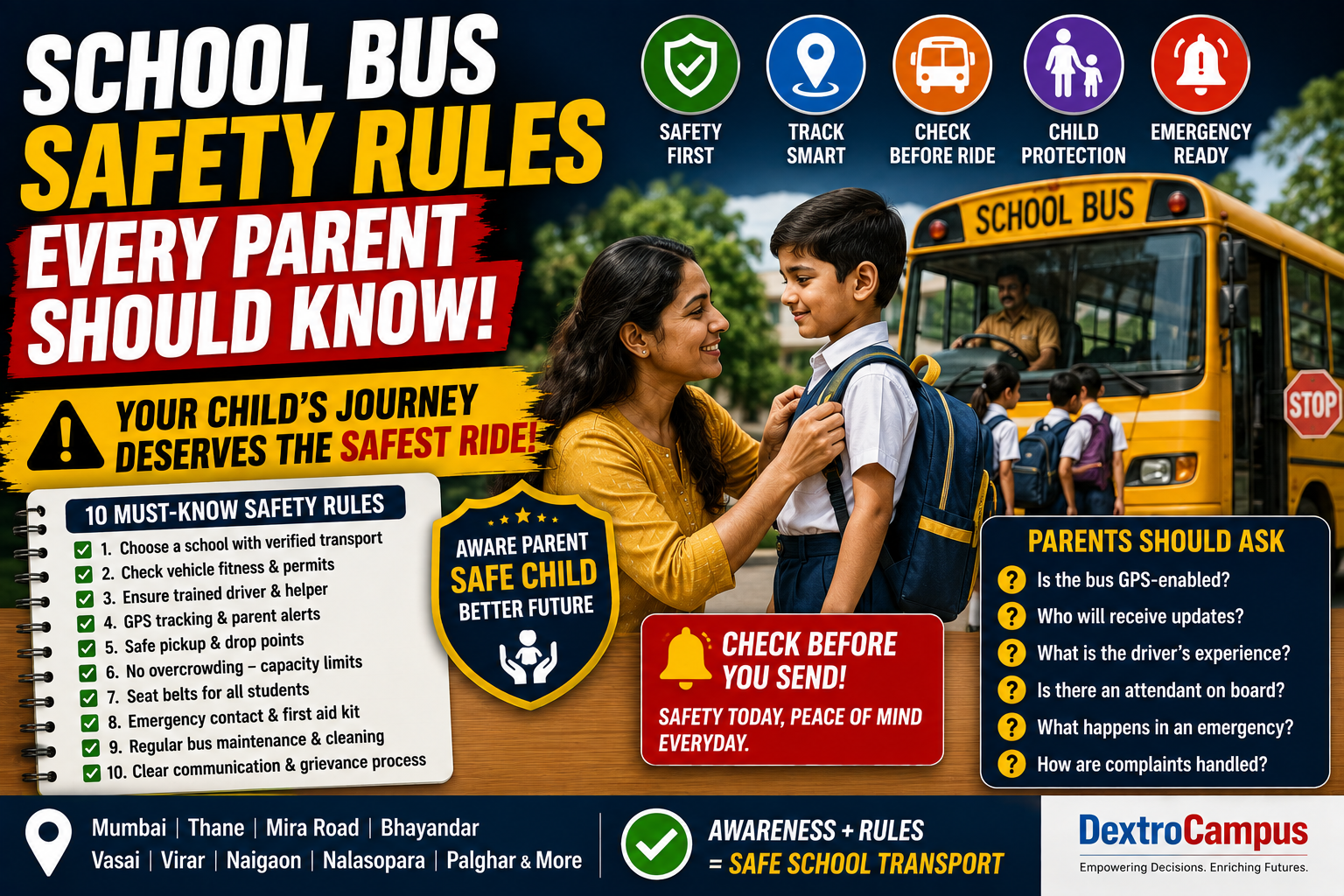
For many parents, school transport is convenient.
It saves time.
It can help working parents manage morning schedules.
It can also make a school located farther from home practical.
But there is one question that should come before convenience:
"Is my child travelling in a properly managed and safe school transport system?"
The DextroCampus content plan identifies Day 7, Blog 1 as "School Bus Safety Rules Every Parent Should Know."
For families across Mumbai, Thane, Mira Road, Bhayandar, Vasai, Naigaon, Nalasopara, Virar and Palghar, school transport can become part of the daily routine for hundreds of journeys each academic year.
That makes transport safety a school-selection issue—not simply a bus-service issue.
CBSE's school-safety requirements specifically state that schools must ensure the safety and security of students in school buses and other school transportation, and must observe applicable State Government, municipal and Transport Department requirements concerning transport precautions.
1. Why School Bus Safety Matters
A child may spend:
- 30 minutes on the bus each morning
- 30 minutes returning home
- More time when traffic is heavy
Over an academic year, that can mean hundreds of hours in school transport.
So parents should evaluate transport with the same seriousness as:
- Classroom safety
- Teacher quality
- Campus security
- Emergency preparedness
The Parent Principle
A school bus should not be judged only by whether it arrives on time.
Parents should also examine:
Vehicle + Driver + Attendant + Route + Monitoring + Emergency Preparedness.
2. Check Whether the Bus Is Properly Identified
One of the simplest checks is the vehicle's identification.
CBSE's school transport guidance states that school buses should be identifiable as school buses, with the school name displayed prominently; hired buses should indicate that they are on school duty. Driver and school/contact information should also be visibly displayed.
Parents Should Check
- Is "School Bus" clearly displayed?
- Is the school name visible?
- Is the transport provider identifiable?
- Is a school or emergency contact number available?
- Can parents identify the assigned vehicle easily?
A clearly identifiable vehicle is easier to monitor and report.
3. Ask About the Vehicle's Fitness
Parents should not judge a school bus only by its appearance.
A clean-looking bus can still have an outdated or missing compliance document.
Ask the school or transport operator about:
- Registration Certificate
- Fitness Certificate
- Insurance
- Permit
- Pollution-related compliance
- Other documents required by the applicable transport authority
Maharashtra's school-bus rules provide for a school transport committee that verifies vehicle documents including the Registration Certificate, Certificate of Fitness, Certificate of Insurance, Permit, Pollution Under Control certificate, driving licence, fire extinguisher and first-aid kit.
Parent Rule
Do not hesitate to ask whether the transport documentation is current.
4. Check the Driver's Credentials
The driver is one of the most important safety factors.
Parents should ask:
- Does the driver hold the required licence?
- Does the driver have the required experience?
- Has the driver's identity been verified?
- Are medical and eyesight checks conducted?
- Does the school monitor driver performance?
- Is there a replacement-driver process?
The Maharashtra school-bus rules referenced above require a school-bus driver to have five years of driving experience, hold the relevant transport licence and a valid badge.
The broader Supreme Court school-bus directions have also emphasised driver experience, medical fitness and periodic safety checks.
5. Ask Whether There Is a Trained Attendant
A driver should be focused on driving.
Children may need supervision while:
- Boarding
- Sitting
- Getting off
- Moving through the bus
- Responding to an emergency
Maharashtra's school-bus framework provides for school transport oversight and attendant-related safety requirements. CBSE guidance also identifies the presence of an attendant as an important transport-safety measure.
Ask the School
"Who supervises children inside the bus while it is moving?"
"Is the attendant trained?"
"Is the same attendant normally assigned to the route?"
These questions are particularly important for younger children.
6. Check for First-Aid Equipment
Every school transport system should be prepared for minor injuries and emergencies.
CBSE's transport guidance identifies a first-aid box as a school-bus safety requirement.
Parents should ask:
- Is a first-aid box available?
- Is it maintained?
- Who knows how to use it?
- Is there a procedure for medical emergencies?
- Who contacts parents?
Maharashtra's school-bus rules also require the transport committee to verify the first-aid kit.
7. Check Fire-Safety Equipment
A school bus should have appropriate fire-safety equipment.
CBSE's published transport guidelines specify a fire extinguisher in the bus.
The Maharashtra school-bus rules referenced above provide for fire extinguishers and specify equipment requirements according to the vehicle type and capacity.
Parents Should Ask
- Where is the extinguisher located?
- Is it accessible?
- Is it maintained?
- Does the driver/attendant know how to use it?
- Is there an emergency evacuation procedure?
Do not treat a fire extinguisher as just another item on a checklist.
The staff should know what to do with it.
8. Look at the Windows and Doors
Children should not be able to place their heads, arms or other body parts outside a moving bus.
Published school-bus safety guidance includes protected windows and reliable door locks. CBSE's transport guidance specifically refers to horizontal window grills/mesh and reliable door locks.
The Supreme Court directions similarly emphasised secure doors and protected windows.
During a Bus Inspection
Look at:
- Window protection
- Door locks
- Emergency exit
- Door operation
- Step condition
- General accessibility
If something looks damaged, ask the school to explain how it is handled.
9. Ask About Speed Control
Speed is one of the most important transport-safety questions.
The school-bus safety guidance published by CBSE refers to speed-control devices and a 40 km/h limit in its listed guidelines.
The Supreme Court directions cited in school-bus safety guidance have also included speed-control requirements.
Parents Should Ask
"How does the school monitor bus speed?"
A good transport system should not rely only on a driver's personal judgement.
Ask whether the school has:
- Speed monitoring
- GPS-based monitoring
- Route oversight
- Complaint mechanisms
- Periodic transport audits
10. Check Whether the Bus Is Overcrowded
A bus should never be evaluated solely on whether every child has technically "found a place."
Parents should look for:
- Adequate seating
- Safe movement
- No unsafe standing
- No blocked aisles
- No excessive school bags creating hazards
- Appropriate capacity management
The Supreme Court directions have addressed student capacity and safe boarding/disembarking, while Maharashtra's rules contain specific transport requirements.
Parent Question
"What is the permitted seating capacity of this vehicle, and how many children are assigned to the route?"
11. School Pickup and Drop-Off Safety Is Critical
A safe bus journey can still become unsafe at the final 30 seconds.
The dangerous point may be:
Getting off the bus.
Parents should ask:
- Where is the official bus stop?
- Is it away from heavy traffic?
- Does an attendant supervise children?
- Does the school have a handover procedure?
- What happens if a parent is not present?
- What happens if nobody comes to receive a young child?
For younger children, the handover procedure deserves particular attention.
Parent Rule
Do not choose a pickup point only because it is close to home.
Choose the safest practical location.
12. Ask What Happens If Nobody Comes to Receive the Child
This is especially important for:
- Nursery
- Junior KG
- Senior KG
- Primary children
Ask the school:
"If the authorised person is not present at the stop, what happens to the child?"
A good procedure should clearly identify:
- Who supervises the child?
- Who is contacted?
- Where is the child taken?
- How is the incident recorded?
- When can the child be released?
Never leave this question unanswered for a young child.
13. Does the School Use GPS Tracking?
GPS can give parents greater visibility into:
- Bus location
- Route progress
- Delays
- Arrival estimates
But GPS alone does not make a transport system safe.
A GPS device cannot replace:
- A trained driver
- An attendant
- Proper vehicle maintenance
- Emergency preparedness
- Safe pickup points
Ask
"Is GPS available?"
Then ask:
"Who monitors it, and what happens when the bus deviates from the expected route?"
That second question is often more useful.
14. Ask About Parent Notifications
Some schools may provide:
- SMS alerts
- App notifications
- GPS links
- Bus arrival alerts
- Route notifications
Ask:
- When is an alert sent?
- Is it automatic?
- Who receives it?
- What happens if the bus is delayed?
- How are route changes communicated?
A useful transport communication system should reduce uncertainty for parents.
15. Ask How Emergencies Are Handled
Imagine:
- A vehicle breaks down.
- A child becomes unwell.
- There is a traffic accident.
- The bus reaches the wrong location.
- The driver becomes unavailable.
- Severe weather causes a delay.
Ask the school:
"What is your emergency transport procedure?"
Then ask:
"Who contacts parents?"
"Who contacts emergency services?"
"Where are children taken?"
"How is attendance verified?"
CBSE requires schools to ensure student safety in school transportation and to follow applicable safety guidelines and transport precautions.
16. Check Whether the School Has a Transport Committee
This is particularly relevant in Maharashtra.
The Maharashtra Motor Vehicles (Regulations for School Buses) Rules provide for a school transport committee dealing with safe transportation, transportation fees and bus stops, and for verification of specified vehicle and safety documents.
The referenced framework also provides for participation from school, parent, traffic/police, motor vehicle, education and other relevant representatives.
Parent Question
"Who is responsible for transport safety at the school?"
You should know the answer.
17. Ask Who Handles Complaints
Suppose:
- The bus is repeatedly late.
- The driver drives aggressively.
- The attendant is absent.
- The bus is overcrowded.
- The pickup point is unsafe.
- Your child reports bullying or unsafe behaviour.
Who should you contact?
Ask for:
Transport Coordinator / Transport Manager / School Office
and preferably a written escalation procedure.
A transport service without a clear complaint mechanism creates unnecessary uncertainty.
18. Do Not Judge Safety by a New-Looking Bus
A shiny bus may look impressive.
But safety depends on more than appearance.
Look Beyond:
Paint
Seats
Air conditioning
Entertainment systems
Instead ask about:
- Fitness
- Insurance
- Driver credentials
- Attendant
- Fire safety
- First aid
- Emergency exits
- Route monitoring
- Capacity
- Maintenance
- Complaint handling
Remember
A premium-looking bus is not automatically a safer bus.
19. School Bus Safety Checklist for Parents
Use this before selecting school transport:
| Safety Check. Parent Verification | |
| Vehicle identification | ✓ / ✗ |
| Fitness certificate | ✓ / ✗ |
| Insurance | ✓ / ✗ |
| Permit | ✓ / ✗ |
| PUC/compliance | ✓ / ✗ |
| Qualified driver | ✓ / ✗ |
| Driver experience | ✓ / ✗ |
| Driver medical fitness | ✓ / ✗ |
| Trained attendant | ✓ / ✗ |
| First-aid box | ✓ / ✗ |
| Fire extinguisher | ✓ / ✗ |
| Protected windows | ✓ / ✗ |
| Secure doors | ✓ / ✗ |
| Emergency arrangements | ✓ / ✗ |
| Safe pickup/drop point | ✓ / ✗ |
| GPS/monitoring | ✓ / ✗ |
| Parent communication | ✓ / ✗ |
| Complaint process | ✓ / ✗ |
Do not mark a box based on assumptions.
Ask and verify.
20. Questions to Ask During a School Visit
Instead of asking:
"Is your bus safe?"
ask specific questions.
Vehicle
"Can I see the transport vehicle?"
Driver
"What are the driver's experience and verification procedures?"
Attendant
"Is there a trained attendant on this route?"
Documents
"Are the vehicle's fitness, insurance and permit documents current?"
Emergency
"What happens if the bus breaks down?"
Tracking
"Can parents track the bus?"
Pickup
"How are young children handed over at the stop?"
Complaints
"Who should I contact if I have a transport safety concern?"
Specific questions produce more useful answers.
21. School Bus vs Private Transport: The Safety Question
Parents sometimes assume:
School bus = safe
and:
Private van = unsafe
That is too simplistic.
The real comparison should be:
| Factor | ||
| Driver verification | Check | Check |
| Vehicle fitness | Check | Check |
| Attendant | Check | Check |
| Emergency process | Check | Check |
| GPS | Check | Check |
| Parent communication | Check | Check |
| Pickup safety | Check | Check |
| Complaint mechanism | Check | Check |
The safest option is the one with stronger verified safety controls, not simply the label attached to the vehicle.
22. What Younger Children Need From School Transport
Nursery and primary children have different needs from older students.
Parents should pay extra attention to:
- Attendant supervision
- Safe boarding
- Safe drop-off
- Parent/authorised-person handover
- Child identification
- Attendance tracking
- Emergency contacts
- Seat availability
- Clear route information
For very young children, handover safety can be as important as vehicle safety.
23. What Parents Should Teach Children
School transport safety is not only the school's responsibility.
Teach your child:
Before Boarding
- Wait away from moving traffic.
- Do not run toward the bus.
- Wait until the bus has stopped.
Inside the Bus
- Remain seated.
- Keep the aisle clear.
- Do not push other children.
- Follow the attendant's instructions.
- Keep body parts inside the bus.
While Getting Off
- Wait for the bus to stop completely.
- Do not rush.
- Move away from the bus carefully.
Emergency
Teach your child to know:
- The school name
- Parent/guardian contact
- How to alert the attendant
- Where emergency exits are, when age-appropriate
24. Red Flags Parents Should Never Ignore
🚩 No Visible School Identification
The vehicle is difficult to identify.
🚩 Driver Details Are Unclear
The school cannot explain who is driving the route.
🚩 No Attendant for Young Children
There is no clear supervision arrangement.
🚩 Overcrowding
Children are squeezed into the vehicle.
🚩 Unsafe Pickup Point
Children must cross dangerous roads or stand in heavy traffic.
🚩 No Emergency Procedure
Nobody can explain what happens during a breakdown or accident.
🚩 No Complaint Contact
Parents do not know whom to call.
🚩 Repeated Unsafe Driving Complaints
The school dismisses repeated concerns without investigation.
One concern may require clarification.
Repeated unresolved concerns deserve serious attention.
25. The 10-Minute Transport Audit
Before selecting a school, spend 10 minutes investigating transport.
Minute 1–2: Vehicle
Look at the bus and its condition.
Minute 3: Driver
Ask about credentials and experience.
Minute 4: Attendant
Ask who supervises children.
Minute 5: Documents
Ask about fitness, insurance and permit.
Minute 6: Emergency
Ask about first aid and fire equipment.
Minute 7: Tracking
Ask about GPS and parent notifications.
Minute 8: Pickup
Check the proposed bus stop.
Minute 9: Communication
Get the transport contact number.
Minute 10: Complaint
Ask what happens when a parent reports a safety concern.
Ten minutes can reveal a lot about the seriousness with which a school approaches transport.
26. School Transport Safety in Maharashtra
For Maharashtra parents, school transport should be evaluated against the applicable state transport rules as well as school-specific procedures.
The Maharashtra school-bus rules provide for transport oversight through a school transport committee and include requirements concerning documentation, vehicle equipment, driver qualifications and safe transport arrangements.
For CBSE-affiliated schools, CBSE also requires schools to observe State Government, municipal and Transport Department prescriptions concerning transport precautions.
Parent Takeaway
Do not evaluate a school bus using only the school's brochure.
Ask for the actual transport process.
27. Local Parent Checklist: Mumbai to Palghar
For families in:
- Mumbai
- Thane
- Mira Road
- Bhayandar
- Vasai
- Naigaon
- Nalasopara
- Virar
- Palghar
transport decisions should also consider the daily route.
A school may be academically attractive but involve:
- Long travel time
- Heavy traffic
- Multiple route stops
- Early pickup
- Late return
- Difficult crossing points
Therefore, ask:
"How long does the bus normally take from my pickup point to school?"
Do not rely solely on the distance shown on a map.
28. Safety vs Convenience: Which Should Win?
Suppose two schools are similar academically.
School A
- Shorter commute
- Clear transport procedures
- Trained attendant
- Strong parent communication
School B
- Longer commute
- Attractive facilities
- Less transparent transport information
Parents should not automatically choose School B because its campus looks better.
Transport is part of the child's daily experience.
Parent Rule
A slightly longer school commute may be manageable. An unclear safety system should not be ignored.
29. Parent Transport Decision Matrix
Score each shortlisted school:
| Factor | |||
| Vehicle compliance | /5 | /5 | /5 |
| Driver verification | /5 | /5 | /5 |
| Attendant supervision | /5 | /5 | /5 |
| Emergency readiness | /5 | /5 | /5 |
| Pickup/drop safety | /5 | /5 | /5 |
| GPS/monitoring | /5 | /5 | /5 |
| Parent communication | /5 | /5 | /5 |
| Complaint handling | /5 | /5 | /5 |
| Route practicality | /5 | /5 | /5 |
| Overall confidence | /5 | /5 | /5 |
This is a parent comparison framework, not an official safety rating.
30. Parent School Bus Safety Checklist 2027
Before signing up for school transport:
- I have seen or inspected the vehicle.
- I know the transport provider.
- I know who drives my child's route.
- Driver credentials are verified.
- Driver experience is known.
- An appropriate attendant is assigned.
- Vehicle fitness is verified.
- Insurance is verified.
- Permit requirements are satisfied.
- First-aid equipment is available.
- Fire-safety equipment is available.
- Windows and doors have appropriate safety features.
- Emergency arrangements are clear.
- Pickup point is safe.
- Drop-off procedure is clear.
- GPS/monitoring arrangements are understood.
- Parent notifications are explained.
- Transport contact number is saved.
- Complaint procedure is known.
- My child understands basic bus safety.
31. The One Question Every Parent Should Ask
If you remember only one question from this article, ask:
"Can you explain your complete school transport safety system—from vehicle fitness and driver verification to pickup, emergency handling and parent communication?"
A serious transport provider should be able to explain the process clearly.
Related DextroCampus Guides & Resources
- School Transport Fees 2027: What Determines the Cost? — understand the financial side of school transport.
- How to Choose the Right School Transport Option for Your Child — compare transport choices based on safety and practicality.
- School Bus vs Private Van: Safety & Cost Comparison — evaluate two common transport options.
- School Bus GPS Tracking: Why It Matters for Parents — understand tracking and parent notifications.
- School Pickup & Drop-Off Safety Checklist — focus specifically on the most sensitive points of the daily journey.
- School Safety Standards: 20 Things Parents Should Check — expand the safety audit beyond transport.
Frequently Asked Questions (FAQs)
1. What should parents check before choosing a school bus?
Parents should check vehicle fitness, insurance and permit documentation, driver credentials, attendant supervision, first-aid and fire-safety equipment, emergency arrangements, safe pickup/drop-off points and the school's transport complaint process.
2. Is GPS tracking enough to make a school bus safe?
No. GPS can improve visibility and communication, but it does not replace vehicle maintenance, driver verification, trained supervision, emergency preparedness and safe boarding and drop-off procedures.
3. Should a school bus have an attendant?
Parents should check the applicable transport rules and the school's transport arrangements. School-bus safety guidance and Maharashtra's transport framework recognise attendant/supervision arrangements as important safety measures, particularly for children travelling by school transport.
4. What documents should parents ask about for a school bus?
Parents can ask whether the vehicle has current registration, fitness, insurance, permit and applicable pollution/compliance documentation, and whether the driver's licence and required credentials are valid. Maharashtra's school-bus framework specifically provides for verification of several such documents by the school transport committee.
5. What should parents do if they notice unsafe school-bus driving?
Record the concern, including the date, route and relevant details, and report it to the school's transport coordinator or management in writing. If the concern involves an immediate safety risk or suspected regulatory violation, parents should consider contacting the appropriate transport or law-enforcement authority.
6. How can parents make school transport safer for young children?
Choose a transport system with appropriate supervision, clear pickup and drop-off procedures, reliable parent communication and emergency arrangements. Parents should also teach children basic rules such as remaining seated, keeping body parts inside the vehicle and following the attendant's instructions.
Conclusion & Parent Checklist
School transport is not simply:
Bus + Driver + Route.
A genuinely responsible transport system involves:
Safe vehicle
Qualified driver
Appropriate supervision
Emergency preparedness
Safe pickup and drop-off
Parent communication
Clear accountability
CBSE requires affiliated schools to address safety in school transportation and to follow applicable State Government, municipal and Transport Department requirements.
Maharashtra's school-bus framework also provides for transport committees and verification of important vehicle and safety documents.
For parents in Mumbai, Thane, Mira Road, Bhayandar, Vasai, Naigaon, Nalasopara, Virar and Palghar, this should be part of the school-selection process.
Before you choose a school bus, ask:
Who drives it?
Who supervises the children?
Is the vehicle compliant?
What happens in an emergency?
How are children handed over at the destination?
How does the school respond to complaints?
The best school transport decision is not necessarily the one with the newest bus or the cheapest fee.
It is the one where safety procedures are clear, documented, monitored and taken seriously.
Do not ask only, "Does the school provide transport?" Ask, "How does the school keep my child safe while travelling?"
Tags:
Get Weekly Insights
Join 10k+ parents getting smarter about education.