
School Admission Enquiry vs Application: What's the Difference?
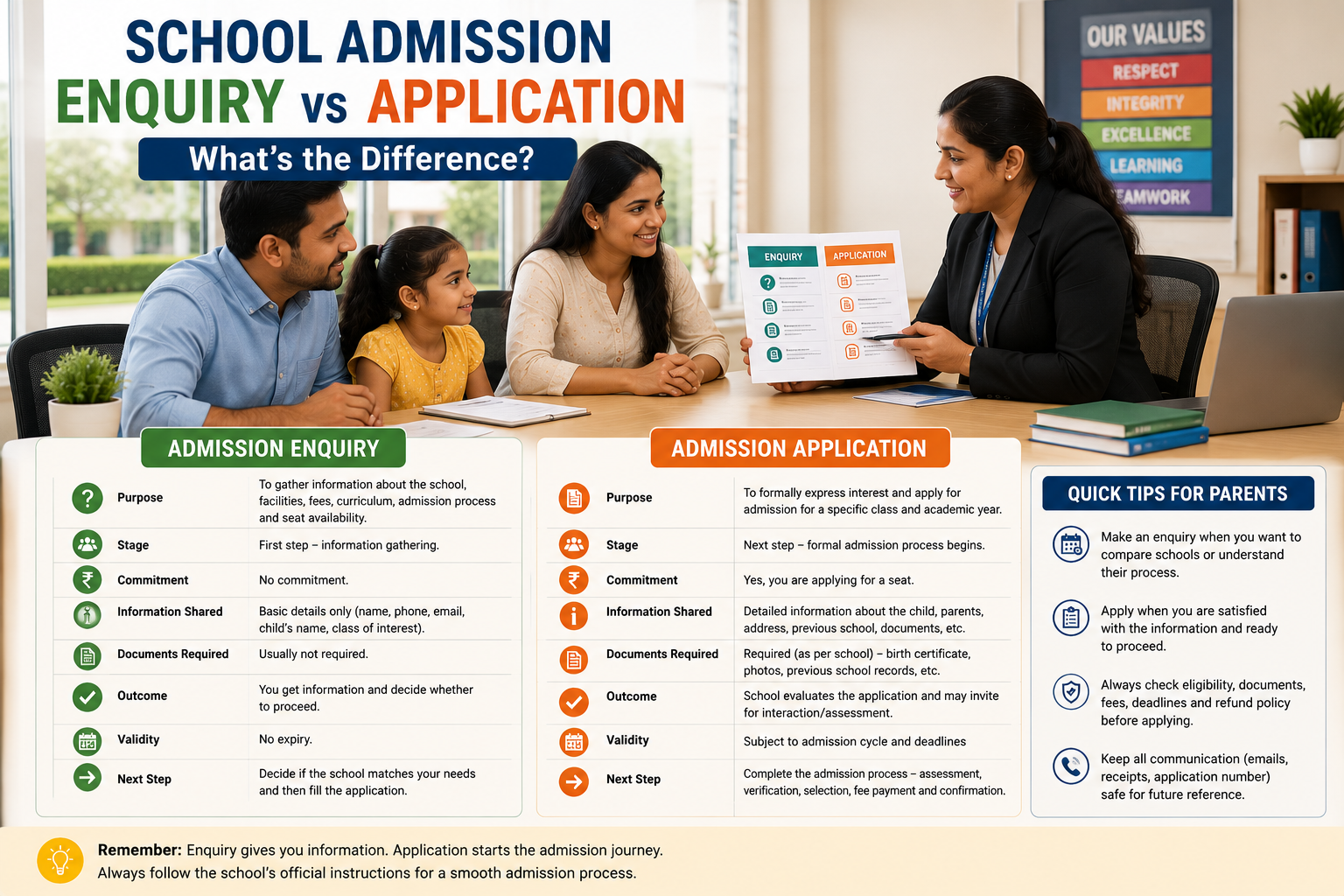
School Admission Enquiry vs Application: What's the Difference?
Last Updated: August 10, 2026
Many parents use the words school admission enquiry and school admission application interchangeably. They are related, but they usually serve different purposes.
A school admission enquiry is generally an information-gathering step. Parents use it to ask about admissions, classes, fees, eligibility, school timings, availability and the application process.
A school admission application is a more formal step in which a parent submits the child's information for consideration for admission.
The exact terminology and process vary from school to school. Some schools may combine enquiry and registration, while others may have separate stages.
For parents planning admission for 2027, understanding the difference can help avoid confusion and missed deadlines.
School Admission Enquiry vs Application: Quick Answer
An enquiry helps you learn about a school; an application formally starts the admission process.
An enquiry might ask:
"Is admission available for Class 1 for 2027?"
An application is more like:
"Here is my child's information and supporting documentation. I want to apply for a seat in Class 1."
Neither term has exactly the same meaning at every school, so parents should always follow the school's own instructions.
Admission Enquiry vs Application: Comparison
| AspectAdmission EnquiryAdmission Application | ||
| Main purpose | Gather information | Formally apply for admission |
| Typical stage | Early stage | Formal admission stage |
| Child's details | Basic information may be requested | Detailed information usually required |
| Documents | Usually limited or none | Documents may be required |
| Fee | May be free | May involve an application/registration fee |
| Seat request | Usually informational | Usually linked to admission consideration |
| Outcome | Information or next steps | Application review/decision |
| Deadline | May not have one | Usually follows a defined admission schedule |
| Next step | Decide whether to apply | Verification, assessment or selection process |
Important: This table describes common practice. A particular school's process may be different.
What Is a School Admission Enquiry?
A school admission enquiry is an opportunity to gather information before deciding whether to apply.
Parents might contact the school by:
- Phone
- Website enquiry form
- Admission portal
- School office
- Campus visit
- Official messaging channel
An enquiry may be useful when parents are still comparing schools.
Questions Parents Can Ask During an Enquiry
You might ask:
- Is admission open for the required class?
- Which academic year is currently accepting applications?
- What is the eligibility requirement?
- What documents are required?
- Is an application form available?
- Is there an application fee?
- What are the school timings?
- Is transport available?
- Does the school have an entrance assessment?
- Is a parent-child interaction required?
- What is the application deadline?
- How does the school communicate admission decisions?
These questions can help parents decide whether the school fits their needs.
What Is a School Admission Application?
A school admission application is the formal submission through which parents provide information for the school to consider the child's admission.
An application can be:
- Online
- Offline
- Through a school admission portal
- Through a prescribed application form
The form may ask for detailed information about:
Child
- Full name
- Date of birth
- Address
- Class requested
- Previous school
- Academic information
Parents/Guardians
- Names
- Contact information
- Email address
- Other details requested by the school
Supporting Documents
Depending on the school and class, parents may be asked to provide documents such as:
- Birth certificate
- Previous-school records
- Report card
- Transfer Certificate, where applicable
- Date-of-birth proof
- Address proof, where requested
- Photographs
- Other school-specific documents
For applicable CBSE admissions, the Board's official rules identify documentation such as qualifying-examination records, Transfer Certificates and date-of-birth proof. (cbse.gov.in)
Does an Enquiry Mean You Have Applied?
Usually, no.
If you simply call a school and ask:
"Do you have seats available for Class 2?"
you have made an enquiry.
You have not necessarily submitted an admission application.
Likewise, filling out a general "contact us" or "admission enquiry" form on a website should not automatically be interpreted as a formal application.
Look for clear wording such as:
- Registration
- Apply Now
- Admission Application
- Application Form
- Submit Application
- Complete Registration
If you are uncertain, ask the school:
"Has my enquiry been registered as a formal admission application, or do I need to complete another form?"
Can You Apply Without Making an Enquiry?
Often, yes.
An enquiry is not necessarily a mandatory step before applying.
If the school has already published its admission process and application form, parents may be able to proceed directly to the application.
However, some schools may have a registration or enquiry stage before the formal application.
The school's instructions determine the process.
When Should Parents Make an Admission Enquiry?
An enquiry is particularly useful when you are still gathering information.
Consider making an enquiry when:
You Are Comparing Schools
You can ask several schools about:
- Curriculum
- Fees
- Admission dates
- Transport
- School timings
- Activities
- Application requirements
You Are Unsure About Eligibility
Ask whether your child is eligible for the desired class before investing time in an application.
You Don't Know Whether Admission Is Open
An enquiry can clarify whether the school is currently accepting applications.
You Need Information About Documents
If you are unsure which documents are required, ask before submitting anything.
You Are Planning Early
Parents planning for the 2027 academic year can enquire well before they are ready to submit an application, depending on the school's process.
When Should You Submit an Application?
An application makes sense when you have enough information to decide that the school is worth applying to and the school has opened its application process.
Before applying, confirm:
- Correct academic year
- Correct class
- Eligibility
- Application deadline
- Required documents
- Application fee, if applicable
- Application procedure
- Assessment/interview requirements
Do not submit an application simply because you made an enquiry.
Does an Admission Enquiry Guarantee a Seat?
No.
An enquiry generally provides information.
It does not normally mean:
- A seat has been reserved
- Admission has been approved
- The child has been selected
- Fees have been fixed for the child
- The application has been accepted
Seat availability and admission decisions depend on the school's actual process.
Does an Application Guarantee Admission?
No.
Submitting an application usually means that the school will consider the application according to its process.
Admission may depend on:
- Eligibility
- Available seats
- School-specific criteria
- Required documentation
- Assessment, where applicable
- Other applicable rules
For CBSE schools, Board rules establish applicable admission requirements, but a completed application does not itself guarantee admission to a particular school. (cbse.gov.in)
Is There a Fee for an Admission Enquiry?
An enquiry may be free, but parents should not assume that every school uses the same process.
If someone asks you to pay money for an enquiry, ask:
- What is the payment for?
- Is it an application or registration fee?
- Is it refundable?
- Is there an official receipt?
- Is the payment instruction published by the school?
Always use official school payment channels.
Is There a Fee for an Admission Application?
Some schools may charge an application or registration fee, while others may not.
The amount and refund conditions vary.
Parents should verify the current amount directly with the school rather than relying on old fee information.
Never invent or assume an application fee.
What Happens After an Application?
Once the formal application has been submitted, the next steps can include:
- Application acknowledgement
- Document verification
- Assessment or interaction, if applicable
- Application review
- Selection or waitlist communication
- Admission offer
- Fee payment
- Final confirmation
Not every school uses every stage.
This is why parents should save the application number and carefully monitor the school's official communication.
Example: How the Two Processes Work
Imagine a parent is considering a school for Class 1.
Step 1 — Enquiry
The parent asks:
"Is Class 1 admission available for 2027?"
The school provides information about eligibility, application dates and documents.
This is an enquiry.
Step 2 — Decision
The parent reviews the information and decides that the school is suitable.
Step 3 — Application
The parent completes the school's admission form and submits the required information and documents.
This is the formal application.
Step 4 — School Review
The school processes the application according to its admission procedure.
Step 5 — Decision
The school communicates the outcome and any next steps.
This simple example shows why enquiry and application should not automatically be treated as the same thing.
Admission Enquiry vs Registration vs Application
Parents may encounter a third term: registration.
These three words can sometimes create confusion.
Enquiry
Usually means:
"I want information."
Registration
Usually means:
"I want to register my interest or start the admission process."
Application
Usually means:
"I am formally applying for admission."
But schools can use these terms differently.
For example, one school might call its first online form a "registration form," while another might call a similar form an "admission application."
Therefore, the school's definition is more important than the label.
Questions Parents Should Ask Before Moving From Enquiry to Application
Before submitting an application, ask:
1. Is admission open?
Confirm that applications are currently being accepted.
2. Which class is available?
Do not assume that availability in one class means availability in another.
3. Which academic year?
Confirm whether the application is for 2027–28 or another session.
4. What documents are required?
Prepare the correct documents before starting.
5. Is there a deadline?
Record it immediately.
6. Is there an application fee?
Confirm the current amount and payment method.
7. Is an assessment required?
Ask what happens after submission.
8. How will the result be communicated?
Find out whether the school uses email, SMS, phone or an online portal.
Common Parent Mistakes
Mistake 1: Assuming an enquiry reserves a seat
An enquiry is generally informational.
Mistake 2: Assuming a website enquiry is an application
A contact form and formal application form may be completely different.
Mistake 3: Missing the application deadline
An enquiry does not necessarily keep the application window open.
Mistake 4: Paying without understanding the payment
Confirm what the payment represents.
Mistake 5: Submitting the wrong documents
Use the school's current document checklist.
Mistake 6: Assuming application means selection
Application and admission confirmation are different stages.
Mistake 7: Relying on verbal information alone
Save important admission communication.
Mistake 8: Not asking what happens next
After an enquiry or application, understand the next step.
A Simple Parent Decision Tree
Use this quick approach:
Do you need more information?
→ Yes: Make an admission enquiry.
→ No: Check whether applications are open.
Are applications open for the required class?
→ Yes: Review eligibility and documents.
→ No: Ask the school when applications are expected to open.
Are you ready to formally apply?
→ Yes: Complete the application.
→ No: Continue comparing schools and gathering information.
Has the application been submitted?
→ Yes: Save the application number and monitor communication.
School Admission Enquiry Checklist
Before contacting a school, write down:
- Child's age
- Current class
- Class required
- Academic year
- Current school, if applicable
- Preferred campus/branch
- Questions about fees
- Questions about transport
- Questions about admission dates
- Questions about documents
This makes the enquiry more useful and reduces repeated calls or emails.
School Admission Application Checklist
Before submitting the application:
- Eligibility checked
- Correct class selected
- Correct academic year selected
- Child's name checked
- Date of birth checked
- Parent details checked
- Address checked
- Documents prepared
- Photograph prepared if required
- Application fee checked
- Deadline noted
- Final review completed
- Application submitted
- Confirmation/application number saved
Frequently Asked Questions
What is the difference between school admission enquiry and application?
An admission enquiry is generally used to obtain information about the school and admission process. An application is a formal submission requesting consideration for admission.
Is a school admission enquiry necessary before applying?
Not always. Some schools allow parents to apply directly, while others may have an enquiry or registration stage. Follow the school's instructions.
Does an enquiry reserve a seat?
Usually, no. An enquiry normally provides information and does not itself confirm or reserve admission.
Does submitting an application guarantee admission?
No. Admission depends on the school's process, eligibility, available seats and applicable criteria.
Is admission enquiry free?
It may be, but parents should confirm with the school. Do not assume that a payment request is merely an enquiry fee.
Is registration the same as application?
Not necessarily. Schools use these terms differently. Check what the specific school means by registration.
Can I enquire at multiple schools?
Yes. Making enquiries at several schools can help parents compare options before deciding where to apply.
Can I apply to multiple schools?
Parents can consider multiple schools where their processes allow it. However, carefully review each school's application fees, deadlines, admission terms and cancellation/refund conditions.
What should I do after submitting an application?
Save the confirmation and application number, monitor official communication, keep documents ready and follow the school's next-step instructions.
How do I know whether my enquiry became an application?
Check whether you received an application/registration number and whether the school confirms that a formal application was submitted. If unclear, contact the school's admission office.
Parent-Friendly Summary
Think of the admission journey this way:
Enquiry = Ask
You are collecting information.
Registration = Start
You are beginning the school's admission process, if the school uses registration as a formal stage.
Application = Apply
You are formally submitting your child's details for consideration.
Selection = Decision
The school communicates the outcome.
Confirmation = Complete
You finish the required admission formalities.
This is a useful general framework, but the exact terminology can vary from school to school.
Conclusion
Understanding the difference between a school admission enquiry and application can save parents time and prevent misunderstandings.
An enquiry is generally the right step when you need information about eligibility, fees, availability, documents or the admission process. An application is the formal step taken when you are ready to seek admission through the school's prescribed procedure.
Before submitting anything, check the school's latest instructions for the 2027 admission cycle. Confirm the class, academic year, eligibility, documents, fees and deadlines. Then save your application confirmation and follow the school's next steps.
Most importantly, do not assume that an enquiry reserves a seat or that an application automatically guarantees admission. The school's official admission procedure determines what each stage means.
Source note: The distinction between enquiry, registration and application is based on common admission-process terminology and should be treated as a practical guide, not a universal legal definition. Individual schools may use these terms differently. Official CBSE admission requirements should be checked separately where applicable. (cbse.gov.in)
Tags:
Get Weekly Insights
Join 10k+ parents getting smarter about education.