
School Admission Confirmation Letter: What Parents Should Check
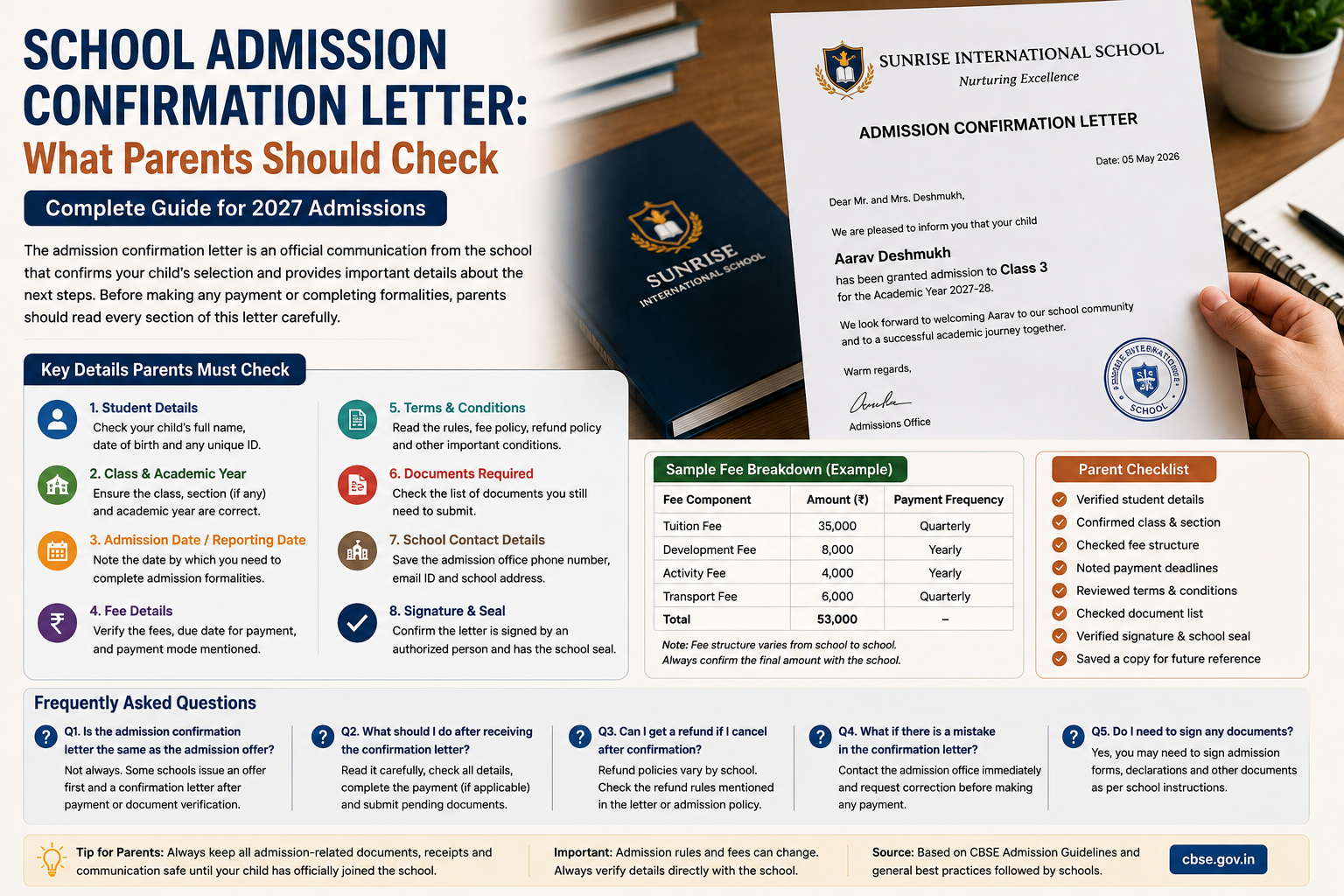
School Admission Confirmation Letter: What Parents Should Check
Last Updated: August 10, 2026
Receiving a school admission confirmation letter is an important moment for parents. But before paying fees, submitting remaining documents or assuming that everything is complete, parents should read the letter carefully and verify the details.
A confirmation letter may contain information about the child's name, class, academic year, admission status, reporting date, documents still required, payment deadline and other school-specific instructions. The exact format and terminology vary from school to school.
For CBSE schools, official admission requirements also make accurate student records and supporting documents important. CBSE states that information such as the student's name and date of birth should be entered correctly and supported by valid documents.
This guide explains what parents should check when they receive a school admission confirmation letter for 2027.
What Is a School Admission Confirmation Letter?
A school admission confirmation letter is an official communication from a school informing a parent or guardian about the outcome of an admission application and the next steps required, where applicable.
Depending on the school, it may be called:
- Admission confirmation letter
- Admission offer letter
- Selection letter
- Admission approval letter
- Provisional admission letter
- Admission communication
These terms are not necessarily interchangeable. Parents should read the actual document to understand whether the school is offering admission, confirming admission or asking the parent to complete additional formalities.
Do not assume that receiving an email automatically means every admission formalities are complete.
8 Things Parents Should Check Immediately
| What to CheckWhy It Matters | |
| Student name | Prevents record errors |
| Date of birth | Should match official documents |
| Class | Confirms the class offered |
| Academic year | Confirms the admission cycle |
| Admission deadline | Prevents missed formalities |
| Fees | Clarifies what is currently payable |
| Documents | Shows what remains pending |
| Terms and conditions | Explains important obligations |
1. Check Your Child's Full Name
The first thing parents should verify is the child's name.
Compare the name in the confirmation letter with:
- Birth certificate
- Existing school records
- Application form
- Transfer Certificate, where applicable
- Other documents submitted during admission
CBSE guidance advises schools and parents to ensure that the student's name and parents' names are entered correctly and consistently. It specifically advises against nicknames and abbreviations where official records are concerned.
If you notice an error, contact the school before the information is transferred into further records.
2. Verify the Date of Birth
Check the date of birth against the child's official birth certificate.
Do not assume that a one-digit error is harmless.
The date of birth can become part of the student's long-term school and academic record. CBSE's guidance specifically emphasizes accurate recording of the date of birth and consistency with supporting documents.
If the confirmation letter contains the wrong date, ask the school how it should be corrected before completing further formalities.
3. Confirm the Class and Academic Year
Make sure the letter clearly corresponds to the admission you applied for.
Check:
- Class
- Section, if already allocated
- Academic year
- Admission category, if mentioned
- School branch/campus, if applicable
For example, if you applied for Class 5 for the 2027–28 academic year, make sure the letter does not refer to another class or academic session.
For transfer students, class eligibility can also depend on previous-school records. CBSE's admission rules state that students must meet applicable qualifying requirements and that, in relevant transfer cases, the Transfer Certificate is important for determining the class to which a student may be admitted.
4. Look for the Admission or Reporting Date
The confirmation letter may include a date by which parents need to complete admission formalities.
This could relate to:
- Fee payment
- Document submission
- Physical verification
- Reporting to the school
- Orientation
- Final admission confirmation
Write the date somewhere visible.
If the letter does not clearly state a deadline, contact the school's admission office through an official channel rather than assuming there is no deadline.
5. Check the Fee Information Carefully
If the confirmation letter mentions fees, read the fee section carefully.
Check whether it identifies:
- Amount currently payable
- Tuition fee
- Other applicable charges
- Transport fee, if applicable
- Optional services
- Payment frequency
- Payment deadline
- Payment method
- Refund or cancellation conditions, if stated
Do not treat an example fee table found online as the actual fee of a school.
School fees can vary by institution, class, academic year and optional services. Parents should verify the current fee structure directly with the school.
Questions to Ask Before Paying
If anything is unclear, ask:
- What amount is payable now?
- What does the amount include?
- Are there additional compulsory charges?
- Is transport included?
- What is the payment deadline?
- What happens if the admission is cancelled?
- Is a receipt issued after payment?
Keep the answer and payment receipt for your records.
6. Check Which Documents Are Still Pending
A confirmation letter may be issued before every document has been completed.
Look for a section such as:
- Documents required
- Pending documents
- Documents to be submitted
- Admission formalities
- Verification requirements
Depending on the child's circumstances, the school may request documents such as:
- Birth certificate
- Previous-school report card
- Transfer Certificate/School Leaving Certificate
- Qualifying examination documents
- Address proof
- Photographs
- Other school-specific documents
CBSE's admission rules identify documents including the School Leaving Certificate/Transfer Certificate, qualifying-examination documents and date-of-birth proof for applicable admissions.
Always follow the particular school's current checklist.
7. Read the Terms and Conditions
Parents sometimes focus only on the words "admission confirmed" and skip the remaining pages.
Do not do this.
Read the conditions relating to:
- Fee payment
- Cancellation
- Refunds
- Withdrawal
- Required documents
- School policies
- Reporting
- Parent declarations
- Transport
- Other services
The terms can contain deadlines or conditions that are not obvious from the first page.
If something seems unclear, ask the school before agreeing or paying.
8. Verify the School and Contact Details
Check that the letter comes from the correct school and uses the school's official communication channel.
Pay attention to:
- School name
- Campus/branch
- Official email domain
- Contact details
- Admission office information
- Website or portal mentioned in the communication
If you receive a payment request from an unfamiliar bank account, personal number or third party, do not assume that it is genuine.
Verify the request directly with the school using contact information obtained from its official website or admission portal.
Is an Admission Confirmation Letter the Same as an Offer Letter?
Not necessarily.
A school may first issue an offer or selection communication and then require parents to complete additional steps before final admission.
Another school may use a single communication that combines selection and confirmation.
Therefore, parents should look for phrases such as:
- "Admission offered"
- "Selected for admission"
- "Provisional admission"
- "Admission confirmed"
- "Complete the following formalities"
- "Pay the applicable fee by..."
- "Submit the following documents by..."
The wording matters.
If you are unsure whether the admission is final, ask the school directly.
What Should Parents Do After Receiving the Letter?
A practical sequence is:
Step 1: Read the Entire Letter
Do not stop after seeing the admission decision.
Step 2: Check Personal Details
Verify name, date of birth, class and academic year.
Step 3: Check Deadlines
Write down every date mentioned.
Step 4: Prepare Pending Documents
Organize the documents requested by the school.
Step 5: Review Fees
Understand exactly what needs to be paid and when.
Step 6: Ask Questions
Contact the school if any term or instruction is unclear.
Step 7: Complete Formalities
Follow the school's stated procedure.
Step 8: Save Proof
Keep the letter, receipts, emails and confirmation messages.
What If There Is a Mistake in the Confirmation Letter?
Do not ignore it.
Examples include:
- Wrong spelling of the child's name
- Wrong date of birth
- Wrong class
- Wrong academic year
- Wrong parent name
- Wrong campus
- Incorrect application number
Contact the school promptly.
Provide:
- Application number
- Copy of the confirmation letter
- Correct information
- Supporting document, if applicable
CBSE has specifically highlighted the importance of preventing errors in student data because corrections to personal information can become more complicated later.
What If the Fee Amount Looks Different From What You Expected?
Do not rely on an old website page, social-media post or another parent's fee information.
Ask the school for the current fee structure and a clear breakup.
This is especially important when the amount includes multiple components.
Parents should retain:
- Fee circular
- Fee structure
- Payment receipt
- Transaction reference
- Written clarification from the school
What If the Confirmation Letter Says "Provisional"?
The word provisional deserves attention.
It may indicate that one or more conditions still need to be completed, such as:
- Document verification
- Eligibility confirmation
- Transfer documentation
- Fee payment
- Submission of required records
Do not assume that "provisional" and "final" mean the same thing.
Read the conditions carefully and ask the school what remains pending.
What If You Cannot Meet the Deadline?
Contact the school as soon as possible.
Explain the reason and ask whether an extension or alternative procedure is available.
Do not simply miss the deadline and assume that the seat will remain available.
Whether an extension is possible depends on the school's own policy and circumstances.
What Should Transfer Students Check?
Parents transferring a child from another school should pay particular attention to documentation.
CBSE's admission rules state that, where applicable, a student moving from another school must produce an authenticated Transfer Certificate before the student's name can be entered in the admission register. The rules also specify that a student should not be admitted to a class higher than the class for which the Transfer Certificate entitles the student.
Before completing the transfer, parents should therefore confirm:
- Previous-school records
- Transfer Certificate requirements
- Class eligibility
- Academic records
- Any board-specific requirements
Admission Confirmation Letter Checklist
Before completing admission, check all of the following:
- Child's full name is correct
- Date of birth is correct
- Parent/guardian names are correct
- Class is correct
- Academic year is correct
- School branch is correct
- Admission status is clear
- Reporting date is noted
- Payment deadline is noted
- Fee amount has been verified
- Pending documents are identified
- Terms and conditions are understood
- Refund/cancellation terms are checked
- Official contact details are verified
- Letter has been saved
- Payment receipt will be saved after payment
How Parents Should Store Admission Documents
Create one digital folder for the child's admission.
For example:
School Admission 2027
Inside it, keep:
- Application form
- Admission confirmation letter
- Fee structure
- Payment receipts
- Birth certificate
- Previous-school records
- Transfer Certificate, if applicable
- School emails
- Important SMS screenshots
- Other admission documents
Also consider keeping physical copies of important documents where appropriate.
This makes it easier to find information when the school requests it later.
Frequently Asked Questions
Is an admission confirmation letter proof that admission is final?
Not always. The wording and conditions matter. Some schools may require fee payment, document verification or other formalities before admission is fully completed.
What should I check first in an admission confirmation letter?
Start with the child's name, date of birth, class, academic year, admission status and deadline.
What if my child's name is spelled incorrectly?
Contact the school promptly and request correction using the relevant supporting document. Do not ignore the error.
Should I pay fees immediately after receiving the letter?
Only after reading the payment instructions and confirming the amount, deadline and terms with the school where necessary.
Can the school change the admission decision?
The answer depends on the school's terms and the circumstances. Parents should carefully read whether the offer is provisional or subject to specific conditions.
What happens if I miss the fee-payment deadline?
Contact the school immediately. Whether the deadline can be extended depends on the school's policy.
Do I need to keep the admission confirmation letter?
Yes. Keep it safely with the application, payment receipts and other admission records.
What documents may still be required after admission confirmation?
It varies by school and student. Possible documents include birth-date proof, previous-school records, Transfer Certificate and other school-specific documents.
Does CBSE issue every school's admission confirmation letter?
No. Individual schools conduct their admission processes and issue their own admission communications. CBSE provides applicable Board-level admission rules and requirements.
Final Advice for Parents
An admission confirmation letter should not be treated as something to glance at and file away.
Use it as a checklist for the final stage of the admission process.
Verify the child's details. Check the class and academic year. Note every deadline. Understand the fees. Identify pending documents. Read the terms and conditions. Confirm anything unclear with the school. Then save the final records safely.
For CBSE schools, parents should also remember that Board requirements operate alongside applicable State/UT rules and the individual school's admission procedure. CBSE states that admissions up to Class VIII are regulated by the applicable State/UT rules.
For school admission 2027, the safest approach is to rely on the latest communication issued by the school and verify important information before making payments or completing irreversible formalities.
Conclusion
Receiving a school admission confirmation letter is an important step, but parents should take a few minutes to verify every important detail before moving forward.
Check the child's personal information, class, academic year, admission status, deadlines, fees, pending documents and terms. If anything is incorrect or unclear, contact the school's admission office through an official channel.
A careful review now can help prevent avoidable problems later in the child's school records and admission process.
Tags:
Get Weekly Insights
Join 10k+ parents getting smarter about education.
Read Next

How to Choose the Right School Transport Option for Your Child in 2027: Safety, Cost & Convenience Guide
8/19/2026

What Makes a School Worth Paying Higher Fees For in 2027? 10 Things Parents Should Check
8/17/2026

How to Calculate the Real Cost of Sending Your Child to School in 2027: The Complete Parent Budget Guide
8/17/2026