VR in Indian Classrooms: Gimmick or the Future of Learning? (63 characters)
The Classroom of 2025: Stepping Beyond Textbooks
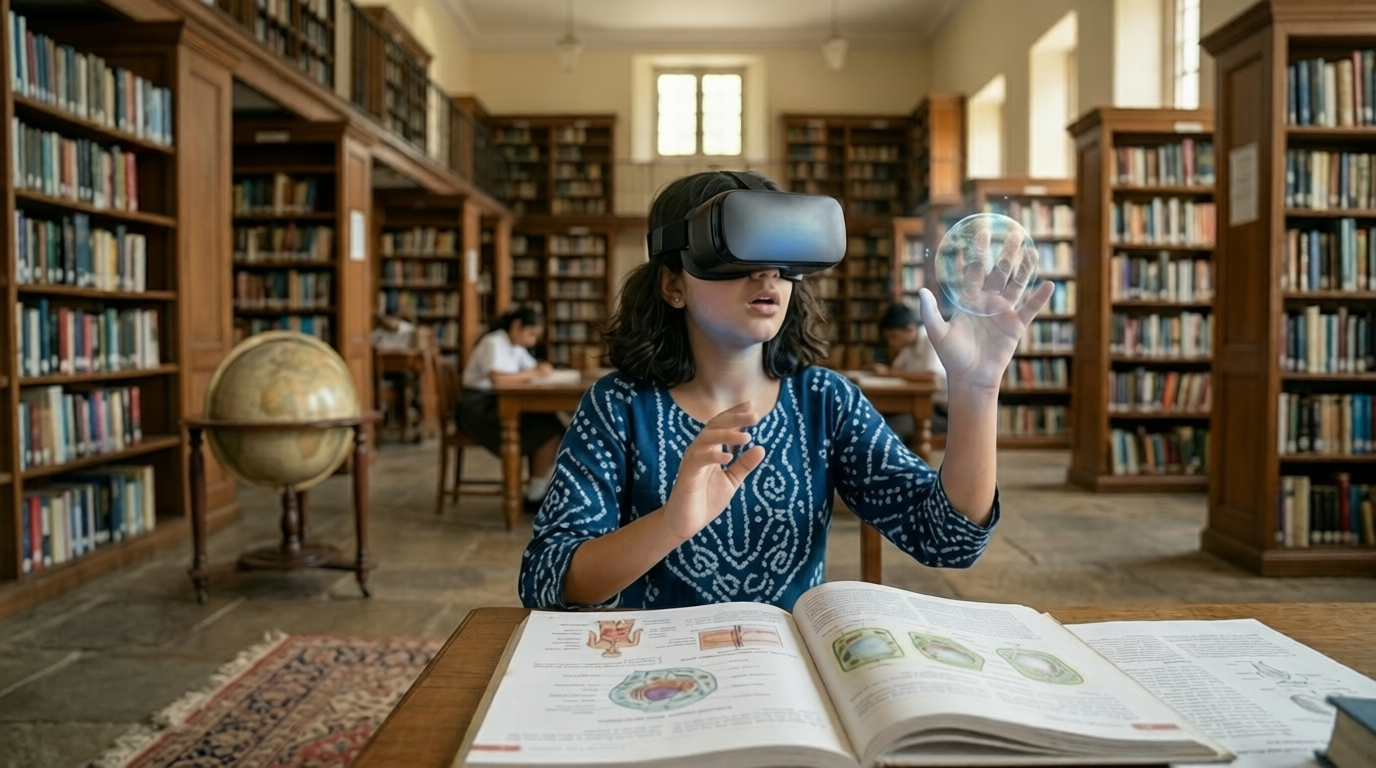
Imagine your child sitting at their desk, not just reading about the ruins of Hampi, but actually walking through them, examining the intricate carvings as if they were standing there. Picture them dissecting a human heart, watching the valves open and close in real-time, all within a safe, digital environment. This isn’t science fiction; it’s the emerging landscape of Virtual Reality (VR) in education.
According to a 2024 report by Precedence Research, the global AR and VR in education market is projected to reach over USD 14 billion by 2030, driven significantly by adoption in regions like India. Following the guidelines of the National Education Policy (NEP) 2020, which strongly advocates for experiential learning and technological integration, progressive schools across India are beginning to move beyond passive lecture-based teaching. But as this technology moves from a luxury exhibit to a possible classroom standard, a crucial question arises for Indian parents: Is VR a genuine tool for enhancing deep learning, or just a sophisticated gimmick that adds to the burden of school fees?
How VR Transforms Learning: Making the Abstract Concrete
The primary strength of VR lies in its ability to make abstract concepts tangible. For subjects that require visualization, such as geometry, molecular biology, or astrophysics, textbooks and 2D diagrams often fall short.
When a student struggles to understand the structure of an atom, VR allows them to zoom inside, seeing the electrons orbit the nucleus. In history, abstract dates and events transform into immersive stories. A lesson on the freedom struggle doesn’t just involve memorizing facts; it can include a virtual walk through the Jallianwala Bagh as it was in 1919, creating a powerful emotional connection that aids retention. This shift from passive consumption of data to active, experiential participation is what makes VR so potent.
Furthermore, VR addresses different learning styles. Visual and kinesthetic learners, who often struggle with traditional audial lectures, excel when given a spatial environment to explore. For parents comparing schools on DextroCampus (dextrocampus.com), checking if an institution effectively integrates tools like VR can provide insight into its commitment to modern, inclusive pedagogy.
Bridging the Gap with Critical Skills
This focus on visualization and immersive problem-solving is crucial for building future-ready skills. It trains students not just to memorize solutions, but to explore and innovate within a spatial context, a skill highly valued in fields like engineering, medicine, and architecture.
For students who have been sparked by the immersive possibilities in the classroom but want structured, guided online learning to excel academically, DX Coaching (dx-coaching.web.app) offers quality curated courses designed to help Indian students build real academic skills, solidifying the conceptual understanding built through technologies like VR.
Addressing the Anxiety: Cost and Content in India
Despite the benefits, the adoption of VR in Indian schools isn't without significant challenges. The most immediate anxiety for parents is cost. Standalone VR headsets, while decreasing in price, still represent a massive investment for schools. This leads to concerns about equity: Will VR only benefit children in elite private schools, further widening the educational divide? While low-cost options like Google Cardboard (using a smartphone) exist, they offer a less immersive and often lower-quality experience.
Another hurdle is curriculum-aligned content. Having the hardware is one thing; having a library of high-quality, culturally relevant, and curriculum-mapped educational VR experiences in multiple Indian languages is another. Currently, much of the content is English-centric and developed internationally, which might not align with specific school board requirements.
The Parent’s New Roadmap: Navigating the Shift
As a parent, you don't need to be a tech expert, but you do need to be a discerning guide. The goal isn’t simply to get technology into the classroom, but to ensure it is used effectively.
When evaluating a school's technological facilities, ask specific questions. How many headsets are available? What subjects are they used for? Are the VR lessons integrated into the weekly timetable or just used for demo days? A school that uses dextrocampus.com to showcase a balanced integration of both advanced technology and solid pedagogical practices is likely a better bet than one that uses tech only as a marketing tool.
The Balanced Future
Virtual Reality in education is at a critical inflection point in India. While the current adoption is fragmented, the direction is clear. The key will be to manage the integration thoughtfully, ensuring technological exposure doesn't lead to isolation, physical strain, or a wider equity gap. By focusing on purposeful, pedagogically sound usage, Indian educators can use VR to empower students, making quality education more effective, engaging, and genuinely immersive.
At DextroCampus, we help you connect with the institutions making these thoughtful transitions, ensuring your child receives the best of both traditional wisdom and modern innovation.
Tags:
Get Weekly Insights
Join 10k+ parents getting smarter about education.