
Private School vs International School: What Is the Real Difference in 2027?
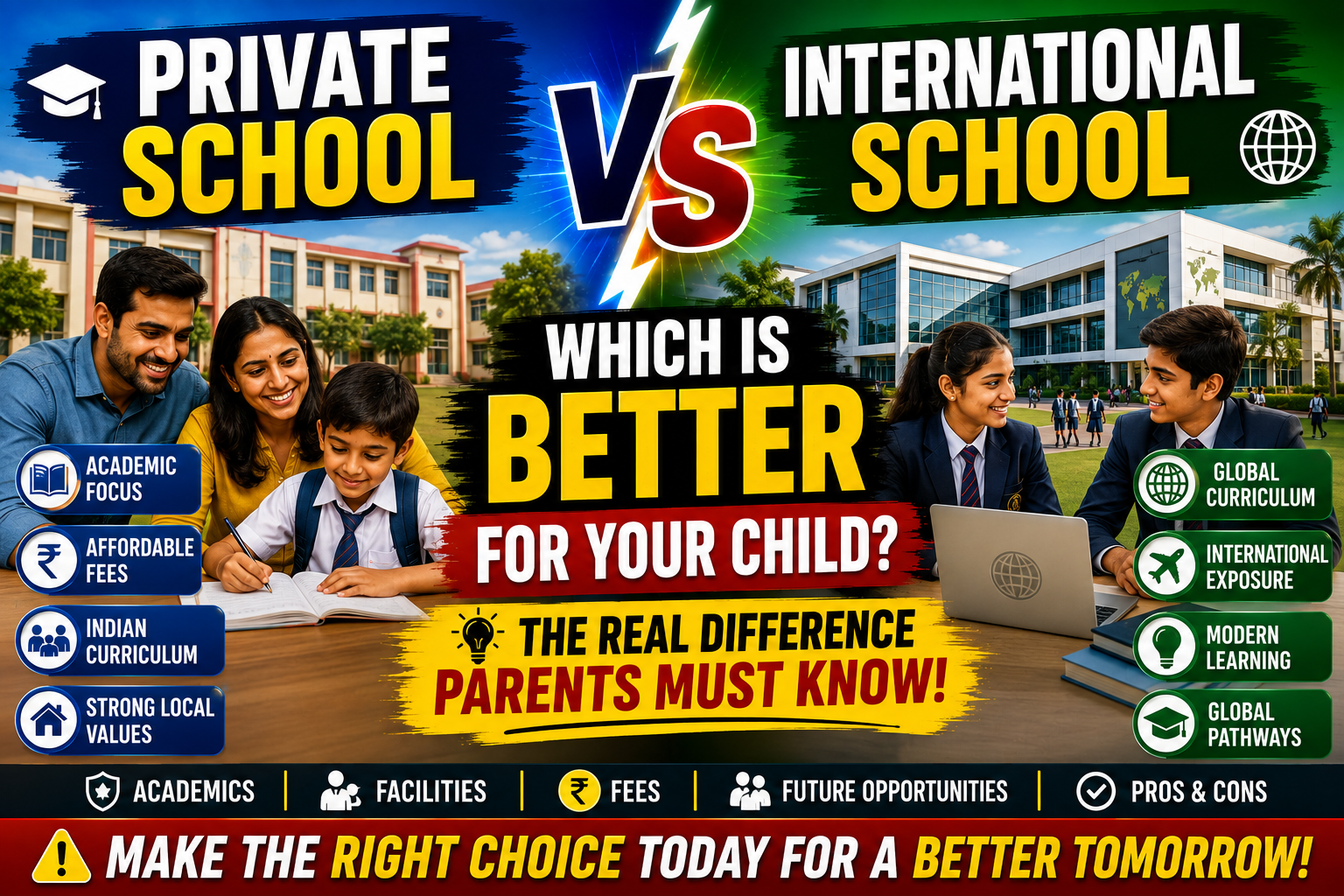
For many Indian parents, the words “private school” and “international school” create an immediate impression.
Private school may sound practical, affordable and academically focused.
International school may sound premium, global and future-oriented.
But there is an important distinction parents should understand:
“Private” and “international” do not describe exactly the same thing.
A private school is generally a school operated by a non-government entity such as a trust, society or other eligible organisation.
An international school may use an international curriculum or provide an international educational framework.
For example, Cambridge International offers programmes from early years through advanced levels and says its curriculum can be adapted to local contexts; schools may also combine Cambridge with national curricula.
Similarly, the IB offers programmes such as the Primary Years Programme, which uses an inquiry-based, transdisciplinary and student-centred framework.
This means parents should not make the decision based only on the school's name.
The better question is:
“What curriculum is actually being delivered, how well is it taught, and does it fit my child's future?”
This guide explains the real difference for families comparing schools in Mumbai, Thane, Vasai, Virar, Mira Road, Bhayandar, Nalasopara, Naigaon, Palghar and across Maharashtra.
What Is a Private School?
A private school is generally operated by a non-government organisation rather than being directly run as a government school.
In India, private schools can follow different educational boards or curricula.
Depending on the school, this may include:
- CBSE
- CISCE/ICSE
- Maharashtra State Board
- IB
- Cambridge
- Other recognised curricula
Therefore:
Private school does not automatically mean CBSE.
And:
Private school does not automatically mean traditional education.
The school must be evaluated individually.
For example, CBSE's current affiliation framework includes schools established by eligible entities such as registered societies and other organisations. CBSE also maintains an official directory through SARAS where parents can check affiliation status.
What Is an International School?
The term international school can be used in different ways.
A school may call itself international because it offers:
- IB programmes
- Cambridge programmes
- IGCSE
- International qualifications
- A globally oriented curriculum
- International teaching approaches
- International student opportunities
But parents should never assume that the word “International” by itself proves that a school follows IB or Cambridge.
The curriculum and affiliation/authorisation should be verified directly.
Cambridge, for example, provides a structured pathway from ages 3 to 19 and offers a broad range of subjects.
The IB operates multiple programmes in India, including PYP, MYP, DP and IB Career-related Programme.
So parents should ask:
“Which international curriculum or qualification does your school actually offer?”
That one question can eliminate a lot of confusion.
The Most Important Difference: School Type vs Curriculum
This is the key concept.
| Term & What It Primarily Tells Parents | |
| Private school | Who operates the school |
| Government school | Government-run educational institution |
| CBSE school | School affiliated with CBSE |
| ICSE school | School associated with CISCE's ICSE pathway |
| IB school | School authorised to offer one or more IB programmes |
| Cambridge school | School offering Cambridge programmes/qualifications |
| International school | A term that can indicate international curriculum or orientation; must be verified |
Therefore, comparing:
Private vs International
is not always an apples-to-apples comparison.
A school can potentially be:
Private + International.
For example, a privately operated school may offer Cambridge or IB.
This is why parents should compare the actual curriculum and educational model, not just the marketing category.
Private School vs International School: Key Comparison
| Curriculum | CBSE, ICSE, State Board or other | IB, Cambridge or another international curriculum |
| Ownership | Usually non-government | Often privately operated, but verify |
| Academic structure | Depends on board | Depends on programme |
| Teaching approach | Varies significantly | Often designed around the specific international framework |
| Fees | Wide range | Often higher, but varies |
| Facilities | Varies | Often positioned as premium, but must be verified |
| English exposure | Depends on school | Often strong, depending on programme |
| Global exposure | Depends on school | May be more prominent |
| Indian curriculum alignment | Depends on board | Depends on programme and school |
| University pathway | Indian and/or global | Indian and international options |
| Class size | Varies | Varies |
| Best fit | Depends on child and goals | Depends on child and goals |
Important: These are general patterns, not guarantees.
A high-quality private CBSE school may be a much better choice for a particular child than a poorly managed international school.
Does “International” Mean Better?
No.
This is one of the biggest mistakes parents make.
An international curriculum can offer a different educational experience, but the word “international” does not automatically guarantee:
- Better teachers
- Better learning outcomes
- Better discipline
- Better student support
- Better university admissions
- Better facilities
The actual school matters.
Parents should ask:
Who teaches the child?
How large are the classes?
How is learning assessed?
What happens when a child struggles?
What opportunities are actually available?
These questions are more useful than simply looking at the school's branding.
What Does a CBSE Private School Offer?
CBSE is a national school board with a very large network across India.
CBSE states that its curriculum aims to support physical, intellectual and social development and that its affiliated schools operate within board and government requirements.
A private CBSE school may therefore be a strong option for families who value:
- A familiar Indian curriculum
- National mobility
- Structured academic progression
- CBSE assessment systems
- Access to a broad school network
- A pathway that can work well for families who relocate within India
CBSE's national reach can be particularly useful for families with transferable jobs or those who may move between Indian cities.
What Does an International Curriculum Offer?
International curricula can have different educational philosophies.
For example, Cambridge describes its curriculum as flexible, international in approach and adaptable to local contexts.
Cambridge also offers different stages, including:
- Cambridge Early Years
- Cambridge Primary
- Cambridge Lower Secondary
- Cambridge Upper Secondary
- Cambridge Advanced
The IB's Primary Years Programme, meanwhile, is inquiry-based, transdisciplinary and student-centred.
Therefore, parents should investigate the specific curriculum, not simply the word “international.”
Private School vs International School: Teaching Style
One potential difference is educational approach.
A conventional Indian curriculum may place considerable emphasis on:
- Subject knowledge
- Structured lessons
- Written assessments
- Examination preparation
- Syllabus progression
International programmes may place greater emphasis, depending on the programme, on:
- Inquiry
- Conceptual understanding
- Research
- Projects
- Application
- Reflection
- Cross-disciplinary learning
But there is overlap.
A modern CBSE school can also use projects and activity-based learning.
An international school can also have rigorous examinations.
Therefore, parents should observe actual classrooms rather than relying on stereotypes.
Fees: Where the Difference Can Become Significant
International schools can have substantially higher total costs than many private schools.
But parents should not assume every international school is expensive or every private school is affordable.
The total cost may include:
- Tuition
- Admission charges
- Development charges
- Transport
- Meals
- Activities
- Technology
- Trips
- Books
- Uniform
- Examination fees
- Residential charges, where applicable
For international programmes, parents should additionally ask whether there are curriculum-specific examination or programme-related costs.
Parents should verify the current complete fee structure directly with the school management.
Never make a decision using only the advertised tuition fee.
Private School vs International School: Which Is Better for Different Children?
A Private Indian-Curriculum School May Suit Your Child If...
- You want a strong Indian academic pathway.
- Your family may relocate within India.
- Your child prefers structured academic learning.
- You are planning an Indian higher-education pathway.
- You want a wider range of fee options.
- You value a familiar board such as CBSE, ICSE or State Board.
- You want strong academic continuity within India.
An International-Curriculum School May Be Worth Considering If...
- Your family values an international curriculum.
- Your child enjoys inquiry and project-based learning.
- You may consider international university options.
- Your family may relocate internationally.
- You want broader global exposure.
- The specific programme matches your child's learning style.
- The long-term cost is comfortable for your family.
These are decision indicators—not automatic recommendations.
Indian University Plans vs International University Plans
This is an important consideration.
Parents should not assume that an international curriculum prevents students from studying in India.
For example, Cambridge states that Cambridge IGCSE and A Level qualifications are recognised for progression in India, subject to the relevant equivalence and institutional requirements.
At the same time, parents considering international universities should understand:
- Curriculum requirements
- Subject prerequisites
- Qualification requirements
- University-specific admission policies
- English-language requirements where applicable
The safest approach is to check the requirements of the actual universities and courses your child may eventually target.
Global Exposure: What Does It Really Mean?
“Global exposure” can be one of the most overused school-marketing phrases.
Parents should ask for evidence.
Does the school provide:
- International collaborations?
- Exchange opportunities?
- International competitions?
- Global projects?
- Foreign-language learning?
- International curriculum?
- Cross-cultural activities?
- Opportunities to interact with students from other countries?
Do not assume that a school has meaningful global exposure simply because it uses the word “International” in its name.
Facilities: Do Not Pay for Facilities Your Child Will Not Use
International schools may showcase:
- Modern laboratories
- Sports facilities
- Performing arts spaces
- Technology labs
- Libraries
- Design studios
- Swimming pools
These can be valuable.
But parents should ask:
How frequently will my child use them?
Also ask:
- Is the facility available to every student?
- How many students share it?
- Are specialist teachers available?
- Is it included in the fee?
- Are additional charges involved?
A facility is valuable only when it contributes meaningfully to the child's education.
Class Size and Teacher Attention
Parents should never assume:
International school = small class
or
Private school = large class.
Both assumptions can be wrong.
Ask every school:
- How many students are in each class?
- How many sections are there?
- How frequently do teachers provide individual feedback?
- What happens when a student falls behind?
- How are advanced learners supported?
Teacher quality and student support often matter more than the category of the school.
Private School vs International School: Decision Matrix
| Parent & Priority What to Consider | |
| Indian curriculum | CBSE, ICSE or State Board options |
| International curriculum | IB, Cambridge or another verified programme |
| Indian university pathway | Check board and course requirements |
| International university pathway | Check qualification recognition and university requirements |
| Affordability | Compare complete annual cost |
| Global exposure | Ask for actual programmes |
| Strong academics | Evaluate teaching and assessment |
| Project-based learning | Observe classroom practice |
| Family relocation | Consider curriculum portability |
| Child's learning style | Match teaching approach to the child |
| Smaller classes | Verify actual class size |
| Facilities | Check real student access |
12 Questions to Ask an International School
Before admission, ask:
- Which curriculum do you actually offer?
- Which organisation authorises or accredits the programme?
- Which grades follow that curriculum?
- What qualification will my child receive?
- How are assessments conducted?
- What are the total annual fees?
- Are there additional programme or examination charges?
- How large are the classes?
- What happens if my child changes schools later?
- How does the curriculum support Indian university admissions?
- What international opportunities are actually available to students?
- Can I speak with current parents about their experience?
10 Questions to Ask a Private School
- Which board is the school affiliated with?
- Can I verify the affiliation independently?
- What is the class size?
- What teaching methods are used?
- How are learning gaps identified?
- What extracurricular activities are available?
- How much English is used in teaching?
- What academic support is available?
- What is the complete fee structure?
- How does the school prepare students for higher education?
For CBSE schools, parents can use the official CBSE school directory to check affiliation status rather than relying only on promotional material.
Red Flags Parents Should Watch For
Be cautious if a school:
- Uses “International” prominently but cannot clearly identify its curriculum.
- Makes vague claims about foreign university admissions.
- Does not provide a transparent fee structure.
- Cannot explain class size.
- Cannot explain teacher qualifications or support.
- Promises guaranteed academic or career outcomes.
- Shows impressive facilities but cannot explain student access.
- Makes global exposure claims without specific programmes.
- Avoids providing affiliation or authorisation details.
Parents should verify important claims directly with the school management or official authority.
A 100-Point Parent School Scorecard
| Factor | |
| Teaching quality | 20 |
| Curriculum fit | 15 |
| Learning outcomes | 15 |
| Student support | 10 |
| Safety and wellbeing | 10 |
| Child's learning style | 10 |
| Fees and affordability | 5 |
| Facilities | 5 |
| Future education pathway | 5 |
| Commute and practicality | 5 |
| Total | 100 |
This is a parent decision-making framework, not an official school rating.
Notice that “international” is not automatically given extra points.
Why?
Because the curriculum must be judged by whether it is right for the child.
Common Mistakes Parents Make
Mistake 1: Assuming International Means Better
The curriculum may be different, but “different” does not automatically mean “better.”
Mistake 2: Comparing Only Fees
A cheaper school can offer excellent value.
A more expensive school may offer facilities that your child barely uses.
Mistake 3: Choosing Based on School Name
“International” can be part of a school's name without telling you enough about its actual curriculum.
Mistake 4: Ignoring Future Plans
The right curriculum depends partly on whether your child is likely to study in India, abroad or both.
Mistake 5: Ignoring the Child
A curriculum should fit the learner.
How Parents Should Make the Final Decision
Step 1: Define the Family Goal
Ask:
- Indian university?
- International university?
- Frequent relocation?
- Strong academic structure?
- Inquiry-based learning?
- Budget-conscious education?
Step 2: Identify the Actual Curriculum
Do not stop at “private” or “international.”
Find out:
CBSE? ICSE? State Board? IB? Cambridge?
Step 3: Compare the Classroom
Observe:
- Teacher interaction
- Student participation
- Learning environment
- Assessment
- Class size
Step 4: Compare Total Cost
Calculate the complete annual cost.
Step 5: Check the Future Pathway
Ask whether the curriculum aligns with the likely next stage.
Step 6: Include the Child
Consider:
- Personality
- Learning style
- Interests
- Confidence
- Academic needs
What Parents in Maharashtra Should Consider
For families in Mumbai, Thane, Vasai, Virar, Mira Road, Bhayandar, Nalasopara, Naigaon and Palghar, location can significantly influence the practical value of a school.
Parents should consider:
- Daily commute
- Transport availability
- School timings
- Activity schedules
- Total annual cost
- Future school changes
- Family routine
A globally oriented school that requires an exhausting daily commute may not be the best choice for a young child.
Likewise, a nearby private school may provide excellent teaching and a much more sustainable routine.
Convenience should not replace quality—but quality must also be practical for the family.
Frequently Asked Questions
1. Is an international school better than a private school?
Not automatically. “Private” describes the school's operating structure, while “international” generally relates to curriculum or educational orientation. A private school can offer an international curriculum, so parents should compare the actual curriculum, teaching quality, fees and future pathway.
2. Are international schools more expensive?
They can be, but there is no universal fee level. Parents should compare the complete annual cost, including tuition, transport, activities, examinations and any curriculum-specific charges.
3. Can a private school offer an international curriculum?
Yes. A privately operated school can offer programmes such as Cambridge or IB if it has the appropriate authorisation and programme arrangements. Parents should verify the exact curriculum directly with the school and relevant organisation.
4. Is CBSE better than IB or Cambridge?
There is no universal winner. CBSE may suit families seeking a strong Indian curriculum and portability within India, while IB or Cambridge may suit families seeking particular international curricula or pathways. The child's learning style and future plans should guide the decision.
5. Do international schools guarantee admission to foreign universities?
No school should be treated as guaranteeing university admission. International curricula may provide qualifications recognised by universities, but admissions depend on the university, programme, student profile and applicable requirements.
6. How can parents verify whether a school is genuinely affiliated with a board?
Parents should use the relevant official authority. For CBSE schools, the official SARAS directory provides school affiliation information. For international programmes, parents should verify the school's status through the relevant programme organisation.
Conclusion & Parent Checklist
The biggest lesson from the private school vs international school comparison is simple:
Do not compare labels. Compare educational models.
A private school may offer:
- CBSE
- ICSE
- State Board
- International programmes
An international school may offer:
- IB
- Cambridge
- IGCSE
- Another international curriculum
Therefore, the real decision is not:
“Private or International?”
It is:
“Which curriculum, teaching approach and school environment are right for my child?”
Parent Checklist
- Identify the exact curriculum.
- Verify board or programme affiliation.
- Compare teaching quality.
- Check actual class size.
- Observe classroom teaching.
- Compare the complete fee structure.
- Check student support systems.
- Evaluate facilities based on actual student access.
- Investigate genuine international exposure.
- Consider Indian and international university pathways.
- Assess your child's learning style.
- Consider daily commute.
- Talk to current parents where possible.
- Visit the school personally.
- Verify important claims directly with the school or relevant official authority.
Expert Takeaway
An international school is not automatically a better school.
A private school is not automatically a traditional school.
The strongest choice is the school whose curriculum, teaching quality, student support, cost, environment and future pathway match your child's needs.
For parents in Maharashtra and across India, the smartest approach is to look beyond the school name and ask one decisive question:
“What exactly will my child learn here, how will they learn it, and where will this education take them next?”
Tags:
Get Weekly Insights
Join 10k+ parents getting smarter about education.