First School for Your Child: Preschool or Big School?
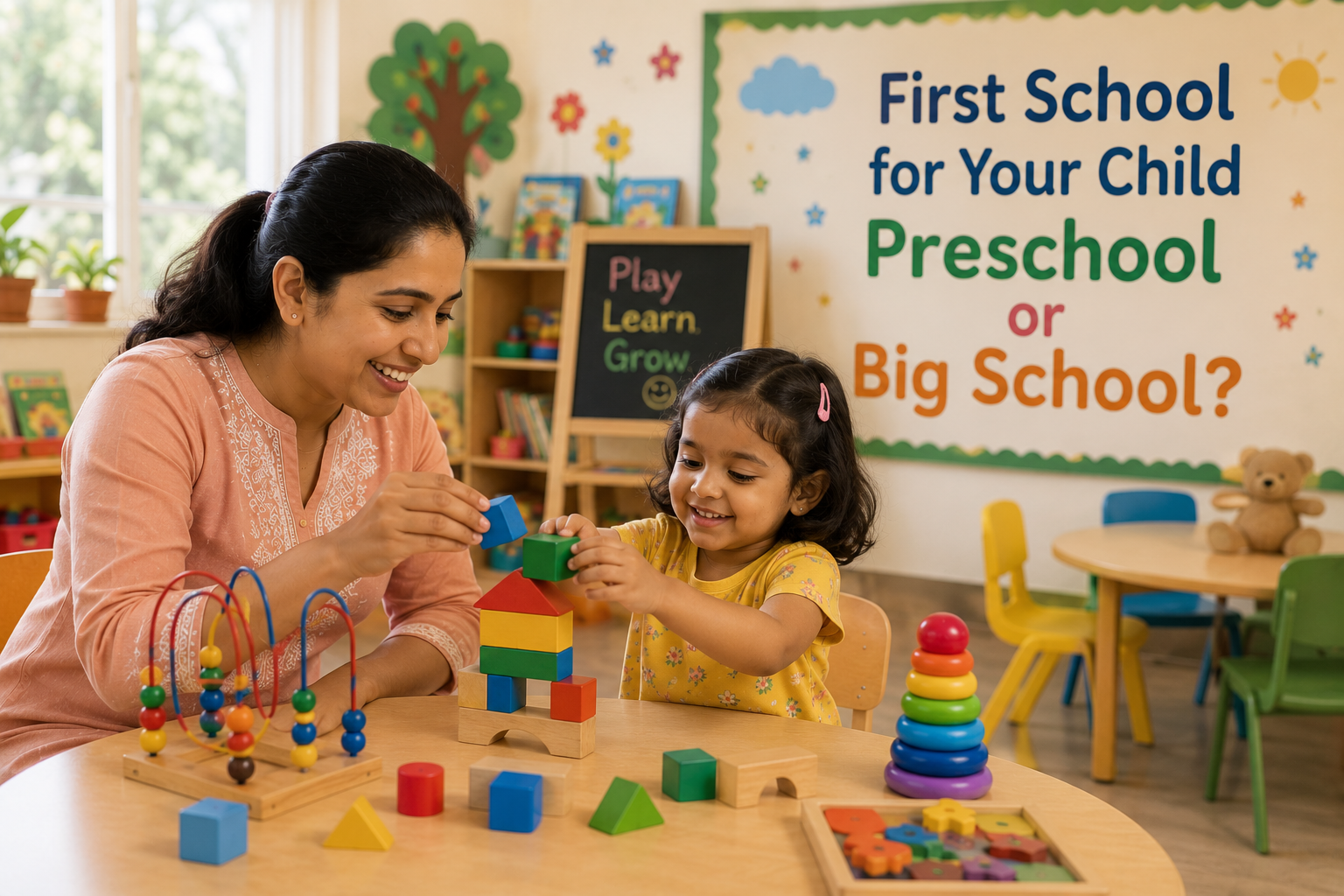
First School for Your Child: Preschool or Big School?
Choosing your child's first school is a decision many parents find surprisingly difficult. Should you choose a preschool that focuses primarily on the early years, or start directly with a larger school that offers Nursery, KG and possibly primary and secondary classes?
There is no universally better option.
For some families, a dedicated preschool may provide a smaller, more focused early-learning environment. For others, starting in a larger school may offer continuity, familiar routines and a longer-term school pathway.
The right decision depends on your child's needs, your family's priorities, location, budget, commute and the actual school environment.
Quick Answer: Preschool or Big School?
Choose based on fit rather than school size.
A preschool may be worth considering if you prioritise:
- A focused early-childhood environment
- Smaller-scale surroundings
- A preschool-specific routine
- A shorter or more flexible programme, where offered
A larger school may be worth considering if you prioritise:
- Continuity from Nursery/KG into higher classes
- A single school campus for multiple stages
- Easier long-term planning
- A broader range of activities or facilities, where genuinely available
But these are general characteristics, not guarantees.
A large school can have an excellent early-years programme, while a preschool can provide an excellent learning environment. Parents should evaluate the actual institution rather than choosing based only on its category.
What Is the Difference Between a Preschool and a Big School?
The biggest difference is usually the range and structure of education offered.
Preschool
A preschool generally focuses on younger children and early childhood education.
Depending on the institution, it may offer:
- Nursery
- Junior KG
- Senior KG
- Other preschool programmes
Big School
For this article, "big school" means a school that generally serves children across several grades, potentially from the early years through primary, secondary or higher levels.
It may offer:
- Nursery or kindergarten
- Primary grades
- Secondary grades
- Higher secondary education, depending on the institution
However, schools differ significantly, so parents should check the actual classes offered.
Preschool vs Big School: At-a-Glance Comparison
| Factor | ||
| Primary focus | Early childhood | Multiple school stages |
| Age group | Usually younger children | May cover many age groups |
| Environment | Often centred around early years | Shared with older students in many cases |
| Long-term continuity | May require a later school transition | May offer continuity across grades |
| School size | Can be smaller, but varies | Often larger, but varies |
| Facilities | Depends on institution | May offer broader facilities, but varies |
| Commute | Depends on location | Depends on location |
| Fees | Vary widely | Vary widely |
| Admission transition later | May be required | May be reduced if the school offers later grades |
| Best for | Depends on child's and family's needs | Depends on child's and family's needs |
The table should be treated as a starting point, not a quality ranking.
1. Consider Your Child's Age and Development
The first question should not be:
"Which school has the better building?"
Ask:
"What kind of environment will help my child adjust and learn comfortably?"
A young child may be entering a structured school environment for the first time.
Consider whether your child is:
- Comfortable in groups
- Used to spending time away from parents
- Able to communicate basic needs
- Becoming comfortable with routines
- Interested in interacting with other children
- Ready for age-appropriate classroom activities
If your child needs a particularly gradual transition, investigate how each school supports new children.
2. Look at the Early-Years Environment
Don't assume that a large school has a better Nursery programme simply because it has more facilities.
During a visit, focus specifically on the early-years classrooms.
Look for:
- Age-appropriate furniture
- Accessible learning materials
- Safe movement areas
- Books and toys
- Opportunities for creative activities
- Comfortable interaction between teachers and children
- Clear supervision
Ask what a typical Nursery or KG day looks like.
The environment experienced by your 3- or 4-year-old matters much more than facilities designed primarily for older students.
3. Consider the Teacher-Child Relationship
For a young child, teachers can have a major influence on how comfortable school feels.
During your visit, observe:
- How teachers speak to children
- Whether children approach teachers comfortably
- Whether teachers listen to children
- How teachers handle mistakes
- How children are encouraged to participate
Ask how the school helps children who are:
- Shy
- New to school
- Missing their parents
- Uncomfortable in groups
- Slow to settle into routines
This information can be more useful than a long list of facilities.
4. Preschool May Offer a More Focused Early-Years Setting
A dedicated preschool is designed around young children.
This can make it easier for the entire environment to focus on:
- Play
- Stories
- Art
- Music
- Movement
- Social interaction
- Early communication
- Age-appropriate routines
However, parents should not automatically assume that every preschool provides these things well.
Ask what actually happens during the school day.
A good question is:
"Can you walk me through a typical day for a Nursery child?"
5. A Big School May Offer Longer-Term Continuity
One potential advantage of starting in a larger school is continuity.
If the school offers Nursery, KG and later grades, your child may be able to remain within the same school system for several years.
This can mean:
- Fewer school changes
- Familiarity with the campus
- Familiarity with school procedures
- Existing relationships with teachers and staff
- Easier long-term planning for parents
But parents should not assume that admission into Nursery automatically guarantees admission into every future grade.
Ask the school how progression works.
6. Consider the Future School Transition
If you choose a preschool that ends after Senior KG, your child may need to apply to another school for Class 1.
That is not necessarily a disadvantage.
A later transition can give parents another opportunity to choose a school based on the child's development and changing needs.
However, it does mean parents need to plan ahead.
Ask yourself:
- Am I comfortable managing another admission process?
- Will I want my child to change schools later?
- How competitive is the next-stage admission environment?
- Will the new school be close to home?
- Will my child find another transition difficult?
There is no universally correct answer.
7. Compare the Commute
For young children, daily travel deserves serious consideration.
A school that is farther away may create:
- Earlier wake-up times
- Longer travel
- More time spent in traffic
- Less time for rest and play
Compare the actual morning and afternoon travel time, not just the distance.
If two schools are similar in quality, the more practical commute may be a significant advantage.
8. Don't Assume Bigger Means Better
A larger school may have:
- More classrooms
- Larger grounds
- More facilities
- More grades
- More activities
But none of these automatically means that the early-years experience will be better.
Likewise, a smaller preschool may have fewer facilities but provide a comfortable environment that suits your child.
The useful question is:
"Which facilities and resources will my child actually use?"
9. Compare the Daily Routine
Ask both types of schools about the child's actual daily schedule.
Find out about:
- Arrival
- Circle or group activities
- Stories
- Art
- Play
- Outdoor time
- Meals or snack breaks
- Rest or quiet periods
- Pickup
A young child generally benefits from a routine that balances structured activities with opportunities for movement and play.
Don't choose a school based solely on how many academic activities appear on the timetable.
10. Look at School Safety
Safety should be evaluated regardless of school size.
Ask about:
- Entry and exit
- Child pickup
- Visitor access
- Emergency procedures
- Supervision
- Handover procedures
- Transport arrangements
A large campus may have more complex movement and access arrangements.
A smaller preschool may have a simpler physical environment.
Neither should be assumed to be safer without checking the actual arrangements.
11. Compare Parent Communication
Parents of young children often need regular communication with the school.
Ask how the school communicates:
- Important notices
- Events
- Schedule changes
- Child-related concerns
- Parent meetings
- Attendance information
- Other updates
Possible methods include:
- Parent apps
- Portals
- Phone
- Printed notices
The technology itself is less important than whether communication is clear, timely and useful.
12. Consider Fees and the Total Cost
Don't compare schools based only on the monthly tuition amount.
Ask about the complete applicable cost, including any charges for:
- Admission
- Tuition
- Annual expenses
- Activities
- Books
- Uniform
- Transport
- Meals, if offered
- Other school-specific services
The DextroCampus content plan includes separate articles addressing school fees and hidden school costs, so parents can use those as supporting resources when comparing options.
Always request the current fee structure from the school.
Do not assume that a fee quoted for one academic year remains unchanged for another.
13. Think About Your Family's Practical Needs
The best school for a child also needs to work for the family.
Consider:
- Parent work schedules
- School timings
- Transport
- Sibling schedules
- Distance
- Emergency pickup
- Holiday schedules
- Total cost
A school that is excellent but impossible to manage every day can create unnecessary stress for both parents and children.
14. Ask About Activities Beyond Academics
At the early-years stage, children can benefit from opportunities involving:
- Art
- Music
- Stories
- Movement
- Outdoor play
- Building
- Puzzles
- Group activities
- Creative exploration
Ask the school what children actually do rather than simply looking at a facilities list.
A school may advertise many activities but offer them differently from what parents expect.
15. Consider the Transition to Class 1
If your child starts in a preschool, ask what happens after Senior KG.
Some parents prefer to make the Class 1 decision later.
Others prefer a school where the child can continue through multiple grades.
Both approaches can work.
The important thing is to understand your preferred path before making the initial decision.
Preschool or Big School: Which Is Better?
There is no universal winner.
Preschool may suit families who want:
- A dedicated early-childhood environment
- A smaller or more focused setting, where available
- A school centred primarily on younger children
- Flexibility to reassess the Class 1 school later
A larger school may suit families who want:
- Longer-term continuity
- Fewer major school transitions
- Multiple school stages in one institution
- A single long-term school pathway
These are possibilities, not guarantees.
The quality of the individual school matters more than the label.
Questions to Ask a Preschool
Before admission, ask:
- What classes do you offer?
- What does a typical Nursery day look like?
- How are new children helped to settle?
- How do teachers communicate with parents?
- What are the school timings?
- What safety procedures are followed?
- Is transport available?
- What is the current fee structure?
- What happens after Senior KG?
- Will parents need to find another school for Class 1?
Questions to Ask a Big School
Ask:
- What is the early-years routine?
- How are Nursery and KG classrooms separated from older students where appropriate?
- How are young children supervised?
- What facilities are actually available to Nursery/KG students?
- What happens during pickup and dispersal?
- How does the school support new children?
- What are the transport arrangements?
- What is the current fee structure?
- How does progression to higher classes work?
- Does continuing into Class 1 require a separate admission process?
A Simple Decision Framework for Parents
Score each shortlisted school from 1 to 5 for:
| Factor | ||
| Child comfort | ||
| Teacher interaction | ||
| Safety | ||
| Daily routine | ||
| Commute | ||
| Parent communication | ||
| Total cost | ||
| Activities | ||
| Future continuity | ||
| Overall family fit |
The score is not a scientific ranking.
Its purpose is to help parents turn a vague decision into a structured comparison.
Common Mistakes Parents Make
Choosing based on reputation alone
A famous school may not be the right fit for your child.
Choosing based on the building
A large campus doesn't automatically mean better early-years education.
Ignoring the commute
Daily travel can affect the child's routine significantly.
Looking only at fees
The cheapest or most expensive school is not automatically the right choice.
Assuming continuity is always better
Staying in one school can be convenient, but a later school change can also be appropriate.
Comparing facilities instead of actual use
Ask whether Nursery children can actually use the facilities being advertised.
Making the decision before visiting
Whenever possible, see the environment and ask questions before confirming admission.
Frequently Asked Questions
Is preschool better than a big school for a 3-year-old?
Neither is automatically better. Parents should compare the actual early-years environment, teachers, safety, routine, commute, cost and child suitability.
Is it better to start in a school that goes up to Class 10 or 12?
It can provide continuity, but long-term continuity should not be the only selection criterion. The early-years experience remains especially important.
Will my child have to change schools after preschool?
It depends on the preschool. Some offer only early-years classes, while others may have a longer academic pathway. Ask what classes the institution offers.
Is a smaller preschool better for shy children?
Not necessarily. A smaller setting may feel comfortable for some children, but teacher quality and the school's approach to helping shy children settle are more important than size alone.
Does a big school have better facilities?
It may have a broader range of facilities, but availability does not guarantee that Nursery children will use them regularly. Ask what is actually available to your child's class.
Should I choose a school close to home?
A practical commute is important for a young child, but location should be considered alongside safety, teaching, environment and overall suitability.
Which option is easier for working parents?
There is no universal answer. Compare timings, transport, commute, holiday schedules, pickup procedures and total cost against your family's routine.
What should matter most when choosing the first school?
Focus on the child's comfort, safety, teacher interaction and learning environment first. Then consider practical factors such as commute, fees, transport and long-term continuity.
Final Takeaway
The choice between preschool and a big school is not about which category is better. It is about which environment is better suited to your child and family.
A dedicated preschool can offer a focused early-years setting, while a larger school can offer continuity across multiple grades. Both can be good choices.
Before deciding, visit the school where possible, observe the early-years environment, speak with staff, understand the daily routine and check the actual costs.
Most importantly, don't choose a school simply because it is famous, large or expensive.
Choose the environment where your child can feel safe, build confidence, enjoy learning and gradually become independent.
Last Updated: August 2026
Tags:
Get Weekly Insights
Join 10k+ parents getting smarter about education.