
How to Prepare Your Child for the First School Admission Meeting
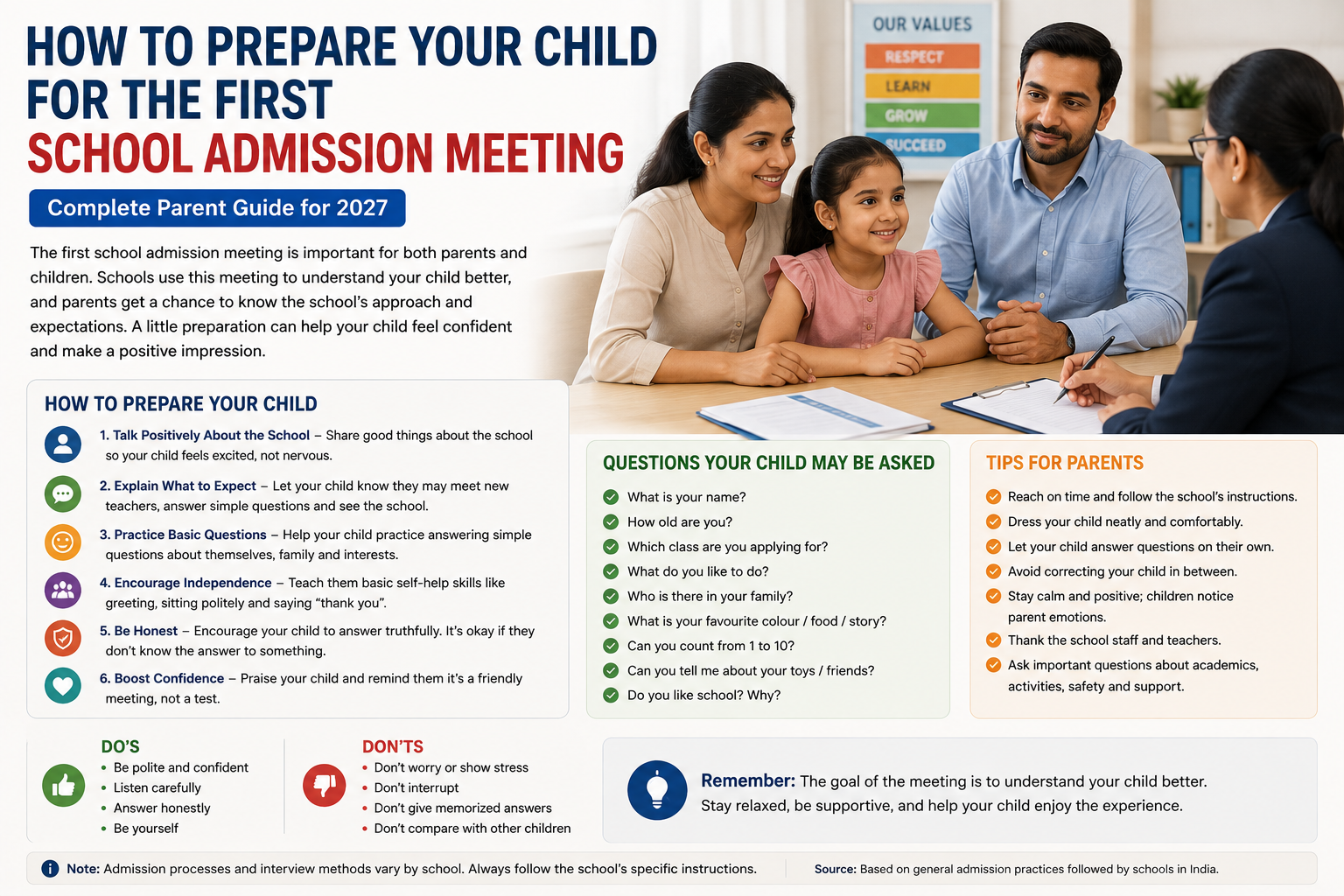
How to Prepare Your Child for the First School Admission Meeting
Last Updated: August 10, 2026
A first school admission meeting can feel exciting—and sometimes stressful—for both parents and children. The best preparation is usually not about teaching a child memorised answers. It is about helping the child understand what to expect, communicate naturally, feel comfortable meeting unfamiliar adults and answer simple questions honestly.
It is also important to remember that not every school conducts an admission interview or parent-child meeting. Admission procedures vary by school, class and circumstances. Parents should follow the school's specific instructions rather than assuming that every school uses the same format.
For applicable CBSE admissions, the official rules focus on eligibility and documentation requirements; they do not prescribe one universal interview format for every school.
Here is a practical guide for parents preparing their child for a first school admission meeting in 2027.
What Is a School Admission Meeting?
A school admission meeting can take different forms depending on the school.
It may involve:
- A conversation between parents and school staff
- A parent-child interaction
- A student interaction
- An academic assessment
- A school-readiness activity
- A meeting with a teacher or admissions team
- A combination of these
Some schools may not conduct an interview at all.
For this reason, parents should first ask the school:
"Could you please explain what will happen during the admission meeting?"
Knowing the format can prevent unnecessary preparation and anxiety.
The Main Goal: Help Your Child Feel Comfortable
The most useful preparation is confidence without pressure.
A child should understand:
- Where they are going
- Who they may meet
- That adults may ask questions
- That it is okay to take time before answering
- That they should speak honestly
- That they do not need to memorise a script
The meeting should not feel like a high-pressure examination.
For younger children especially, forcing repeated mock interviews can make an unfamiliar situation feel even more intimidating.
1. Talk Positively About the School
Start the conversation several days before the meeting.
Tell your child simple things such as:
- "We are going to visit a school."
- "You may meet a teacher."
- "They may ask you some questions."
- "You can tell them about things you like."
- "You can ask questions too."
Avoid saying:
- "You must impress them."
- "Don't make any mistakes."
- "If you don't answer, you won't get admission."
- "Other children are better prepared."
Children often notice parental anxiety.
A calm parent can make the experience feel much easier.
2. Explain What May Happen
Children are more comfortable when they know what to expect.
Explain that the meeting may include:
- Entering a new room
- Greeting a teacher
- Sitting with parents
- Answering simple questions
- Talking about interests
- Looking at books, pictures or activities
- Meeting other staff
- Leaving after the conversation
Do not tell your child that these things will definitely happen unless the school has confirmed them.
Use language such as:
"They may ask you..."
rather than:
"They will ask you..."
3. Practise Basic Questions Naturally
Parents can practise simple questions at home without turning the exercise into a formal interview.
For example:
- What is your name?
- How old are you?
- Which class are you applying for?
- Where do you live?
- Who is in your family?
- What do you like doing?
- What is your favourite story?
- What games do you enjoy?
- What do you like about your current school?
- What would you like to learn?
For younger children, questions may be even simpler.
The goal is conversation practice, not memorisation.
4. Encourage Your Child to Answer Independently
One common mistake parents make is answering every question for the child.
If the teacher asks:
"What is your favourite game?"
give your child an opportunity to answer.
Parents can help if the child genuinely does not understand the question, but they should avoid speaking over the child.
A natural answer is generally more useful than a rehearsed speech.
5. Teach Your Child to Say "I Don't Know"
Children sometimes believe they must answer every question.
Teach them that it is acceptable to say:
- "I don't know."
- "I'm not sure."
- "Can you please explain?"
- "I don't remember."
This is much better than encouraging a child to invent an answer.
The purpose of preparation should be to build confidence and honesty—not to teach children how to give artificial responses.
6. Practise Greeting and Basic Manners
Children can practise simple social behaviour before the meeting.
For example:
- Greeting the teacher
- Saying "please"
- Saying "thank you"
- Listening while someone is speaking
- Waiting for their turn
- Sitting comfortably
- Saying goodbye
Keep this simple.
There is no need to teach a child a complicated performance.
7. Build Independence Through Everyday Activities
Parents can help children become more comfortable in unfamiliar situations by giving them age-appropriate independence.
For example, encourage your child to:
- Introduce themselves
- Choose between simple options
- Pack a small bag
- Put away their belongings
- Ask for help when needed
- Speak directly to another adult
- Follow simple instructions
These are useful everyday skills regardless of whether the school conducts an admission meeting.
8. Help Your Child Talk About Their Interests
A child may naturally speak more confidently about something they enjoy.
Talk about:
- Favourite books
- Games
- Drawing
- Music
- Sports
- Animals
- Toys
- Friends
- Family activities
- Hobbies
You can ask open-ended questions such as:
"What do you like about drawing?"
rather than asking only questions that can be answered with "yes" or "no."
9. Don't Teach Memorised Answers
Memorised answers can make a child sound uncomfortable and can make the meeting more stressful.
Instead of teaching:
"My name is Aarav. My hobbies are reading, drawing and playing cricket."
help the child understand how to introduce themselves naturally.
For example:
Parent: "Tell me about yourself."
Child: "My name is Aarav. I like drawing and playing cricket."
That is enough.
The exact answer should reflect the child's real personality and interests.
10. Prepare Parents Too
The meeting may involve parents as much as the child.
Parents should be ready to discuss:
- Previous school or preschool
- Child's daily routine
- Learning habits
- Interests
- Strengths
- Areas where support may be useful
- School expectations
- Reason for choosing the school
- Questions about the school's approach
Do not exaggerate the child's abilities.
If the child struggles with something, explain it honestly and constructively.
The goal should be to find a suitable school environment, not simply to create a perfect picture.
Questions Parents May Be Asked
Depending on the school and class, parents may be asked questions such as:
About the Child
- What does your child enjoy doing?
- What are your child's interests?
- How does your child interact with other children?
- What does your child find difficult?
- What kind of support does your child need?
About Schooling
- Which school/preschool does the child currently attend?
- Why are you considering a change?
- What are you looking for in a school?
- How involved are you in your child's learning?
About Daily Routine
- What time does the child usually wake up?
- What does the child's study routine look like?
- How much screen time does the child typically have?
The exact questions vary, so parents should not assume that a particular list will be used.
Questions Your Child May Be Asked
For younger children, questions could include:
- What is your name?
- How old are you?
- What is your favourite colour?
- What is your favourite food?
- What do you like to play?
- Can you tell me about your family?
- What is your favourite story?
- Can you count?
- Can you identify basic shapes or colours?
- What do you like doing at school?
Again, these are examples for practice, not a guaranteed interview question list.
11. Read or Play Together Before the Meeting
Instead of spending hours on interview preparation, use normal activities to build communication.
Try:
- Reading a story together
- Drawing
- Building with blocks
- Playing a board game
- Talking about pictures
- Singing songs
- Counting objects
- Discussing everyday experiences
These activities encourage children to listen, communicate and explain their thinking.
12. Visit the School If Possible
If the school offers a campus visit or orientation before the meeting, use the opportunity.
A child may feel more comfortable when the building is no longer completely unfamiliar.
During a visit, parents can also observe:
- Classroom environment
- Teacher interaction
- Student behaviour
- Safety arrangements
- Cleanliness
- Activity spaces
- Parent communication
- General atmosphere
Recent parenting guidance on school selection similarly recommends looking beyond attractive infrastructure and asking about the child's actual daily learning environment, safety, teacher development and parent involvement.
13. Let Your Child Ask Questions
Admission meetings should not necessarily be one-way conversations.
Encourage your child to ask simple questions if appropriate.
For example:
- "Where is the playground?"
- "Do you have a library?"
- "What do we do in art class?"
- "When is lunch?"
Parents can also prepare their own questions about:
- Curriculum
- School timings
- Activities
- Transport
- Communication
- Student support
- Safety
- Fees
14. Prepare Documents the Night Before
If the school has requested documents, prepare them before the meeting.
The exact list depends on the school.
Possible documents may include:
- Admission application acknowledgement
- Birth certificate
- Previous-school records
- Report card
- Transfer Certificate, where applicable
- Photographs
- Address proof, where requested
- Other school-specific documents
For applicable CBSE admissions, official rules identify documents such as the School Leaving Certificate/Transfer Certificate, qualifying-examination records and date-of-birth proof.
Do not carry documents simply because an internet checklist says they are required. Follow the school's instructions.
15. Choose Comfortable Clothing
The child should look neat and feel comfortable.
Parents should avoid turning the meeting into a fashion exercise.
The priority should be:
- Clean
- Comfortable
- Appropriate
- Suitable for sitting and moving around
If the school has provided a dress instruction, follow it.
16. Plan the Journey
Arriving late can add unnecessary stress.
Before the meeting:
- Check the location
- Estimate travel time
- Allow extra time for traffic
- Check parking or entry instructions
- Keep the school's contact information available
- Carry the required documents
For families travelling across busy areas such as Vasai, Nalasopara, Naigaon, Virar, Mira Road or Bhayandar, building extra travel time into the plan can make the morning considerably calmer.
17. Avoid Last-Minute Cramming
The night before the meeting is not the time to teach your child dozens of new facts.
Avoid:
- Long mock interviews
- Repeated questioning
- Late-night study
- Threats about admission
- Comparing the child with friends
- Forcing memorised answers
Instead:
- Pack documents
- Prepare clothes
- Check the route
- Explain what to expect
- Let the child sleep properly
- Keep the atmosphere relaxed
18. What Parents Should Not Say
Avoid statements such as:
"You have to get selected."
"Don't say anything wrong."
"Your friend already knows all the answers."
"If you don't answer, we'll be very upset."
These statements can increase anxiety.
Instead say:
"Just be yourself and answer honestly."
"It's okay if you don't know something."
"We are going to meet the school and learn about it too."
19. What to Do If Your Child Becomes Shy
Shyness does not mean that preparation has failed.
If your child becomes quiet:
- Give them time
- Don't interrupt immediately
- Avoid answering every question
- Don't scold them
- Encourage them gently
- Let the teacher interact naturally
Some children take longer to become comfortable with unfamiliar adults.
Parents should avoid turning a moment of hesitation into a crisis.
20. What If Your Child Gives a Wrong Answer?
Stay calm.
A child may misunderstand a question, forget something or simply make a mistake.
Do not visibly panic or immediately correct every answer.
If clarification is necessary, the parent can politely help after the child has had an opportunity to respond.
The goal is not to produce flawless answers.
A Simple 7-Day Preparation Plan
7 Days Before
Explain the purpose of the meeting and talk positively about school.
6 Days Before
Practise basic conversation and introductions.
5 Days Before
Talk about the child's interests, hobbies and favourite activities.
4 Days Before
Review the school's instructions and prepare parent questions.
3 Days Before
If possible, visit or discuss the school environment with your child.
2 Days Before
Check documents, clothes, route and appointment details.
1 Day Before
Keep preparation light. Pack everything and let your child rest.
Meeting Day
Have breakfast, leave early and keep the conversation positive.
Parent Checklist
Before Leaving Home
- Admission appointment confirmed
- Application number available
- Required documents packed
- Child is comfortable and rested
- Appropriate clothes ready
- Route checked
- School contact details saved
- Parent questions prepared
During the Meeting
- Let the child answer independently
- Listen carefully
- Stay calm
- Answer parent questions honestly
- Ask important questions
- Follow school instructions
After the Meeting
- Note any next steps
- Save any communication
- Record deadlines
- Submit pending documents if requested
- Wait for official communication
Frequently Asked Questions
Does every school conduct an admission interview?
No. Admission procedures vary by school, class and circumstances. Parents should check the school's specific instructions.
How should I prepare my child for a school admission meeting?
Explain what to expect, practise simple conversation, encourage independent answers and keep preparation relaxed. Avoid forcing memorised responses.
What questions might a school ask a child?
Questions vary, but younger children may be asked about their name, age, family, interests, favourite activities or basic age-appropriate concepts. These are examples, not guaranteed questions.
Should I teach my child answers word-for-word?
No. Help your child understand the type of conversation they may have rather than memorising scripts.
What if my child is shy?
Give the child time to become comfortable. Avoid answering every question for them or scolding them for being quiet.
What should parents prepare for the meeting?
Parents should understand the school's instructions, know their child's educational background and be ready to discuss the child's interests, routine and learning needs.
Should parents ask questions during the meeting?
Yes, when the school provides an opportunity. Ask practical questions about academics, student support, activities, communication, safety and other matters important to your family.
What documents should I carry?
Carry only the documents the school has requested. Depending on the admission circumstances, these may include application records, birth-date proof, previous-school records and Transfer Certificate where applicable.
The Most Important Advice
The first school admission meeting should not become a performance competition.
Your child does not need to sound like an adult.
Your child does not need to memorise impressive answers.
Your child does not need to know everything.
What parents can do is create a calm environment where the child can communicate naturally.
Prepare the child, but don't script the child.
That distinction can make the entire experience more comfortable.
Conclusion
Preparing for a first school admission meeting is mainly about confidence, communication and familiarity.
Parents should understand the school's process, explain what their child may experience, practise simple conversations, encourage independence and prepare the required documents. At the same time, they should avoid excessive pressure, memorised answers and comparisons with other children.
Most importantly, remember that admission processes differ between schools. A meeting may be a parent interaction, student interaction, assessment or something else entirely—or there may be no interview at all.
For school admission 2027, check the school's latest official instructions before preparing your child, and treat the meeting as an opportunity for both sides to understand whether the school and child are a suitable fit.
Source note: Specific admission requirements should always be verified with the concerned school. CBSE's official admission rules establish applicable eligibility and documentation requirements but do not prescribe one universal school-admission interview format.
Tags:
Get Weekly Insights
Join 10k+ parents getting smarter about education.