
How to Prepare Your Child for Class 1 Admission 2027
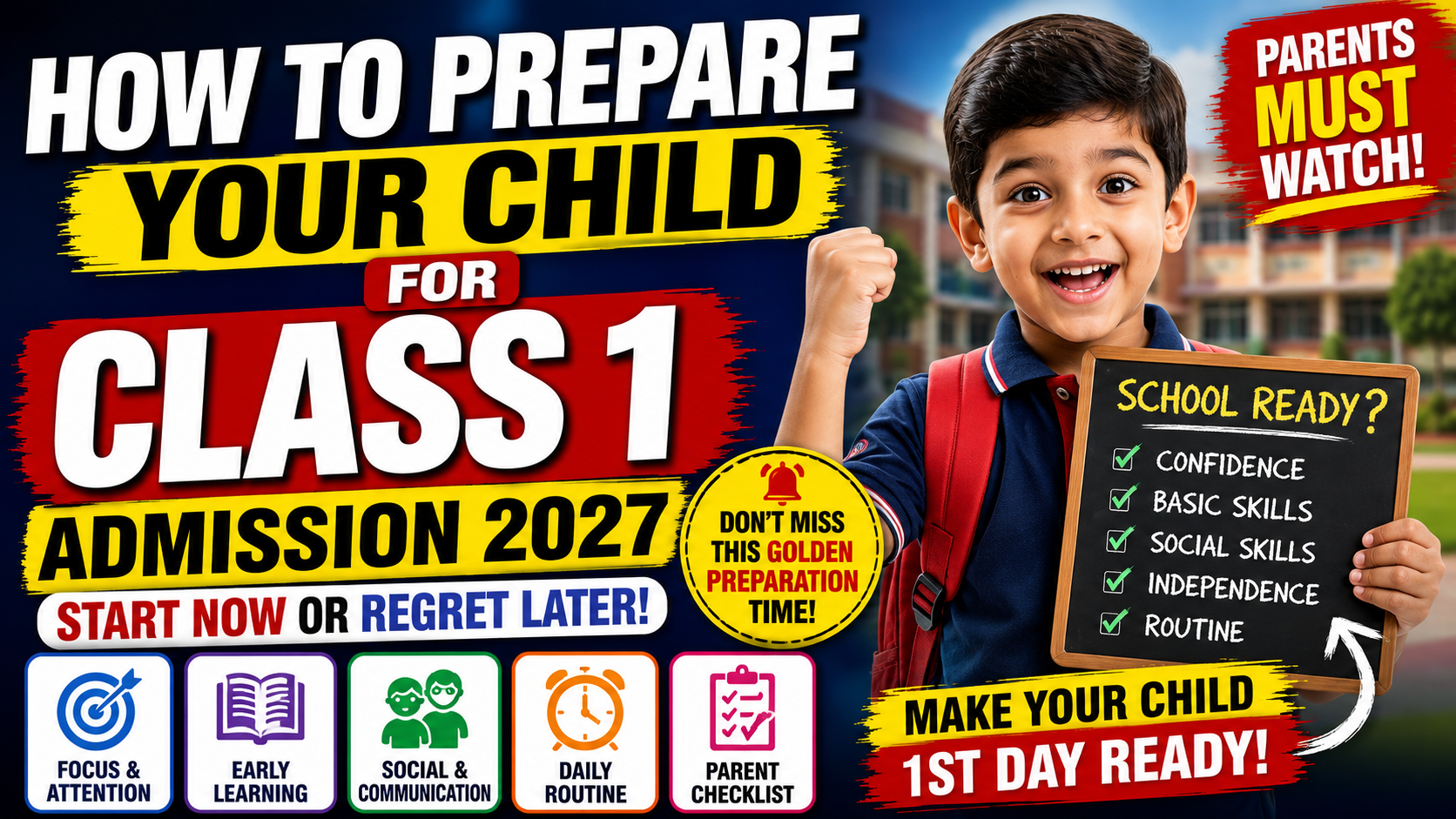
How to Prepare Your Child for Class 1 Admission 2027
Preparing your child for Class 1 admission 2027 is not just about getting the documents and admission form ready. Parents should also focus on an equally important area: school readiness.
A common mistake parents make is assuming that a child must complete several books, solve difficult mathematics problems or memorise interview answers before entering Class 1.
That is not the right approach.
Class 1 preparation should go beyond academics. A child entering Class 1 gradually needs confidence, communication skills, independence, basic literacy and numeracy, listening skills, social skills and the ability to follow a daily routine.
The National Curriculum Framework for the Foundational Stage places play at the centre of learning and encourages balanced opportunities for free, guided and structured play during the Foundational Stage, including Grades 1 and 2.
So, if your child is starting Class 1 in 2027, the goal should be to become school-ready, not exam-ready.
Class 1 Admission Preparation: Where Should Parents Start?
Parents can begin with these seven areas:
- Communication
- Early reading and language
- Basic mathematics
- Independence
- Social skills
- Daily routine
- Confidence and emotional readiness
You do not need to turn your home into a classroom.
Small activities repeated regularly can make a meaningful difference.
1. Build Your Child's Communication Skills
One of the most useful skills for Class 1 is the ability to communicate.
Your child should gradually become comfortable with:
- Saying their name
- Talking about their family
- Asking for help
- Answering simple questions
- Describing something they see
- Telling you about their day
- Expressing when they are uncomfortable
- Speaking politely with another adult
Try This at Home
Instead of asking only:
“How was school today?”
ask more specific questions:
- What was the most interesting thing you did today?
- Who did you play with?
- What story did you hear?
- What made you happy?
- Was anything difficult?
This encourages children to express their thoughts instead of giving only one-word answers.
2. Start Reading Practice Without Pressure
Early literacy is an important part of foundational learning.
For a child preparing for Class 1, parents can encourage:
- Letter recognition
- Sound awareness
- Recognition of familiar words
- Listening to stories
- Picture reading
- Vocabulary development
- Interest in books
- Simple writing practice
Make Reading Fun
You do not always need worksheets.
Try this simple approach:
Picture → Ask → Child Answers → Discuss
For example, show your child a picture of a market and ask:
“What do you see?”
Encourage your child to identify:
- People
- Colours
- Objects
- Numbers
- Actions
This combines language, observation and communication.
3. Practise Basic Maths Through Everyday Activities
Do not make mathematics feel like punishment.
Children can develop early numeracy through everyday activities.
While Eating
“How many apples are there?”
While Shopping
“We need three packets. Can you count them?”
While Playing
“Who has more blocks?”
While Walking
“Can you find three red objects?”
Useful areas to practise include:
- Counting
- Number recognition
- Comparing quantities
- Simple patterns
- Shapes
- Sorting
- Basic addition using objects
Everyday activities can make mathematics feel natural rather than stressful.
4. Teach Independence Before Class 1
This is one area parents often underestimate.
A child may know numbers and letters but still struggle with everyday school routines.
Before Class 1, gradually encourage your child to:
- Wear their shoes
- Open their lunch box
- Drink water independently
- Keep books in the correct place
- Pack simple belongings
- Use the washroom independently, where appropriate
- Carry their school bag
- Ask an adult for help
- Clean up after an activity
The objective is not perfection.
The objective is:
“I can try it myself.”
That confidence can be extremely useful when a child starts primary school.
5. Prepare Your Child for a School Routine
Class 1 can feel very different from preschool.
There may be:
- A fixed timetable
- Longer periods of sitting
- Classroom instructions
- Group activities
- Homework or practice work
- Break times
- New teachers
- New classmates
Start adjusting the routine gradually.
A Simple Pre-Class 1 Routine
Morning: Wake up → freshen up → breakfast
Day: Play → reading/activity → outdoor time
Evening: Light learning → family time → prepare belongings
Night: Story/reading → fixed bedtime
Do not suddenly change everything one week before school begins.
A gradual routine is easier for children to adjust to.
6. Teach Your Child How to Listen
Listening is an underrated school skill.
At home, practise simple two-step instructions:
“Take your book and keep it on the table.”
Then gradually increase the complexity:
“Take your red pencil, put it in the box and bring the book.”
Keep it playful.
You can also play:
- Simon Says
- Memory games
- Story sequencing
- Follow-the-instruction games
- Treasure hunts
These activities can support listening, attention and the ability to follow instructions.
7. Build Social Skills
Class 1 means spending more time with other children.
Your child may need to learn how to:
- Share
- Wait for a turn
- Listen to others
- Join a group
- Ask politely
- Deal with small disagreements
- Follow simple rules
- Ask a teacher for assistance
Free and guided play can help children practise social interaction and self-regulation.
Don't Solve Every Small Problem for Your Child
If two children are arguing over a toy, do not immediately intervene.
Instead ask:
“What happened?”
Then:
“What can you do now?”
This gives your child an opportunity to practise problem-solving.
8. Prepare Your Child Emotionally
Starting Class 1 can be exciting and scary at the same time.
Some children may worry about:
- A new teacher
- New classmates
- Being away from parents
- Getting answers wrong
- Asking for help
- Finding the classroom
- Eating lunch independently
Parents should talk about these things before school starts.
Try saying:
“If you don't understand something, you can ask your teacher.”
Instead of:
“You must know everything.”
This difference matters.
9. Don't Force Your Child to Memorise Interview Answers
If a school conducts an interaction or assessment as part of its admission process, parents may want to prepare their child.
That is fine — but avoid turning it into coaching.
Do not force the child to memorise:
- A long self-introduction
- Fixed answers
- Complicated definitions
- Artificial speeches
Instead, practise natural conversation.
For example:
Adult: What is your name?
Child: My name is Aarav.
Adult: What do you like?
Child: I like drawing.
Adult: Tell me about your picture.
Child: This is my house and this is my dog.
The goal is confidence and communication, not a rehearsed performance.
10. Visit the School Before the First Day
If the school allows it, visiting the campus can help make the environment familiar.
Show your child:
- School entrance
- Classroom area
- Playground
- Library, where applicable
- Washroom area
- Transport or pick-up area
You can say:
“This is where you will come to learn and play.”
Avoid creating fear around school.
Do not say:
“You should be scared of the teacher.”
Instead say:
“Your teacher will help you learn new things.”
11. Start a Simple School-Ready Practice Session
Parents do not need three-hour study sessions.
For many young children, short and engaging activities are more practical.
A sample routine could include:
| ActivityFocus | |
| Story reading | Language |
| Counting game | Numeracy |
| Drawing | Creativity and fine motor skills |
| Conversation | Communication |
| Outdoor play | Physical development |
| Puzzle/game | Thinking skills |
| Independent task | Self-confidence |
The exact duration should depend on the child's age, attention span and existing routine.
12. What Should a Child Know Before Class 1?
There is no single universal checklist that every child must complete before entering Class 1.
However, parents can look at broad readiness areas.
Language
The child can gradually:
- Understand simple instructions
- Communicate basic needs
- Listen to stories
- Talk about familiar things
- Recognise some letters or words depending on prior learning
Mathematics
The child can gradually:
- Count
- Recognise numbers
- Compare quantities
- Identify common shapes
- Recognise simple patterns
Social Skills
The child can gradually:
- Share
- Take turns
- Participate in group activities
- Follow simple rules
Independence
The child can gradually:
- Manage simple belongings
- Eat and drink independently
- Ask for help
- Follow a basic routine
Emotional Readiness
The child can gradually:
- Separate from parents for some time
- Express feelings
- Handle small frustrations
- Try again after making a mistake
Remember:
School readiness is broader than reading and writing.
13. What Parents Should NOT Do Before Class 1
Some preparation methods can create unnecessary stress.
Don't Compare
Avoid saying:
“Look, your friend already knows this.”
Every child develops at a different pace.
Don't Overload With Tuition
A child entering Class 1 does not necessarily need multiple coaching classes.
Don't Use Fear
Statements such as:
“If you don't study, the teacher will punish you.”
can create anxiety around school.
Don't Make Every Activity a Test
Not every drawing, story or counting game needs a score.
Don't Expect Perfection
Mistakes are part of learning.
14. The Biggest Class 1 Preparation Mistake
One of the biggest mistakes parents can make is preparing a child only academically.
Parents may spend months teaching:
- Alphabets
- Numbers
- Writing
- Reading
but forget:
- Independence
- Communication
- Listening
- Social interaction
- Emotional confidence
- Daily routine
That means Class 1 preparation should be holistic.
A child needs more than academic knowledge to feel comfortable in a new school environment.
Class 1 Admission 2027: Parent Checklist
Before your child starts Class 1, ask yourself:
- Can my child communicate basic needs?
- Can my child follow simple instructions?
- Can my child manage some everyday tasks independently?
- Does my child show interest in books or stories?
- Can my child count and recognise some numbers?
- Can my child participate in simple group activities?
- Can my child ask an adult for help?
- Is my child's sleep routine reasonably consistent?
- Have we discussed school positively?
- Has my child had an opportunity to become familiar with the new school?
You do not need every box to be perfect.
Use this checklist to identify areas where your child may need gentle practice.
A Simple 30-Day Class 1 Preparation Plan
Parents who want a structured approach can divide preparation into four weeks.
Week 1: Communication
Focus on:
- Storytelling
- Conversations
- Picture description
- Listening games
Week 2: Independence
Practise:
- Packing
- Eating
- Wearing shoes
- Managing personal belongings
- Asking for help
Week 3: Early Learning
Introduce:
- Counting games
- Letter and sound activities
- Story reading
- Shapes
- Patterns
Week 4: School Routine
Practise:
- Fixed wake-up time
- Breakfast routine
- Short learning sessions
- Outdoor play
- Fixed bedtime
Keep the activities flexible and enjoyable.
When Should Parents Start Preparing for Class 1 Admission 2027?
There is no need to wait until the final weeks.
Parents can begin gradually during the months before school starts.
Start with everyday habits rather than intensive academic preparation.
At the same time, monitor the school's official admission information for:
- Application dates
- Age eligibility
- Required documents
- Selection process
- School-specific instructions
Admission rules are school- and authority-dependent, so parents should verify the final requirements directly with the school.
FAQs
How can I prepare my child for Class 1 admission?
Focus on communication, early literacy and numeracy, independence, social skills, listening, routine and confidence. Avoid excessive academic pressure.
Should my child know everything before Class 1?
No. Class 1 is itself a learning stage. Children enter with different levels of prior experience and readiness.
How can I improve my child's confidence before Class 1?
Give your child opportunities to speak, make small decisions, complete simple tasks independently and interact with other children.
Should I send my child for Class 1 admission coaching?
There is no universal need for coaching. If a particular school has an interaction or assessment, gentle preparation through conversation and age-appropriate activities is generally more appropriate than intensive coaching.
What should my child know in maths before Class 1?
Basic counting, number recognition, comparison, shapes and simple patterns can be useful foundations. The exact expectations depend on the child's prior learning and school.
How do I prepare my child emotionally for Class 1?
Talk positively about school, explain what the daily routine may look like, allow the child to ask questions and reassure them that asking teachers for help is normal.
What if my child cannot read before Class 1?
Don't panic. Early literacy develops progressively. Encourage stories, conversations, picture books, letter and sound activities, and discuss your concerns with the child's preschool teacher or receiving school where appropriate.
Conclusion
Preparing your child for Class 1 admission 2027 is not about making them study like an older student.
It is about helping them become confident, curious, independent and ready to learn.
Build reading habits. Play counting games. Practise communication. Encourage independence. Establish a healthy routine. Let your child interact with others.
Most importantly, do not turn Class 1 preparation into a competition.
Your goal is not to make your child know everything before the first day.
Your goal is to help your child walk into the classroom thinking:
“I can do this. I can learn. And I can ask for help when I need it.”
That is a much stronger beginning to Class 1.
Verification note: Educational frameworks and individual school admission requirements can change. Parents planning admission for 2027–28 should verify school-specific age, admission, assessment and documentation requirements directly with the school and relevant official authority.
Tags:
Get Weekly Insights
Join 10k+ parents getting smarter about education.