
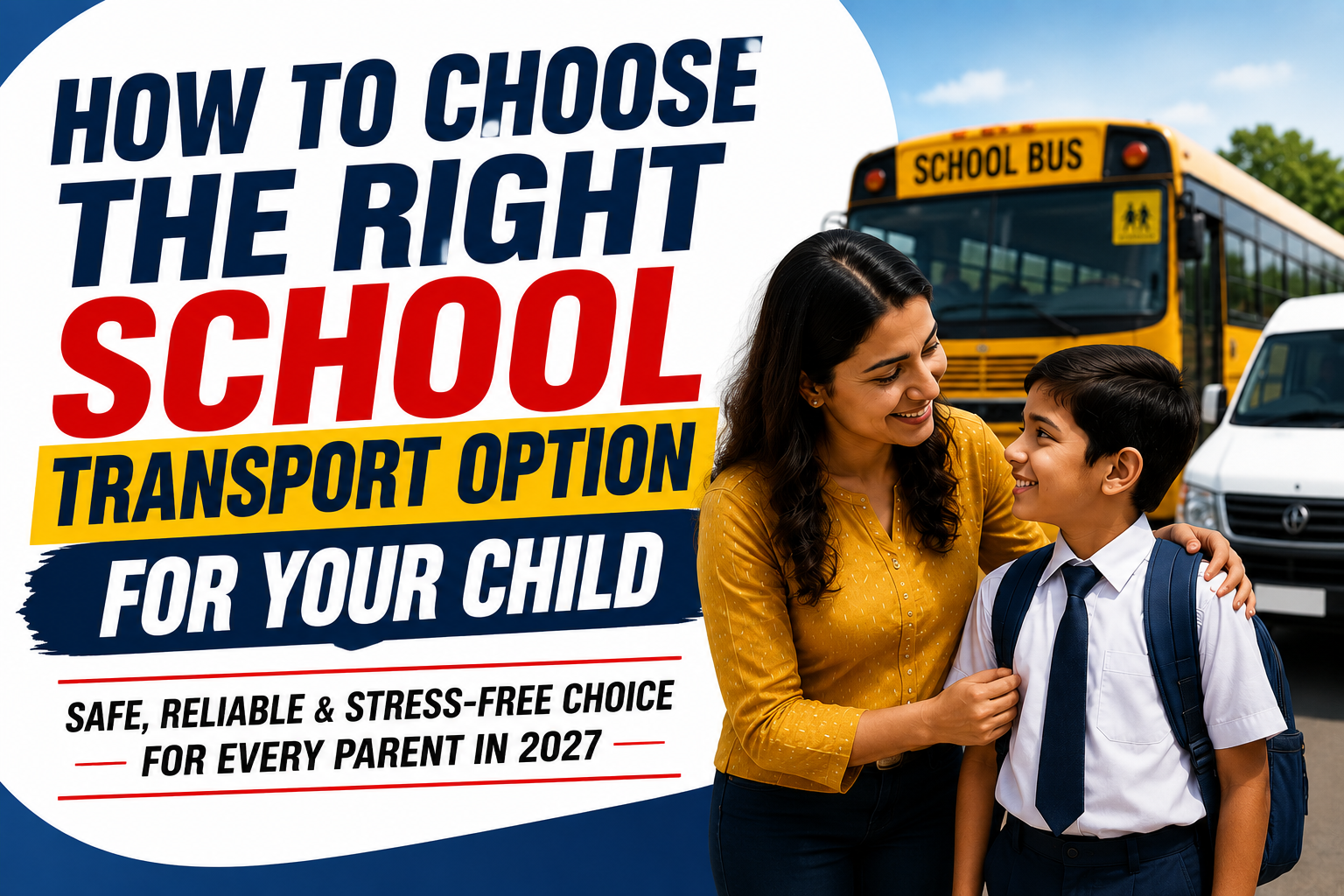
How to Choose the Right School Transport Option for Your Child in 2027: Safety, Cost & Convenience Guide
Choosing a school is only one part of the admission decision.
The next question is:
How will my child travel to and from school every day?
For some families, a school bus is the easiest option. Others prefer a private van because it offers more flexible pickup and drop-off arrangements. Some parents choose to personally drop and collect their child because they want maximum control over the daily journey.
There is no single transport option that is automatically best for every child.
The right choice depends on several factors:
- Child's age
- Distance between home and school
- Road and traffic conditions
- Driver and attendant safety
- Travel time
- Daily family schedule
- Total cost
- Emergency arrangements
- Pickup and drop-off safety
- Reliability
The DextroCampus 30-Day Content Plan lists Day 7, Blog 2 as "How to Choose the Right School Transport Option for Your Child."
For parents across Mumbai, Thane, Mira Road, Bhayandar, Vasai, Naigaon, Nalasopara, Virar and Palghar, transport should be evaluated as part of the overall school-selection process rather than treated as an afterthought.
1. Why Choosing the Right School Transport Matters
A child may travel to school hundreds of times during an academic year.
That means transport can influence:
- Daily punctuality
- Morning routine
- Energy levels
- Stress
- Safety
- Family scheduling
- School attendance
- Overall convenience
A school that looks ideal on paper may become difficult if the daily journey is excessively long or unreliable.
Similarly, a slightly more expensive school may become more practical if its transport system provides a safer and more manageable daily commute.
The Parent Principle
Do not choose transport only because it is cheap or convenient.
Choose the option that provides the best balance of:
Safety + Supervision + Reliability + Travel Time + Cost.
2. The Three Main School Transport Options
Most parents generally consider three options.
Option 1: School Bus
The school or its transport provider operates a designated school bus.
Option 2: Private Van
A private transport operator provides pickup and drop-off, sometimes with smaller groups and more flexible routes.
Option 3: Self-Transport
Parents or authorised family members personally drop and collect the child.
Each has advantages and limitations.
3. School Bus: Advantages and Limitations
A school bus can be a practical choice when the school has a well-managed transport system.
Potential Advantages
- Established school route
- Multiple children travel together
- Designated pickup points
- School-linked transport management
- Potential GPS monitoring
- Driver and attendant arrangements
- Can reduce daily parental driving
Possible Limitations
- Fixed pickup times
- Multiple stops
- Longer route duration
- Less flexibility
- Transport fees
- Child may spend considerable time travelling
Parents should assess the actual route, not simply whether the school provides a bus.
4. Private Van: Advantages and Limitations
Private vans may offer smaller-group transport and more flexible arrangements.
Potential Advantages
- Doorstep or near-home pickup may be available
- Smaller group size
- Flexible timings
- Potentially shorter route
- Convenient for working parents
Possible Limitations
- Safety standards may vary between operators
- Parents need to verify driver and vehicle credentials
- Replacement arrangements may be unclear
- Emergency procedures may be less transparent
- Route monitoring may differ
Parent Rule
A private van should be evaluated using the same seriousness as a school bus.
Do not assume:
"It is a small vehicle, so it must be safer."
5. Self-Transport: Advantages and Limitations
Some families prefer to personally drop and collect their children.
Potential Advantages
- Maximum parental control
- Flexible departure time
- Direct travel
- No dependence on school-bus schedules
- Easier communication when plans change
Possible Limitations
- Daily driving responsibility
- Traffic-related stress
- Fuel and vehicle costs
- Parking difficulties
- Time commitment
- Difficulties when parents have work or other responsibilities
For families with demanding work schedules, self-transport can become difficult even when it initially appears attractive.
6. School Bus vs Private Van vs Self-Transport
| Factor | |||
| Supervision | Often structured | Depends on operator | Parent-controlled |
| Route flexibility | Lower | Moderate/High | Very high |
| Pickup flexibility | Usually fixed | Often flexible | Very high |
| Parent involvement | Moderate | Moderate | High |
| Cost | Varies | Varies | Fuel/time/vehicle cost |
| Group travel | Usually | Usually smaller group | No |
| GPS | May be available | Depends on provider | Personal navigation |
| Emergency system | Check school policy | Check operator | Parent-managed |
| Best suited for | Regular school commute | Flexible pickup needs | Families wanting direct control |
Important: This is a comparison framework, not a universal rating. Actual safety and service quality depend on the specific provider.
7. Safety Should Be Your First Filter
Before comparing price, ask:
Is this transport arrangement safe enough for my child?
For school buses, CBSE's published transport guidance includes requirements and precautions covering vehicle identification, driver experience, conductors/attendants, first-aid equipment, emergency alert systems and other safety features.
Maharashtra's Highway Traffic Police also advises parents to ensure that the mode of transport arranged for children is safe and encourages parents to observe and report violations.
Check:
- Vehicle condition
- Driver credentials
- Driver experience
- Attendant/conductor arrangements
- First-aid availability
- Fire-safety equipment
- Emergency contact process
- Safe boarding and deboarding
- Pickup location
- Drop-off procedure
8. Verify the Driver
The driver is one of the most important factors in transport safety.
Parents should ask the school or transport provider:
- Is the driver's licence valid?
- Does the driver have appropriate experience?
- Has background verification been conducted?
- Are medical and eyesight checks performed?
- Is the driver trained for school transport?
- What happens when the regular driver is absent?
CBSE's published school-transport precautions specify a valid licence and minimum five years of heavy-vehicle driving experience for school-bus drivers in the referenced guidance.
For actual admission decisions, parents should verify the current applicable transport requirements for the specific vehicle and location.
9. Check Whether an Attendant Is Available
For younger children, the person supervising children inside the vehicle can be extremely important.
Ask:
"Who is responsible for the children while the driver is driving?"
Then ask:
- Is an attendant present?
- Is the attendant trained?
- Who helps children board and leave?
- Who handles a child who becomes unwell?
- Who contacts parents during an emergency?
CBSE's published guidance provides for a conductor and trained attendant arrangements in school buses.
For younger children, parents should give additional importance to boarding, deboarding and handover supervision.
10. Check Vehicle Documents and Fitness
A school bus should not be evaluated simply by its appearance.
Ask whether the relevant vehicle documents are current, including:
- Registration
- Fitness
- Insurance
- Permit
- Applicable pollution/compliance documents
The Maharashtra Motor Vehicle Department maintains official information on motor-vehicle laws and rules and notes that the applicable Motor Vehicles Act and related rules govern legal requirements.
Parent Tip
You do not necessarily need to become a transport-law expert.
Simply ask the school:
"Are all required vehicle documents current and verified?"
11. Check the Pickup and Drop-Off Point
Parents often spend more time evaluating the bus than the location where the child enters or exits it.
That is a mistake.
A safe bus stop should ideally minimise exposure to:
- Fast-moving traffic
- Blind corners
- Unsafe road crossings
- Crowded intersections
- Poor visibility
Maharashtra Highway Traffic Police advises children and parents to use safe road-crossing practices and specifically tells parents to ensure that the transport mode arranged for children is safe.
Visit the Actual Stop
If possible, visit the proposed pickup point at the approximate pickup time.
A location that looks safe at 11 a.m. may be very different during morning traffic.
12. Consider Your Child's Age
The younger the child, the more important supervision becomes.
Nursery and Kindergarten
Prioritise:
- Attendant supervision
- Safe handover
- Shorter practical travel time
- Clear parent communication
- Safe pickup point
Primary School
Consider:
- Child's independence
- Route duration
- Supervision
- Reliability
Older Students
They may manage longer journeys more independently, but parents should still consider:
- Travel fatigue
- Late arrival
- Safety
- Route complexity
- Daily schedule
Key Point
Transport suitability changes as children grow.
The best option for a five-year-old may not be the best option for a fifteen-year-old.
13. How Much Travel Time Is Too Much?
There is no single universal travel-time number that makes a route safe or unsafe for every child.
Instead, evaluate the complete journey.
Ask:
- What time must the child wake up?
- What time does the child leave home?
- How many stops are there?
- How long is the return journey?
- Does traffic regularly increase the travel time?
- Does the child still have enough time for sleep, homework and play?
A school may be only 8 kilometres away but still require a long commute because of traffic.
Parent Rule
Measure travel time, not just distance.
14. Compare Total Transport Cost
Do not compare only the quoted monthly transport fee.
Calculate:
Annual Transport Cost =
Transport Fee
Registration or applicable one-time charges
Additional route charges, if applicable
Other compulsory transport-related costs
For self-transport, calculate:
- Fuel
- Parking
- Vehicle maintenance
- Driver cost, if applicable
- Parent's time
A "free" parent-driven school journey is not necessarily cost-free.
15. Ask About GPS Tracking
GPS can improve parent visibility.
Depending on the school or provider, parents may receive:
- Bus location
- Estimated arrival
- Route information
- Delay notifications
But GPS should be treated as an additional safety and communication tool, not a substitute for proper transport management.
Ask:
"Is GPS tracking available?"
Then ask:
"Who monitors the route when the bus deviates from the expected path?"
That second question is more important than simply knowing whether a tracking app exists.
16. Ask About Emergency Procedures
Before choosing transport, ask:
"What happens if the bus breaks down?"
Also ask:
- What happens if the driver becomes unavailable?
- Who contacts parents?
- Is there a replacement vehicle?
- How are children supervised during delays?
- What happens during an accident?
- Who contacts emergency services?
- How is attendance checked?
CBSE's published transport guidance includes emergency-oriented features such as first-aid equipment and alarm/siren arrangements.
A responsible transport provider should be able to explain its emergency process clearly.
17. Ask About Vehicle Overcrowding
A cheap transport option is not a good option if children are packed into an unsuitable vehicle.
During a transport inspection, look for:
- Adequate seating
- Clear movement space
- Safe boarding
- No unsafe standing
- Proper storage for school bags
- Appropriate passenger capacity
Ask:
"How many children are assigned to this vehicle?"
and:
"What is the permitted seating capacity?"
18. Check Communication With Parents
Good transport management should make communication easy.
Parents should know:
- Transport coordinator's contact
- Driver/attendant contact process
- Pickup timing
- Delay notification method
- Route-change procedure
- Emergency contact
If a bus is 30 minutes late, parents should not have to make five phone calls simply to find out where their child is.
19. Ask About Changes and Cancellation
Families' circumstances can change.
Your child may:
- Change schools
- Stop using transport
- Move home
- Change route
- Switch to self-transport
Before paying, ask:
"What is the procedure for changing or cancelling transport?"
Also ask:
"Is any advance transport payment refundable?"
Do not assume the transport refund policy is identical to the school's tuition refund policy.
20. School Transport Red Flags
Parents should investigate carefully when they notice:
🚩 No Clear Driver Information
The school cannot explain who operates the route.
🚩 No Clear Attendant Arrangement
Nobody can explain who supervises children.
🚩 Unclear Vehicle Documents
The provider avoids answering basic compliance questions.
🚩 Unsafe Pickup Point
Children have to cross a busy road without appropriate arrangements.
🚩 Repeated Delays
The bus regularly causes significant disruption.
🚩 No Emergency Process
Nobody can explain what happens during a breakdown.
🚩 No Complaint Contact
Parents do not know where to report safety concerns.
A red flag is a reason to investigate further, not automatically proof that a school has violated a rule.
21. Questions to Ask the School Before Selecting Transport
Save these questions on your phone.
Safety
- Who operates the transport service?
- Is the vehicle properly registered and fit?
- Is insurance current?
- Who is the driver?
- Is the driver verified?
- Is an attendant available?
Route
- What is the pickup point?
- What is the approximate journey time?
- How many stops are there?
- What happens when traffic causes delays?
Monitoring
- Is GPS available?
- Who monitors the route?
- Are parents notified about delays?
Emergency
- What happens during a breakdown?
- What is the emergency contact procedure?
- Is first-aid equipment available?
Financial
- What is the total annual transport cost?
- Are there additional charges?
- What is the cancellation/refund policy?
22. A Simple Decision Matrix for Parents
Give each option a score from 1 to 5.
| Factor | |||
| Safety confidence | /5 | /5 | /5 |
| Supervision | /5 | /5 | /5 |
| Driver confidence | /5 | /5 | /5 |
| Route suitability | /5 | /5 | /5 |
| Travel time | /5 | /5 | /5 |
| Reliability | /5 | /5 | /5 |
| Emergency readiness | /5 | /5 | /5 |
| Parent convenience | /5 | /5 | /5 |
| Cost | /5 | /5 | /5 |
| Flexibility | /5 | /5 | /5 |
Do not simply choose the option with the highest numerical score.
Give safety and supervision greater weight than convenience.
23. Which Option Is Best for Working Parents?
For working parents, transport decisions often involve a trade-off.
School Bus
Can reduce daily driving responsibilities.
Private Van
May offer more flexible pickup and drop-off.
Self-Transport
Offers maximum parental control but requires daily time commitment.
The right answer depends on the family's actual schedule.
Ask:
"Who will handle transport when I have an early meeting, late workday or unexpected commitment?"
A transport plan should work not only on an ideal day but also on a difficult day.
24. School Transport for Younger Children
For younger children, parents should prioritise:
Supervision
Safe handover
Reliable communication
Short and manageable travel
Emergency preparedness
A low transport fee should never outweigh an unclear supervision system.
25. Local Considerations for Mumbai and Palghar
For families in Mumbai, Thane, Mira Road, Bhayandar, Vasai, Naigaon, Nalasopara, Virar and Palghar, route planning deserves special attention.
A school that appears geographically close may still have a long daily commute because of:
- Peak-hour congestion
- Multiple pickup stops
- Road bottlenecks
- Railway crossings
- School-zone traffic
- Route diversions
Therefore, parents should ask for the actual route and approximate travel time.
If possible, visit the route during school hours before finalising transport.
26. School Bus vs Private Van: Who Should Choose What?
School Bus May Suit Families Who:
- Prefer school-managed transport
- Want a structured route
- Need regular daily transport
- Prefer group travel
- Want to reduce daily driving
Private Van May Suit Families Who:
- Need more flexible pickup
- Live away from the school bus route
- Prefer smaller groups
- Need a more convenient local arrangement
Self-Transport May Suit Families Who:
- Have flexible schedules
- Want direct parental control
- Live close enough for practical daily travel
- Can reliably manage both pickup and drop-off
Again, these are general suitability factors, not guarantees.
27. The 10-Minute Transport Inspection
Before paying for transport:
Minute 1–2: Vehicle
Inspect the actual vehicle if possible.
Minute 3: Driver
Ask about verification and experience.
Minute 4: Attendant
Confirm who supervises children.
Minute 5: Documents
Ask about required vehicle compliance.
Minute 6: Route
Understand pickup points and journey time.
Minute 7: Monitoring
Ask about GPS and communication.
Minute 8: Emergency
Ask about breakdown and emergency procedures.
Minute 9: Cost
Calculate the complete annual amount.
Minute 10: Cancellation
Ask how transport can be changed or cancelled.
This small exercise can prevent a much bigger problem later.
28. Parent Checklist Before Choosing School Transport
- I know who operates the transport.
- I have checked the vehicle condition.
- I have asked about required vehicle documents.
- I know who the driver is.
- Driver verification is clear.
- I know whether an attendant is available.
- I know the pickup location.
- I know the approximate journey time.
- I have considered the child's age.
- I know whether GPS is available.
- I know how delays are communicated.
- I understand the emergency procedure.
- I know the annual transport cost.
- I know additional charges, if any.
- I understand the cancellation/refund policy.
- My child knows basic transport safety rules.
29. The Biggest Mistake Parents Make
The most common mistake is choosing transport based on one factor.
For example:
"This one is cheapest."
Or:
"This one comes directly to my building."
Or:
"The school has GPS."
None of these factors alone is enough.
A better question is:
"Which option provides the safest and most reliable daily journey for my child while remaining practical for our family?"
That is the real transport decision.
Related DextroCampus Guides & Resources
- School Bus Safety Rules Every Parent Should Know — use this as the detailed safety checklist before selecting a bus.
- School Bus vs Private Van: Safety & Cost Comparison — compare the two most common managed transport options.
- School Bus GPS Tracking: Why It Matters for Parents — understand tracking and parent communication.
- School Pickup & Drop-Off Safety Checklist — evaluate the beginning and end of the child's journey.
- School Transport Distance: How Far Is Too Far for a Child? — assess route length and daily travel burden.
- School Transport Fees: What Determines the Cost? — calculate the financial side of the decision.
These titles are drawn from the DextroCampus Day 7 topic cluster in the supplied content plan.
Frequently Asked Questions (FAQs)
1. Which is better: a school bus or private van?
Neither is automatically better. Parents should compare the actual driver's credentials, vehicle compliance, supervision, route, travel time, emergency arrangements, reliability and total cost.
2. Is a school bus safer than a private van?
A school bus can provide structured supervision and school-managed procedures, but safety depends on the actual vehicle, driver, attendant, operator and monitoring system. Parents should verify the specific service rather than relying only on the type of vehicle.
3. Should parents choose school transport for a young child?
School transport can be suitable for young children when there is appropriate supervision, safe boarding and deboarding, reliable parent communication and a clear handover procedure. Younger children generally require greater attention to supervision.
4. Is GPS tracking necessary for school transport?
GPS can be useful for monitoring location and communicating delays, but it should not be treated as a substitute for proper vehicle maintenance, qualified drivers, supervision and emergency preparedness.
5. How should parents calculate school transport cost?
Calculate the complete annual transport expense, including the applicable transport fee and any additional compulsory charges. For self-transport, also consider fuel, parking, vehicle maintenance and the family's time commitment.
6. What should parents check before choosing a school bus in Maharashtra?
Parents should verify the applicable vehicle and driver requirements, safety arrangements, route, pickup and drop-off procedures, emergency systems and the school's transport-management process. Maharashtra's official transport authorities publish applicable motor-vehicle laws and rules, while CBSE-affiliated schools must follow applicable state and transport-department requirements.
Conclusion & Parent Checklist
Choosing school transport is ultimately a child-safety and family-planning decision.
The cheapest option is not automatically the best.
The most convenient option is not automatically the safest.
And a school bus with GPS is not automatically a well-managed transport system.
Parents should evaluate:
Vehicle
→ Driver
→ Attendant
→ Route
→ Pickup/Drop-Off
→ Monitoring
→ Emergency Preparedness
→ Cost
→ Reliability
→ Cancellation Policy
For parents in Mumbai, Thane, Mira Road, Bhayandar, Vasai, Naigaon, Nalasopara, Virar and Palghar, this evaluation is particularly important because daily traffic and route conditions can significantly affect the actual school commute.
Maharashtra's Highway Traffic Police explicitly advises parents to ensure that the transport mode arranged for children is safe and to remain vigilant about violations.
CBSE's published school-transport guidance also sets out detailed precautions concerning drivers, attendants, vehicle facilities, first aid, emergency arrangements and safe transportation.
Final Parent Rule
Do not ask only, "How much does school transport cost?" Ask, "Is this the safest, most reliable and practical way for my child to travel every school day?"
If the answer is clear after checking the evidence, you are in a much stronger position to make the right choice.
Tags:
Get Weekly Insights
Join 10k+ parents getting smarter about education.