
How Parents Can Track Their Child's School Bus in Real Time: Complete GPS Tracking Guide 2027
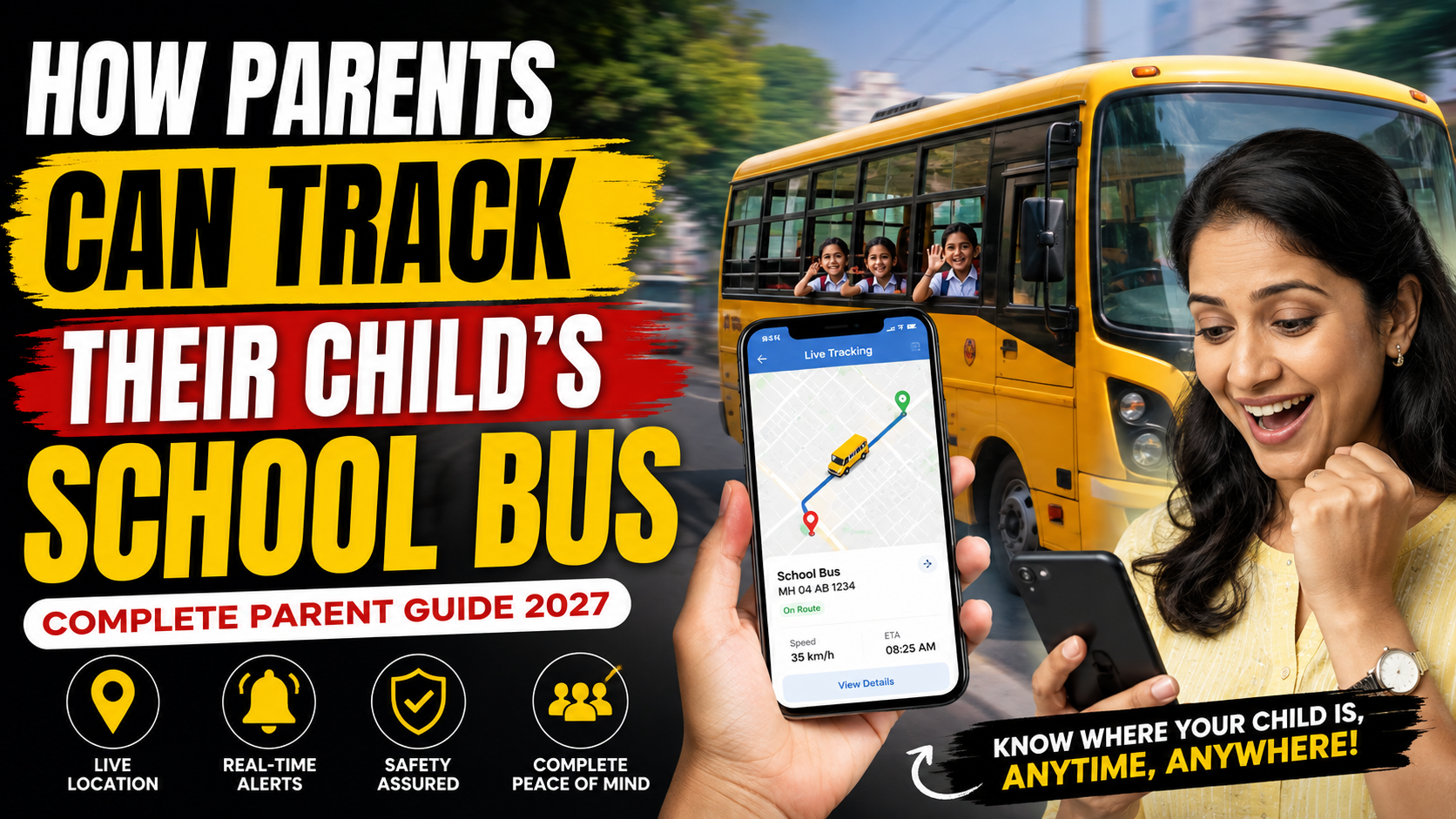
For parents, one of the most stressful parts of the school day can be waiting for the school bus.
The bus is late. Traffic is heavy. The child is not answering the phone. The school gate is crowded. A parent starts wondering: Where is the bus right now? Has it reached the previous stop? Is my child already on the way home?
This is where school bus GPS tracking can make a major difference.
Modern school transport systems can use GPS devices and parent-facing technology to provide information about the vehicle's location and journey. CBSE's published school transport guidelines specifically state that GPS and CCTV arrangements should be provided in school buses and kept in working condition.
However, parents should understand an important distinction:
GPS tells you where the vehicle is. It does not, by itself, prove that your child is safe inside it.
A genuinely effective school transport system combines technology with trained staff, clear routes, proper child handover, emergency communication and strong safety procedures.
For families in Mumbai, Thane, Palghar, Vasai, Virar, Nalasopara, Naigaon, Mira Road and Bhayandar, understanding how school bus tracking works can make daily school travel more predictable and less stressful.
What Is School Bus GPS Tracking?
School bus GPS tracking uses a location-tracking device installed in the vehicle.
The device communicates the vehicle's location to a software platform. Depending on the school's system, parents may receive access through:
- A mobile application
- A school-parent communication app
- A web dashboard
- SMS notifications
- Push notifications
- A school transport portal
The exact features vary between schools.
A basic system may simply display the current bus location, while a more advanced platform may provide:
- Live location
- Route information
- Estimated arrival time
- Pickup alerts
- Drop-off alerts
- Delay notifications
- Geofencing alerts
- Journey history
- Driver or vehicle identification
- Emergency communication
Parents should ask the school exactly which features are available instead of assuming that every GPS-enabled bus provides the same level of tracking.
Why GPS Tracking Matters to Parents
1. It Reduces Uncertainty
Without tracking, parents may have to repeatedly call the school or transport coordinator.
A live location system can provide a much clearer picture of the journey.
For example:
Without GPS:
"Where is the bus? It was supposed to arrive at 7:45."
With GPS:
"The bus is approaching the previous pickup point and is approximately 10 minutes away."
That difference can make the morning routine considerably easier.
2. It Helps Parents Plan Pickup
Parents do not necessarily need to wait outside for a long period.
If the school's system provides reliable arrival information, a parent may be able to leave home closer to the expected arrival time.
This can be particularly useful for working parents.
3. It Helps During Traffic Delays
Mumbai Metropolitan Region traffic can change rapidly.
Routes around Mira Road, Bhayandar, Vasai, Virar, Naigaon and Nalasopara can experience congestion at school-opening and school-closing hours.
GPS cannot eliminate traffic, but it can make delays more visible.
4. It Creates Better Parent-School Communication
A good transport platform can reduce unnecessary calls and give parents a common source of information.
Instead of asking:
"Where is the bus?"
parents can first check the transport system and contact the school only when something unusual occurs.
How Parents Can Track a School Bus
The exact process depends on the school's technology provider, but the general process is straightforward.
Step 1: Ask Whether GPS Tracking Is Available
Before paying transport fees, ask the school:
"Does every school bus have active GPS tracking?"
Do not assume that because a school advertises "smart transport" every vehicle is necessarily tracked in the same way.
Ask whether tracking applies to:
- All buses
- Contracted buses
- School-owned vehicles
- Vans or smaller transport vehicles
Step 2: Get Access to the Parent Platform
If tracking is provided, the school may ask parents to:
- Download an application
- Register a mobile number
- Enter a student ID
- Create a parent account
- Verify contact details
Keep the login credentials secure.
Step 3: Select Your Child or Route
Some systems allow parents to select the child's:
- Bus number
- Route
- Pickup point
- Student profile
The system may then display the vehicle's current location.
Step 4: Check the Live Location
Depending on the platform, the map may show:
- Current bus position
- Route line
- Previous stops
- Upcoming stops
- Approximate arrival time
Remember that GPS location is not always perfectly precise. Buildings, network coverage, device quality and software refresh intervals can affect the information displayed.
Step 5: Use Alerts
If the school provides notifications, activate relevant alerts.
Useful notifications can include:
- Bus approaching pickup point
- Bus departed school
- Bus reached school
- Bus delayed
- Child pickup/drop-off notification
- Route deviation
- Emergency alert
Not every school provides all of these.
Live Location vs ETA: What Is the Difference?
Parents often confuse these two features.
| Feature & What It Tells Parents | |
| Live GPS location | Where the vehicle is currently located |
| ETA | Approximate time before reaching a location |
| Route map | Planned or current journey path |
| Geofence alert | When the vehicle enters/leaves a defined area |
| Pickup alert | Notification related to the pickup stage |
| Delay alert | Notification that the journey is running late |
An ETA is an estimate, not a guarantee.
If traffic suddenly increases, the estimated arrival time can change.
Parents should therefore avoid becoming anxious because the displayed ETA moves by a few minutes.
Does GPS Tracking Mean Parents Can See Their Child's Exact Location?
Usually, the GPS device tracks the vehicle, not the child's body.
This distinction matters.
If the bus is carrying 30 children, the system may show the location of the bus rather than individual children.
Some school transport platforms may combine GPS with student attendance or boarding systems, but parents should verify this directly with the school.
Ask:
"Does your system track only the vehicle, or does it also record student boarding and drop-off?"
That question can reveal how sophisticated the school's transport management actually is.
GPS Tracking and Child Safety: What It Can and Cannot Do
GPS is useful, but it should not be treated as a complete safety solution.
GPS can help with:
- Knowing where the bus is
- Estimating arrival
- Identifying delays
- Monitoring routes
- Improving transport communication
- Supporting incident investigation
GPS cannot replace:
- A responsible driver
- A trained attendant
- Safe boarding
- Safe drop-off
- Child supervision
- Authorised handover
- Emergency procedures
- Proper vehicle maintenance
CBSE transport guidance also includes other safety measures such as emergency exits, fire extinguishers, speed governors and properly functioning GPS/CCTV systems.
The Maharashtra Highway Traffic Police similarly advises parents to remain vigilant, ensure that the child's mode of transport is safe and report school-bus violations to authorities.
What Parents Should Ask the School About GPS Tracking
Before selecting school transport for 2027, ask these questions.
Technology Questions
- Does every bus have GPS?
- Is GPS continuously operational?
- Is the system available to parents?
- Is there a mobile app?
- Can parents see live location?
- Does the system provide ETA?
- Are delay notifications available?
- Are route deviations detected?
Safety Questions
- Who monitors the GPS system?
- What happens if GPS stops working?
- Is CCTV also installed?
- Who responds to an emergency?
- How can parents contact the transport team?
- Is there an attendant on the bus?
- How is student boarding recorded?
Privacy Questions
- What information does the app collect?
- Who can access the child's transport information?
- Can parents see only their own child's route?
- How is account access controlled?
- What happens to transport data when the child leaves the school?
Parents should not be afraid to ask technology and privacy questions.
A transparent school should be able to explain how its transport platform works.
What Happens If the GPS Stops Working?
This is one of the most important questions parents rarely ask.
Imagine that the school bus GPS device loses connectivity.
Can the bus still operate safely?
Yes, the transport system should have a backup communication process.
Parents should know:
- The transport coordinator's contact method
- The school office number
- Emergency contact procedures
- How delays are communicated
- What happens if the tracking platform is unavailable
CBSE's transport guidance has also highlighted the importance of having communication capability in school buses so that the vehicle can contact the school or authorities during an emergency.
Therefore, GPS should be one layer of the system—not the only layer.
GPS Tracking for Younger Children
Parents of Nursery, Junior KG, Senior KG and primary-school children should pay particular attention to the difference between vehicle tracking and child supervision.
A GPS map cannot tell you whether a five-year-old has:
- Properly boarded
- Been seated
- Reached the correct stop
- Been handed to the authorised adult
For younger children, the school should have a clearly defined handover process.
CBSE material also describes procedures for situations where an authorised person does not arrive to collect a younger child at the designated point, including returning the child to school and contacting the parents.
Parents should therefore ask:
"What happens if I am five minutes late?"
The answer should be clear before the first school-bus journey.
How GPS Tracking Helps Working Parents
For dual-working households, transport predictability can be extremely valuable.
A parent may have a meeting at 8:00 AM while the child is expected at school shortly before that.
Instead of repeatedly calling the driver, the parent can use the school's transport platform where available.
Similarly, during afternoon pickup, parents can prepare for the child's arrival without waiting unnecessarily outside the building.
Practical benefit
| Situation | Without Tracking | With Tracking |
| Bus delayed | Repeated calls | Check route status |
| Traffic congestion | Uncertainty | Observe vehicle progress |
| Pickup timing | Fixed guess | Estimated arrival |
| School departure | Parent waits | Departure alert may help |
| Route issue | Harder to identify | Route information may help |
| Communication | Mostly phone-based | App + school contact |
The technology does not make the journey faster.
It makes the journey more predictable.
How Parents Should Use GPS Responsibly
GPS tracking can also create unnecessary anxiety if parents constantly monitor the map.
Parents should avoid:
- Checking the location every few minutes
- Calling the driver repeatedly
- Panicking over small ETA changes
- Treating GPS as proof of complete safety
- Sharing live route information publicly
Instead, use the system when it adds genuine value:
- Before pickup
- During significant delays
- When the school sends an alert
- When a child is unexpectedly late
- During an unusual route situation
The goal is better awareness, not constant surveillance.
A Parent Decision Matrix for School Transport
Use this simple framework while comparing schools.
| Question | Strong System | Weak System |
| GPS available? | Yes, consistently monitored | Unclear |
| Parent access? | App/portal provided | No direct access |
| ETA available? | Yes | No information |
| Delay communication? | Automated + school contact | Parent must call |
| Emergency communication? | Clearly documented | Unclear |
| Child handover? | Written procedure | Informal |
| Backup if GPS fails? | Clearly defined | Unknown |
| CCTV/safety measures? | Transparent | Unclear |
A school does not become "unsafe" simply because it lacks a sophisticated mobile application.
However, parents should understand exactly how transport safety and communication are managed before choosing the service.
School Bus GPS Tracking in Maharashtra
For parents in Maharashtra, school transport should be evaluated within the broader road-safety context.
The Maharashtra Highway Traffic Police explicitly places responsibility on parents to ensure that the transport mode used by their children is safe and encourages parents to observe and report violations.
This is particularly relevant in dense urban and suburban corridors across the Mumbai Metropolitan Region.
For families in:
- Mumbai
- Thane
- Mira Road
- Bhayandar
- Vasai
- Nalasopara
- Naigaon
- Virar
- Palghar
the practical value of live transport information can be significant because journey times can vary substantially with traffic.
Parents should nevertheless verify the exact transport arrangements and applicable requirements directly with the school and relevant authority.
Parents should verify this directly with the school management or official authority for any specific legal, technical or compliance question.
7 Signs of a Good School Bus Tracking System
A strong parent-facing system should ideally provide:
1. Reliable GPS
The vehicle location should update consistently.
2. Clear Parent Access
Parents should know exactly how to access the information.
3. Useful Notifications
Alerts should be relevant rather than excessive.
4. Route Visibility
Parents should understand the planned journey.
5. Delay Communication
The school should have a process for significant delays.
6. Emergency Backup
Parents should know how to contact the school if the technology fails.
7. Human Supervision
Technology should support trained staff—not replace them.
Parent Checklist Before Choosing School Transport
- Ask whether every school bus has GPS.
- Ask whether parents receive live location access.
- Check whether ETA is available.
- Ask whether delay notifications are sent.
- Find out who monitors the system.
- Ask what happens if GPS stops working.
- Understand the emergency communication process.
- Ask whether CCTV is installed.
- Understand the child boarding and drop-off process.
- Confirm authorised pickup arrangements.
- Ask how transport complaints are handled.
- Verify the system during an actual school-day route if possible.
Expert Takeaway
The biggest mistake parents can make is assuming that GPS equals safety.
It does not.
GPS is a visibility tool.
The strongest school transport systems combine:
GPS + supervision + communication + safe vehicles + responsible drivers + child handover + emergency procedures.
When comparing schools for 2027, parents should therefore ask not only:
"Does the school bus have GPS?"
but also:
"What happens when something goes wrong?"
That second question tells you far more about the maturity of the school's transport system.
Frequently Asked Questions (FAQs)
1. Can parents track a school bus in real time?
Yes, if the school provides a parent-facing GPS tracking system. Depending on the platform, parents may be able to view the bus location, route and estimated arrival time through an app, website or notifications.
2. Does GPS track my child or only the school bus?
In many systems, GPS tracks the vehicle rather than the child. Some transport platforms may integrate student boarding or drop-off records, but parents should verify the exact functionality with the school.
3. Is GPS tracking mandatory in every school bus?
CBSE's published school transport guidelines state that GPS and CCTV arrangements should be made in each school bus and kept operational. However, requirements can depend on the school's board, applicable State rules and transport arrangements, so parents should verify the current requirements directly with the relevant authority.
4. What should I do if the school bus GPS stops working?
Use the school's designated transport or emergency contact process. Parents should ask the school in advance what backup communication method is followed when GPS or the transport app is unavailable.
5. Can GPS prevent school bus accidents?
No. GPS can improve vehicle visibility and communication, but it cannot replace safe driving, vehicle maintenance, supervision, road-safety procedures or emergency preparedness.
6. Should parents constantly monitor the school bus location?
No. Parents should use GPS as a practical information tool rather than a source of constant anxiety. Checking before pickup, during significant delays or when an unexpected situation occurs is generally more useful than continuously watching the map.
Conclusion & Parent Checklist
School bus GPS tracking can transform the daily experience of school transport.
Instead of wondering where the bus is, parents can potentially see its progress, prepare for pickup and respond more quickly when there is a significant delay.
But technology should never create false confidence.
For a genuinely safe school transport system, parents should evaluate the vehicle, driver, attendant, GPS, CCTV, communication process, emergency procedures and child handover system together.
For families searching for schools in Vasai, Virar, Nalasopara, Naigaon, Mira Road, Bhayandar, Palghar, Thane and Mumbai, transport safety should be part of the school-selection process—not an afterthought.
Final Parent Checklist
- Confirm GPS availability.
- Ask for parent access to tracking.
- Check whether live location and ETA are available.
- Ask about delay alerts.
- Understand the GPS failure backup.
- Ask about CCTV.
- Verify driver and attendant arrangements.
- Understand authorised child handover.
- Keep school emergency contacts updated.
- Teach your child safe bus behaviour.
- Report repeated safety concerns promptly.
- Verify current transport requirements with the school or official authority.
The best school transport technology is not the one with the most impressive app. It is the system that gives parents useful information while keeping trained people responsible for the child's actual safety.
Tags:
Get Weekly Insights
Join 10k+ parents getting smarter about education.