
English Medium vs Semi-English School: Which Should Parents Choose in 2027?
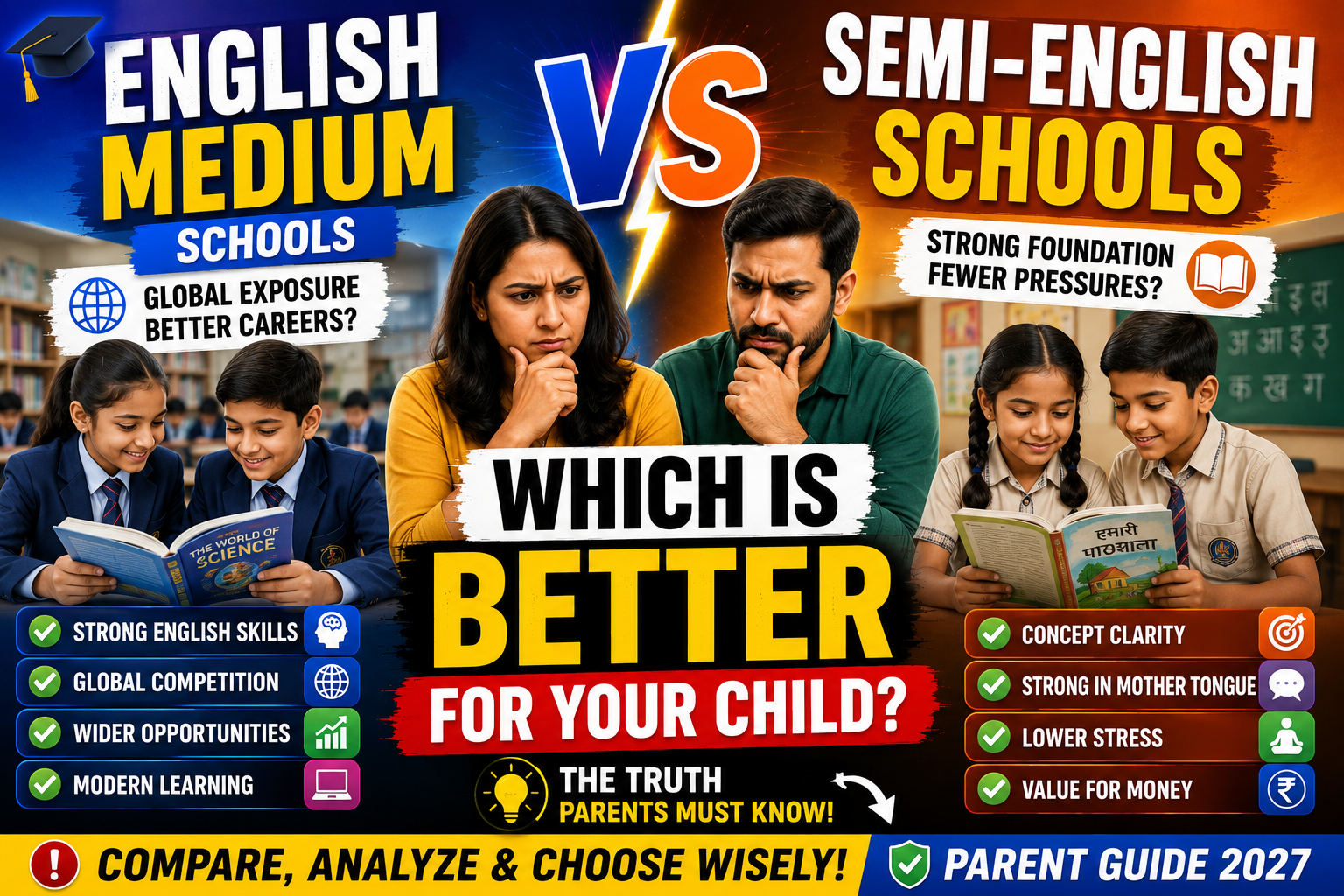
For many parents in Maharashtra, choosing a school medium is almost as important as choosing the school itself.
One admission form may say English Medium.
Another may say Semi-English.
For parents, the immediate questions are often:
- Will my child speak English fluently?
- Will English-medium schooling improve future opportunities?
- Is semi-English easier for children who are stronger in Marathi?
- Will my child struggle with Mathematics and Science in English?
- Is English medium always better?
- Which medium is better for competitive examinations?
- What happens if we change boards or schools later?
There is no single answer that applies to every child.
Maharashtra's education system includes schools operating through different instructional media, and the state has also provided for the introduction of a Semi-English curriculum in non-English-medium schools for Classes 1 to 8 under a government resolution.
That makes it especially important for parents to understand the actual classroom language, rather than choosing a school simply because its brochure uses the words “English Medium” or “Semi-English.”
The right question is:
Which language environment will help my child understand concepts, develop language skills and progress confidently?
What Is an English-Medium School?
In an English-medium school, English is used as the principal language of instruction.
This generally means that classroom teaching, explanations, textbooks and academic communication are substantially conducted in English.
However, parents should not assume that every subject is taught in exactly the same way in every school.
Ask the school:
- Which subjects are taught in English?
- Which textbooks are used?
- What language do teachers normally use while explaining difficult concepts?
- Are students expected to answer in English?
- How much Marathi or another language is used to support understanding?
The actual classroom experience matters more than the label.
What Is a Semi-English School?
The term Semi-English is particularly relevant in Maharashtra.
The Government of Maharashtra has previously issued provisions allowing non-English-medium schools to introduce a Semi-English curriculum for Classes 1 to 8, with the relevant curriculum and learning materials developed through the state's academic and textbook institutions.
In practical terms, parents commonly use “Semi-English” to describe a school where selected subjects—often subjects such as Mathematics and Science—are taught using English textbooks or English terminology while the broader instructional environment may continue to use Marathi or another regional language.
However, parents should not assume that every Semi-English school follows an identical model.
This is one of the most important points in this entire guide.
Before admission, ask the school to explain exactly:
“Which subjects are taught in English, which are taught in Marathi, and what language do teachers use during classroom explanations?”
That answer is more valuable than the label.
English Medium vs Semi-English: Key Comparison
| Factor | ||
| Main instructional language | Primarily English | Mixed language approach depending on school and subject |
| English exposure | Usually higher | Moderate to substantial depending on implementation |
| Regional-language support | May be available | Often stronger |
| Transition for regional-language learners | Can require adjustment | May feel more gradual |
| English academic vocabulary | Stronger daily exposure | Developed particularly through selected subjects |
| Concept explanation | Primarily English | Can involve regional-language support |
| Parent support at home | May require stronger English familiarity | Can be easier for parents comfortable with regional language |
| Future English exposure | Generally extensive | Depends on school and later education pathway |
| Suitability | Children comfortable learning in English | Children who benefit from additional language support may find it useful |
| Best choice | Depends on child and school quality | Depends on child and school quality |
This is a general comparison.
The exact medium and subject-wise language arrangement must be verified directly with each school.
Is English Medium Always Better?
No.
English is an important language and can provide extensive exposure to English vocabulary, reading and communication.
But language of instruction is not the same as quality of education.
A school can teach entirely in English and still have weak teaching.
Similarly, a Semi-English school can provide strong conceptual learning and excellent academic support.
Parents should therefore avoid this assumption:
English Medium = Better School
Instead think:
Good Teaching + Strong Understanding + Appropriate Language Support = Better Learning
The Maharashtra State Board itself provides for multiple examination media, including English and Marathi among other languages, showing that language medium and educational progression should not be treated as identical concepts.
When English Medium May Be a Good Choice
English-medium schooling may be worth considering if:
1. Your Child Is Already Comfortable With English
If your child understands basic English instructions, reads age-appropriate English and enjoys communicating in English, the transition may be easier.
2. Your Family Uses English Regularly
Parents who are comfortable helping with English reading, homework and school communication may find an English-medium environment easier to support.
3. You Want Strong Daily English Exposure
Regular exposure can help children become more familiar with:
- English vocabulary
- Reading
- Writing
- Listening
- Classroom communication
- Academic terminology
However, fluency still depends on how actively the child uses the language.
4. Your Child Plans to Move Into an English-Heavy Academic Environment
If future schooling is likely to involve extensive English-medium instruction, an English-medium foundation may make the transition more familiar.
When Semi-English May Be a Good Choice
Semi-English schooling may be worth considering when:
1. Your Child Understands Concepts Better With Regional-Language Support
A child may understand a difficult concept more quickly when the teacher can explain it using a familiar language.
2. Your Child Is Transitioning Toward English
Semi-English can potentially provide a bridge between a regional-language foundation and greater exposure to English academic terminology.
3. Parents Want Greater Home-Learning Comfort
Parents who are more comfortable with Marathi or another regional language may find it easier to discuss concepts and homework with the child.
4. The School Has Strong Teachers
This is crucial.
A well-trained teacher who can move effectively between languages may help students understand difficult concepts without compromising English exposure.
The Biggest Mistake: Comparing Labels Instead of Classrooms
Suppose you have two schools.
School A: English Medium
- English used throughout the day
- Strong infrastructure
- Large class size
- Limited individual attention
- Students memorise many answers
- Parents receive little academic feedback
School B: Semi-English
- Strong teachers
- Smaller classes
- Teachers explain difficult concepts clearly
- Students participate actively
- Regular feedback
- Strong academic support
Which is better?
There is no reason to automatically choose School A.
The medium matters, but the quality of teaching matters more.
This is consistent with DextroCampus's broader school-selection approach: parents should evaluate schools using transparent, evidence-based criteria rather than relying on labels or reputation alone.
English Skills vs Conceptual Understanding
Parents sometimes feel they must choose between:
English proficiency
and
Conceptual understanding.
They should not.
A strong school should aim to develop both.
For example, imagine a child learning a science concept.
If the child can repeat the English definition but cannot explain what the concept means, the language outcome may look impressive while actual understanding remains weak.
Conversely, a child may understand the concept extremely well but need additional support in expressing the answer in English.
The ideal environment works on both:
“I understand it.”
and
“I can explain it.”
What Parents Should Check Before Choosing English Medium
Ask these questions during a school visit:
English Proficiency
- How much English is spoken inside the classroom?
- Are students encouraged to speak English?
- How does the school support children who are weak in English?
Academic Learning
- How are difficult concepts explained?
- Can teachers provide additional language support?
- How are learning gaps identified?
Reading
- Does the school have a structured reading programme?
- How frequently do children read books beyond textbooks?
Writing
- How do teachers develop vocabulary and writing skills?
- Is writing assessed regularly?
Speaking
- Are students given opportunities for presentations and discussions?
These questions help distinguish genuine English development from simply using English textbooks.
What Parents Should Check Before Choosing Semi-English
For a Semi-English school, ask more detailed questions.
Subject-Wise Medium
Ask:
“Which subjects are taught in English?”
Then ask:
“Which subjects are taught in Marathi?”
Do not stop there.
Ask:
“When a child does not understand a concept, which language does the teacher use to explain it?”
Textbooks
Ask:
- Which textbooks are used?
- Are English textbooks used for Mathematics and Science?
- Are supplementary English materials provided?
Assessment
Ask:
- In which language are tests conducted?
- Can students answer in English?
- How does the school transition students toward greater English usage?
Future Classes
Ask:
“Does the language pattern change as the child moves into higher classes?”
This can be especially important when planning a child's long-term education.
English Medium vs Semi-English: Academic Comparison
| Academic Factor | English Medium | Semi-English |
| English academic vocabulary | High daily exposure | Develops through selected subjects |
| Regional-language support | Depends on school | Often more accessible |
| Concept explanation | English-focused | May use multiple languages |
| English speaking practice | Potentially greater | Depends on school |
| Transition to English-heavy curriculum | May be smoother | May require additional adjustment |
| Concept clarity | Depends on teaching | Depends on teaching |
| Exam performance | Depends on teaching and preparation | Depends on teaching and preparation |
| Future readiness | Depends on overall education | Depends on overall education |
The key word in almost every row is:
Depends.
There is no substitute for evaluating the individual school.
What About Competitive Examinations?
Parents often ask whether English-medium schooling provides an advantage for future competitive examinations.
The answer depends on the examination, stage of education, preparation strategy and language requirements applicable at that time.
For school-age children, the priority should be building:
- Strong fundamentals
- Reading ability
- Mathematical reasoning
- Scientific understanding
- Vocabulary
- Communication
- Problem-solving
Parents should not force a language decision solely because they are thinking about an examination several years in the future.
Build strong learning foundations first.
What About Changing From Semi-English to English Medium?
Changing schools later is possible, but parents should plan the transition carefully.
A child moving from Semi-English to an English-medium school may need additional support with:
- English vocabulary
- Written answers
- Reading comprehension
- Subject-specific terminology
- Classroom instructions
- Speaking confidence
The transition can be easier when the child has already developed strong English reading and comprehension skills.
Parents should therefore avoid waiting until the last moment to build English proficiency.
What About Changing From English Medium to Semi-English?
This may also require adjustment.
A child accustomed to English academic terminology may need time to become comfortable with regional-language explanations or textbooks.
Again, the exact experience depends on the school.
Before changing, compare:
- Board
- Curriculum
- Textbooks
- Subject medium
- Assessment language
- Class level
- Teacher support
The Child's Age Matters
The same medium decision may not have the same impact at every age.
Early Primary
Focus on:
- Language development
- Reading
- Basic numeracy
- Confidence
- Conceptual foundations
Upper Primary
Focus increasingly on:
- Subject vocabulary
- Independent reading
- Writing
- Problem-solving
- Academic communication
Secondary School
Parents should also consider:
- Board curriculum
- Examination language
- Subject requirements
- Future academic plans
- Competitive examination pathway
The older the child, the more important it becomes to examine the transition implications carefully.
Parent Decision Matrix
| Your Child's Situation | What to Investigate |
| Strong English comprehension | English-medium options may be comfortable |
| Strong regional-language foundation | Semi-English may offer a gradual transition |
| Weak English but strong concepts | Check language-support systems |
| Strong English but weak concepts | Prioritise teaching quality |
| Parents not comfortable with English | Check home-learning support |
| Planning a school change | Compare subject-wise medium carefully |
| Moving to another board | Check curriculum and assessment language |
| Child is very young | Prioritise foundational learning |
| Child is entering secondary school | Examine long-term language and board implications |
| Child struggles academically | Focus on teacher support and concept clarity |
10 Questions Every Parent Should Ask Before Admission
- What exactly does “Semi-English” mean in your school?
- Which subjects are taught in English?
- Which subjects are taught in Marathi or another language?
- What language do teachers use when explaining difficult concepts?
- What language are examinations and class tests conducted in?
- How do you support children who are weak in English?
- How do you build English reading and speaking skills?
- Does the subject medium change in higher classes?
- What happens if a child changes from another medium?
- Can parents see examples of textbooks and assessment papers before admission?
These questions can prevent major misunderstandings later.
Red Flags Parents Should Watch For
Be cautious if:
- The school cannot clearly explain its medium structure.
- “Semi-English” is used without specifying subject-wise language.
- Parents are promised fluent English without a clear language-development programme.
- Teachers rely heavily on memorisation.
- Children are discouraged from asking questions because of language barriers.
- The school cannot explain how it supports students who struggle with English.
- The language used during the admission presentation is very different from the classroom language.
- Parents cannot see sample textbooks or assessment formats.
These are not automatic signs of a poor school.
They are signals that parents should investigate further.
Parents should verify the exact medium, curriculum and subject-wise teaching arrangement directly with the school management.
A 100-Point School Medium Scorecard
Instead of scoring only the language medium, score the entire school.
| Factor | Weight |
| Teaching quality | 20 |
| Conceptual understanding | 15 |
| English language development | 15 |
| Academic support | 10 |
| Student participation | 10 |
| Assessment and feedback | 10 |
| Reading and communication | 5 |
| Parent communication | 5 |
| School environment | 5 |
| Commute and practicality | 5 |
| Total | 100 |
This is a parent decision-making framework, not an official rating system.
The purpose is to prevent one factor—such as “English Medium”—from dominating the entire school decision.
English Medium vs Semi-English: Pros and Cons
English Medium
Pros
- Greater daily English exposure
- Regular English academic vocabulary
- Potentially easier transition to English-heavy higher education
- More frequent English communication opportunities
- Can build confidence in English when supported properly
Cons
- May be challenging for children with limited English comprehension
- Parents may find homework support difficult if they are less comfortable with English
- Weak teaching can result in memorisation without understanding
- A child may hesitate to ask questions because of language anxiety
Semi-English
Pros
- Can provide regional-language support
- May help children understand difficult concepts more comfortably
- Can introduce English academic terminology progressively
- May be easier for some families to support at home
- Can provide a bridge toward greater English exposure
Cons
- English exposure may vary significantly by school
- The exact meaning of “Semi-English” can differ in practice
- Children may receive less English speaking practice than in a strong English-medium environment
- Parents need to verify the subject-wise medium carefully
How to Make the Final Decision
Use this five-step approach.
Step 1: Assess Your Child
Consider:
- Current English comprehension
- Reading ability
- Confidence
- Learning style
- Academic strengths
- Academic difficulties
Step 2: Understand the School's Medium
Do not rely on the admission brochure.
Ask for the exact subject-wise arrangement.
Step 3: Evaluate Teaching Quality
Observe whether teachers explain concepts clearly.
Step 4: Consider the Long-Term Path
Think about:
- Board
- Higher classes
- Future school changes
- Academic goals
- Language requirements
Step 5: Choose Learning, Not Labels
The strongest choice is the school where your child can understand concepts, develop language skills and learn confidently.
What Parents in Maharashtra Should Remember
The term Semi-English has particular relevance in Maharashtra because the state has had formal provisions for introducing Semi-English curricula in non-English-medium schools.
At the same time, the Maharashtra State Board operates with multiple examination media, including English and Marathi.
Therefore, parents should avoid treating:
English Medium = one fixed educational model
or
Semi-English = one fixed educational model.
The individual school's implementation matters.
This is especially important when comparing schools around Mumbai, Thane, Vasai, Virar, Mira Road, Bhayandar, Nalasopara, Naigaon and Palghar.
For example, DextroCampus school listings in the Vasai-Virar region show schools operating through different media, including English medium and Semi-English options, reinforcing the importance of checking the exact school-level arrangement rather than relying only on a broad category.
Frequently Asked Questions
1. Is English-medium school better than Semi-English school?
Not automatically. English-medium schools generally provide greater English exposure, while Semi-English schools may provide additional regional-language support. Parents should compare teaching quality, conceptual understanding, English development and the child's needs.
2. What does Semi-English mean in Maharashtra?
The term is used for a model in which selected subjects may be taught through English within a non-English-medium school. Maharashtra has formally provided for Semi-English curricula in non-English-medium schools for Classes 1 to 8. However, parents should verify the exact subject-wise arrangement with each school.
3. Will English-medium schooling improve my child's English?
It can provide greater daily exposure to English, but exposure alone does not guarantee fluency. Reading, speaking, writing, teacher support and regular communication practice also matter.
4. Is Semi-English suitable for a child who is weak in English?
It may be suitable for some children because additional regional-language support can make concept learning more comfortable. Parents should check how much English is actually used and whether the school has a structured English-development programme.
5. Which medium is better for future competitive examinations?
There is no universal answer. The examination, board, stage of education and applicable language options matter. Parents should prioritise strong fundamentals, comprehension, reasoning, communication and subject knowledge rather than choosing a medium based only on a future examination.
6. What should parents ask a Semi-English school before admission?
Ask which subjects are taught in English, which are taught in Marathi or another language, what language teachers use for explanations, what language assessments use, how English skills are developed and whether the medium changes in higher classes.
Conclusion & Parent Checklist
The English Medium vs Semi-English decision is not really a contest between two labels.
It is a decision about how your child learns best.
English-medium schooling can provide strong daily English exposure and may suit children who are comfortable learning in English.
Semi-English schooling may provide a useful balance for children who benefit from regional-language support while developing English academic vocabulary.
But neither option automatically guarantees better education.
The most important factors remain:
Teaching quality + Conceptual Understanding + Language Development + Student Support + Child Fit
Parent Checklist
- Assess your child's current English comprehension.
- Check reading and speaking ability.
- Ask the school exactly what “English Medium” means in practice.
- Ask the school exactly what “Semi-English” means.
- Get the subject-wise medium in writing if possible.
- Ask what language teachers use to explain difficult concepts.
- Check the language of textbooks and assessments.
- Ask how the school supports children who struggle with English.
- Evaluate English reading and speaking opportunities.
- Check whether the medium changes in higher classes.
- Compare teaching quality, not just school labels.
- Consider your child's future school and board transition.
- Evaluate the child's confidence and comfort.
- Consider how easily parents can support learning at home.
- Verify the school's exact medium and curriculum directly with the school management or relevant official authority.
Expert Takeaway
Do not choose English Medium simply because it sounds more modern.
Do not choose Semi-English simply because it sounds easier.
Choose the environment where your child can understand concepts deeply, develop strong language skills, ask questions confidently and progress without unnecessary learning barriers.
For parents in Maharashtra, the smartest approach is simple:
Ask what is actually taught, how it is taught, and how your child will learn—not just what the school calls its medium.
Tags:
Get Weekly Insights
Join 10k+ parents getting smarter about education.