
Can Parents Ask for a Detailed School Fee Breakup in 2027? Complete Parent Guide
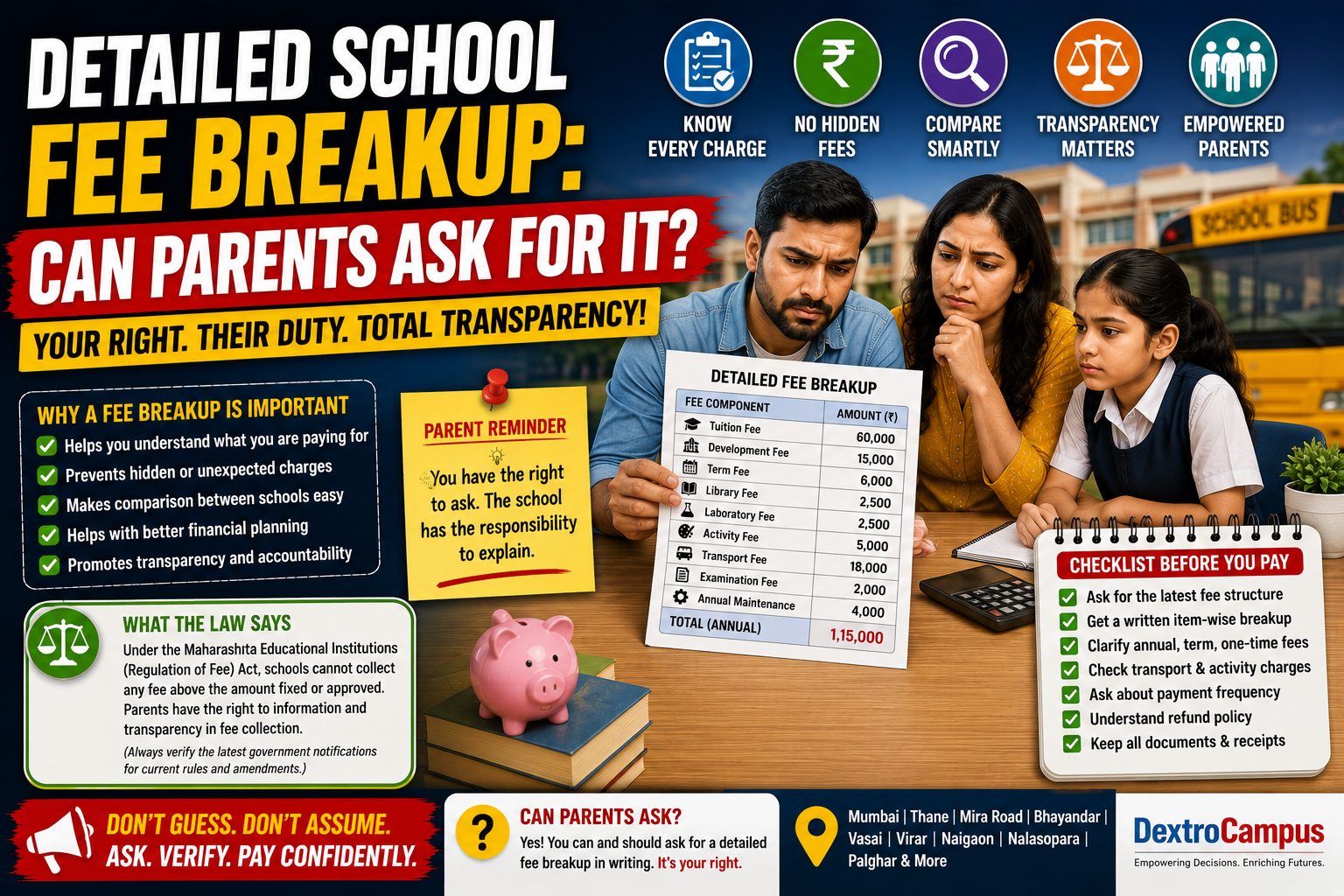
A school may tell a parent:
"The annual fee is ₹1.20 lakh."
That sounds simple.
But what exactly does ₹1.20 lakh include?
Does it cover:
- Tuition?
- Term fee?
- Development charges?
- Transport?
- Activities?
- Examination?
- Library?
- Laboratory?
- Admission-related charges?
- Other services?
This is why a detailed school fee breakup matters.
For parents preparing for 2027 school admission, the headline annual amount is only the starting point. The real question is whether you understand every fee component, its frequency, whether it is compulsory and whether it forms part of the applicable fee structure.
For families across Mumbai, Thane, Mira Road, Bhayandar, Vasai, Naigaon, Nalasopara, Virar and Palghar, an itemised fee comparison can make school selection significantly more transparent.
1. What Is a Detailed School Fee Breakup?
A detailed fee breakup is an itemised explanation of the different charges that make up the total school fee.
Instead of simply saying:
Annual Fee: ₹1,20,000
a clearer structure could identify applicable components such as:
| Fee Component | |
| Tuition fee | ₹70,000 |
| Term-related fee | ₹10,000 |
| Activity-related charges | ₹5,000 |
| Examination fee | ₹2,000 |
| Library/laboratory-related charges | ₹3,000 |
| Transport | ₹20,000 |
| Other applicable charges | ₹10,000 |
| Total | ₹1,20,000 |
This is an illustrative example only. These are not actual fees charged by a particular school.
The purpose is to show parents what an itemised structure looks like.
2. Can Parents Ask the School for a Fee Breakup?
Yes. Parents should ask for one.
The Maharashtra Educational Institutions (Regulation of Fee) Act, 2011 is specifically intended to regulate fee collection by educational institutions in Maharashtra. The Act contains provisions covering fee determination, prohibition of excess fee, Parent-Teacher Associations, fee-regulatory committees, accounts and records.
The 2019 amendment also defines "fee" through multiple components, including tuition, term, library, laboratory, gymkhana, caution money, examination, hostel/mess, admission and specified curricular/co-curricular amounts.
Therefore, parents should not hesitate to ask:
"Please provide the complete item-wise fee structure applicable to my child's class."
That is a practical and sensible admission question.
3. Why Is a Fee Breakup Important?
A detailed breakup helps parents answer five important questions.
1. What am I paying for?
You can identify the purpose of each amount.
2. How much is tuition?
This allows a meaningful school-to-school comparison.
3. Which charges are additional?
Transport, activities and other services can materially change the total.
4. Which charges are recurring?
A one-time payment is different from an annual payment.
5. What is the actual annual cost?
This is the most important number for family budgeting.
4. What Fee Components Can Parents See?
The exact structure varies by school and applicable regulations.
Under Maharashtra's 2019 amendment, the statutory definition of "fee" includes:
- Tuition fee
- Term fee
- Library fee
- Laboratory fee
- Gymkhana fee
- Caution money
- Examination fee
- Hostel and mess charges
- Admission fee
- Security amounts or prescribed curricular/co-curricular payments
- Other amounts payable towards curricular or co-curricular activities or facilities provided by the school
This does not mean every school must charge every category.
It means parents should understand what each amount on their school's fee document represents.
5. Tuition Fee vs Other Charges
Parents frequently make one mistake:
They compare tuition instead of total cost.
Imagine:
School A
Tuition: ₹80,000
Other applicable charges: ₹25,000
Total: ₹1,05,000
School B
Tuition: ₹90,000
Other applicable charges: ₹10,000
Total: ₹1,00,000
School B has higher tuition but lower total cost in this hypothetical example.
Therefore:
Compare the total applicable annual cost, not just tuition.
6. Ask Whether Each Charge Is Monthly, Term-Wise or Annual
This is one of the most important questions parents can ask.
For every fee component, identify its frequency.
| Fee | |
| Tuition | Monthly/other applicable schedule |
| Term fee | Term-wise |
| Activity fee | Annual/term-wise/other |
| Transport | Monthly/annual/other |
| Examination | As applicable |
| Admission fee | Usually admission-related |
| Deposit | One-time/subject to terms |
The actual frequency depends on the school's applicable fee structure.
Maharashtra's 2019 amendment provides that fees are to be paid monthly, bi-monthly or quarterly as decided by school management, while parents intending to pay half-yearly or yearly must be allowed to do so; a rebate may be offered at management's discretion.
7. What Does "Annual Fee" Actually Mean?
Parents should never assume that:
Annual Fee = Tuition × 12
An annual figure may include multiple components.
Ask:
"Does the quoted annual amount include all compulsory charges?"
Then ask:
"Are transport and activity charges included or separate?"
Finally:
"Are there any additional payments I should budget for during the academic year?"
This three-question approach can expose a significant difference between the advertised fee and the family's actual schooling cost.
8. Ask About One-Time Charges Separately
Some payments may be one-time or admission-related.
Parents should identify:
- Admission-related charges
- Security deposits
- Caution money
- Registration-related charges, where applicable
- Initial transport charges
- Other first-year expenses
The Maharashtra amendment separately identifies admission fee and caution money within its statutory definition of fee. It also provides that admission fee should not exceed one month's tuition fee under the amended provision.
Parent Tip
Create two columns:
First-Year Cost
and
Recurring Annual Cost
This prevents one-time charges from being mistaken for recurring expenses.
9. Ask About Development Charges
If a school lists:
Development Fee
or
Infrastructure Charges
ask:
"What exactly does this amount cover?"
Then ask:
"Is it part of the current applicable fee structure?"
The word "development" by itself does not tell parents enough.
The school's fee documentation should help parents understand the relevant fee component.
For a broader explanation, parents can also read the DextroCampus guide on School Development Fee 2027.
10. Ask About Transport Separately
Transport can become a significant annual expense.
Ask:
- Is transport compulsory?
- Is it optional?
- Is it included in the school fee?
- What is the route-wise fee?
- Is the amount monthly or annual?
- Are GPS or other services included?
- Are there additional transport charges?
Do not allow transport to disappear inside a single "total fee" figure.
If your child does not need transport, you should know whether that amount can be excluded.
11. Ask About Activity Charges
Activity-related expenses can include:
- Sports
- Music
- Dance
- Clubs
- Workshops
- Competitions
- Educational programmes
The Maharashtra fee amendment includes curricular and co-curricular activities and facilities within its definition of fee.
Parents should ask:
"Which activities are included in the quoted fee?"
and:
"Which activities have separate charges?"
Also ask whether materials, competitions, trips or specialist programmes cost extra.
12. What If the School Gives Only a Total Figure?
Suppose the school says:
"The total is ₹1,35,000."
You can politely ask:
"Could you please share the item-wise breakup for my child's grade?"
If the answer is:
"Everything is included."
ask:
"Could you please confirm what 'everything' includes?"
A written document is preferable.
You should be able to identify the relevant fee heads rather than relying solely on a verbal explanation.
13. What If the School Says the Fee Structure Is on Its Website?
That is useful—but parents should still verify that they are looking at the current academic year's applicable fee structure.
Check:
- Academic year
- Grade/class
- School branch
- Fee period
- Applicable services
- Transport
- Activity charges
- Payment schedule
- Any revised notification
Do not assume an old PDF or brochure applies to 2027.
The Maharashtra fee framework contains provisions relating to fee determination and disclosure, and the Act establishes a structure for fee regulation and parent participation.
14. Ask for the Fee Structure for the Correct Grade
A common mistake is comparing a school's fee for one class with another school's fee for a different class.
Ask specifically for:
School:
Board:
Academic Year: 2027–28:
Class/Grade:
Division, if relevant:
Transport required: Yes/No
Applicable optional services:
This creates a fairer comparison.
15. Ask Whether the Fee Is the Same for Every Grade
Fees can vary by:
- Grade
- Facilities
- Laboratory requirements
- Activities
- Academic level
- Transport
- School section
Therefore, never assume:
"If Class 3 costs ₹X, Class 6 will cost the same."
Ask for the fee applicable to your child's actual grade.
16. Ask Which Charges Are Compulsory
This is extremely important.
Create three categories:
Compulsory
Every student must pay.
Optional
Parents can choose whether to use the service.
Conditional
The amount applies only if a particular service or activity is selected.
For example:
| Charge | ||
| Verify | ||
| Transport | Depends on use/policy | Verify |
| Activity | Verify | Verify |
| Examination | Verify | Verify |
| Trip | Verify | Verify |
| Club | Verify | Verify |
Do not assume.
Ask the school.
17. Ask About Refundable Deposits
If the fee document includes:
- Security deposit
- Caution money
- Deposit
- Other refundable amount
ask:
"Under what conditions is this amount returned?"
Also ask:
"When is it returned?"
And:
"What deductions, if any, can be made?"
Keep the answer with your admission documents.
18. Ask About Fee Payment Frequency
A school may quote:
₹1,20,000 annual fee
but collect it through instalments.
Parents should ask:
- Monthly?
- Bi-monthly?
- Quarterly?
- Half-yearly?
- Yearly?
Maharashtra's 2019 amendment specifically addresses payment frequency and allows parents who intend to pay half-yearly or yearly to do so, while a rebate may be offered at the school's discretion.
Important
Payment frequency does not change the importance of knowing the total annual fee.
19. Can Parents Compare Fee Breakups Between Schools?
Absolutely—and they should.
Use a standard comparison format:
| Fee Component | |||
| Tuition | ₹ | ₹ | ₹ |
| Term fee | ₹ | ₹ | ₹ |
| Development-related fee | ₹ | ₹ | ₹ |
| Activities | ₹ | ₹ | ₹ |
| Examination | ₹ | ₹ | ₹ |
| Transport | ₹ | ₹ | ₹ |
| Books/uniform | ₹ | ₹ | ₹ |
| Other applicable charges | ₹ | ₹ | ₹ |
| Total annual cost | ₹ | ₹ | ₹ |
This makes comparison much easier.
20. Why Comparing Only the Total Is Also Not Enough
The total annual figure tells you how much.
The breakup tells you why.
Suppose:
School A
Total: ₹1,10,000
School B
Total: ₹1,15,000
The ₹5,000 difference may not tell you much.
But after seeing the breakup, you may discover:
- School B includes transport.
- School B includes activities.
- School B includes examination charges.
- School A charges those separately.
Now the comparison becomes meaningful.
21. What Should Parents Do If a Fee Head Is Unclear?
Do not guess.
Ask:
"What service or facility does this fee cover?"
Then:
"Is this charge mandatory?"
Then:
"Is this amount included in the approved/applicable fee structure?"
And finally:
"Can you provide the explanation in writing?"
The objective is clarity—not confrontation.
22. What If Parents Suspect an Excess Fee?
The Maharashtra Educational Institutions (Regulation of Fee) Act prohibits covered schools from collecting fees above the fee fixed or approved under the applicable framework. The Act also establishes Divisional Fee Regulatory Committees to adjudicate specified disputes between school management and Parent-Teacher Associations regarding fees.
If you believe a school has charged an amount that does not match the applicable fee structure:
First
Ask the school for clarification.
Second
Compare the payment request with the applicable fee document.
Third
Keep receipts and written communication.
Fourth
If unresolved, investigate the appropriate grievance mechanism.
Do not make a public accusation before verifying the documents.
23. Parents Should Keep Every Fee Document
Create one digital folder containing:
- Fee structure
- Admission form
- Offer/admission letter
- Payment receipts
- Transport form
- Activity information
- Refund policy
- School circulars
- Emails
- Written clarifications
This can become extremely useful if there is a disagreement later.
24. Red Flags in a School Fee Structure
🚩 Only a Total Amount Is Given
There is no clear itemisation.
🚩 Fee Heads Are Vague
Terms such as "miscellaneous" appear without explanation.
🚩 Old Academic Year
The document is clearly from an earlier year.
🚩 Different Amounts Are Quoted
The brochure, website and accounts office show different totals.
🚩 Optional Services Are Not Identified
Parents cannot tell what they can decline.
🚩 Payment Schedule Is Missing
There is no clear information about when amounts are due.
🚩 Refund Terms Are Unclear
Parents cannot understand what happens if admission is cancelled.
These are reasons to pause and verify, not automatic proof of a violation.
25. A Five-Minute Fee Breakup Audit
Before paying, follow these steps.
Step 1 — Identify the Total
Write down the complete annual amount.
Step 2 — Break It Down
List every fee head.
Step 3 — Mark Frequency
Write:
Monthly / Term-wise / Annual / One-time
Step 4 — Mark Status
Write:
Compulsory / Optional / Conditional
Step 5 — Calculate
Add the applicable amounts yourself.
Step 6 — Compare
Use the same calculation for every shortlisted school.
Step 7 — Save
Keep the school's written fee document.
26. A Parent-Friendly Fee Worksheet
| Question. & Answer | |
| Academic year | 2027–28 |
| Child's grade | ______ |
| Tuition | ₹______ |
| Term fee | ₹______ |
| Annual charges | ₹______ |
| Development-related charge | ₹______ |
| Activity fee | ₹______ |
| Examination fee | ₹______ |
| Transport | ₹______ |
| Books | ₹______ |
| Uniform | ₹______ |
| Other applicable charges | ₹______ |
| Total annual cost | ₹______ |
| Monthly budget equivalent | ₹______ |
| Refund policy received? | Yes / No |
| Fee breakup received in writing? | Yes / No |
This simple worksheet can make school comparison significantly easier.
27. How Parents Can Ask Without Creating Conflict
You do not need to approach the school aggressively.
Use a professional question:
"We are comparing our shortlisted schools based on total annual cost. Could you please provide the complete item-wise fee structure applicable to this grade, including compulsory and optional charges?"
Then ask:
"Could you also clarify which charges are one-time and which recur each year?"
This is reasonable, clear and parent-friendly.
28. Why a Fee Breakup Helps With Family Budgeting
School expenses are rarely limited to tuition.
A realistic annual budget may include:
School fee
Transport
Activities
Books
Uniform
Equipment
Trips
Other applicable expenses
The detailed breakup helps parents estimate the actual yearly commitment.
This is particularly important for families comparing schools across Maharashtra's Mumbai Metropolitan Region, where commuting and optional services can significantly affect total education costs.
29. Mumbai, Thane and Vasai-Virar Parent Perspective
For families in:
- Mumbai
- Thane
- Mira Road
- Bhayandar
- Vasai
- Naigaon
- Nalasopara
- Virar
- Palghar
school selection often involves comparing multiple schools with different fee structures.
One school may advertise a low tuition figure but charge transport and activities separately.
Another may have a higher tuition figure but bundle more services.
Therefore:
The most useful comparison is an item-by-item annual comparison.
Not:
"Which school has the lowest monthly fee?"
30. What Parents Should Ask Before Paying Any Large Amount
Use this master checklist:
- What is the complete annual fee?
- What is the tuition fee?
- What is the term fee?
- Are there annual charges?
- Is there a development-related fee?
- Is transport separate?
- Is the activity fee separate?
- Are examination charges included?
- Are books included?
- Are uniforms included?
- Which charges are compulsory?
- Which charges are optional?
- Which charges are one-time?
- Which charges recur?
- Is there a refundable deposit?
- What is the refund policy?
- How frequently are payments collected?
- Is the fee structure current for 2027–28?
- Can the complete breakup be provided in writing?
- Have I compared the total annual cost with other schools?
31. The One Question Parents Should Remember
If you remember only one question from this article, ask:
"Please provide the complete item-wise fee breakup for my child's grade for the 2027–28 academic year, including all compulsory, optional, recurring and one-time charges."
Then keep the response.
That document can become one of the most useful pieces of information in your school-selection process.
Frequently Asked Questions (FAQs)
1. Can parents ask schools for a detailed fee breakup?
Yes. Parents should request the current item-wise fee structure for their child's grade and academic year before making a major admission payment. Maharashtra's fee-regulation framework contains provisions dealing with fee determination, regulation and parent participation.
2. What should a school fee breakup include?
It should clearly identify the applicable fee components, such as tuition and other relevant charges, along with payment frequency and any one-time or optional amounts. The exact categories vary by school and applicable regulations.
3. Can schools charge separate activity and transport fees?
The treatment depends on the school's fee structure and applicable rules. Maharashtra's 2019 amendment includes certain curricular and co-curricular activities and facilities within the statutory definition of fee. Parents should ask whether transport and activities are included or separately charged.
4. Should parents compare tuition fees or total annual fees?
Parents should compare total annual cost, while also examining the individual components. A school with lower tuition can still have a higher overall cost after transport, activities and other applicable charges are included.
5. What if a school refuses to explain an unclear fee?
Ask for the current fee structure and written clarification. If you believe the school is collecting an amount above the applicable fixed or approved fee, retain the documents and investigate the appropriate grievance mechanism. Maharashtra's Act provides for Divisional Fee Regulatory Committees in specified fee disputes.
6. Can parents ask which fees are compulsory and which are optional?
Yes. This is one of the most useful questions to ask before admission. Parents should request a clear distinction between compulsory charges, optional services and charges that apply only in particular circumstances.
Conclusion & Parent Checklist
A school fee of ₹1 lakh, ₹1.5 lakh or ₹2 lakh tells parents only one thing:
How much the school says the total is.
It does not automatically tell you:
- What you are paying for.
- Which amount is tuition.
- Which amount is transport.
- Which amount is activity-related.
- Which amount is recurring.
- Which amount is one-time.
- Which amount is optional.
- What happens if you later cancel admission.
That is why a detailed school fee breakup is one of the most important documents parents should request before paying.
Maharashtra's fee-regulation framework recognises multiple fee components and provides mechanisms for fee determination, parent participation and dispute resolution. The 2019 amendment also expressly expanded the statutory definition of fee to cover several curricular and co-curricular amounts and facilities.
For parents across Mumbai, Thane, Mira Road, Bhayandar, Vasai, Naigaon, Nalasopara, Virar and Palghar, the smartest approach is simple:
Ask for the breakup.
Check every component.
Separate compulsory from optional.
Calculate the real annual cost.
Get unclear answers in writing.
And remember:
Do not pay based on a headline number when you can understand the complete fee structure first.
A transparent fee structure helps parents make a better financial decision—and helps them compare schools based on the real cost of education, not just the number displayed in an advertisement.
Ask. Verify. Compare. Then pay.
Tags:
Get Weekly Insights
Join 10k+ parents getting smarter about education.