Day School vs Residential School: Which Is Right for Your Child in 2027?
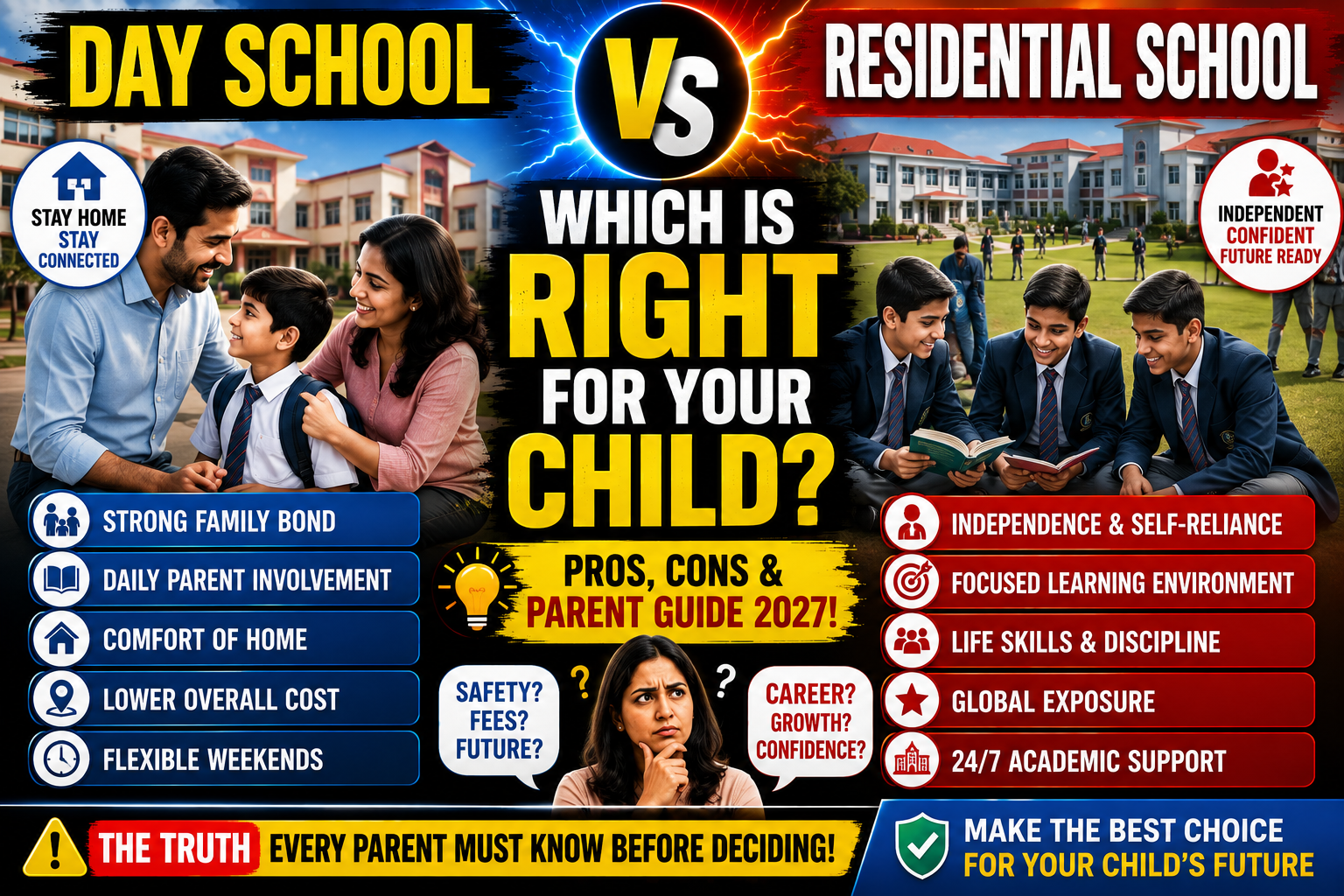
One of the biggest school decisions parents can face is not simply which school to choose, but what type of school environment is right for their child.
Should the child attend a day school and return home every afternoon?
Or should the child live on or near the school campus in a residential or boarding environment?
Both models can provide a strong education.
But they create very different daily experiences.
A day-school student usually divides life between school and home. Parents remain closely involved in homework, routines, meals, activities and emotional support.
A residential-school student spends a much larger part of the week within the school community. Academic schedules, meals, activities, study periods and daily routines are more structured around campus life.
That difference makes this decision much bigger than an academic comparison.
It involves:
- Education
- Independence
- Family relationships
- Emotional readiness
- Safety
- Time management
- Social development
- Cost
- Travel
- Future goals
For parents in Mumbai, Thane, Vasai, Virar, Mira Road, Bhayandar, Nalasopara, Naigaon and Palghar, the practical side of this decision is equally important.
The right question is not:
“Is boarding school better than day school?”
It is:
“Which environment will help my child learn, grow and remain emotionally comfortable?”
What Is a Day School?
A day school is a school where students attend classes during scheduled school hours and return home after the school day.
The child's daily routine generally includes:
- Morning preparation at home
- School attendance
- Classes
- Lunch or school activities
- Sports and extracurricular activities
- Return home
- Homework or study
- Family time
- Sleep at home
The exact timetable differs between schools.
One of the biggest advantages of this model is that parents remain closely connected with the child's everyday life.
What Is a Residential School?
A residential school, often referred to as a boarding school, provides accommodation for students as part of the school experience.
Students may live in designated residential facilities and follow a structured routine that can include:
- Classes
- Study periods
- Meals
- Sports
- Activities
- Recreation
- Supervised residential time
- Bedtime routines
The exact arrangement varies considerably between schools.
Some residential schools may have different boarding schedules, such as full boarding, weekly boarding or other arrangements.
Therefore, parents should ask the school exactly how many days students stay on campus and how frequently they can return home.
Day School vs Residential School: Key Comparison
| FactorDay SchoolResidential School | ||
| Living arrangement | Child lives at home | Child lives in school accommodation |
| Parent involvement | Usually high | More structured and indirect |
| Family time | Daily | Limited during residential periods |
| Independence | Develops mainly at home and school | Often becomes part of daily routine |
| School routine | School hours | Academic + residential routine |
| Peer interaction | Mainly during school | Extends beyond classroom hours |
| Extracurricular exposure | Depends on school timing | Can be integrated into daily schedule |
| Travel | Usually daily commute | Usually limited school commute |
| Home support | Easily available | Less immediate |
| Adjustment | Often easier for younger children | May require greater maturity |
| Cost | Varies by school | Can be substantially higher depending on school |
| Best fit | Children who value family routine | Children ready for structured independence |
This is a general comparison.
The actual experience depends on the school, boarding facilities, class structure, supervision and child.
Advantages of Day School
1. Strong Daily Family Connection
One of the biggest advantages of a day school is that children return home regularly.
Parents can observe:
- Mood
- Homework habits
- Eating patterns
- Friendships
- Academic difficulties
- Stress
- Daily behaviour
This can make it easier to notice problems early.
For younger children, this daily connection can be especially valuable.
2. Familiar Home Environment
Children can study and sleep in a familiar environment.
They have regular access to:
- Parents
- Siblings
- Extended family
- Familiar food
- Home routines
- Personal belongings
- Local community
For some children, this stability can support emotional comfort.
3. Easier Parent Involvement
Parents can directly participate in:
- Homework
- Reading
- School projects
- PTMs
- Revision
- Daily routines
- Extracurricular activities
However, parents should avoid turning involvement into excessive academic pressure.
The goal should be support, not micromanagement.
4. More Flexible Family Routine
Day-school families may find it easier to plan:
- Family events
- Weekend activities
- Local sports
- Tuition
- Medical appointments
- Religious or cultural events
- Visits with relatives
The child's routine remains closely connected to the family schedule.
5. Potentially Easier for Younger Children
Younger children may need more emotional and practical support.
A day-school environment allows them to develop school independence while still returning to the family environment every day.
This does not mean younger children cannot attend residential schools.
It simply means parents should evaluate maturity and emotional readiness carefully rather than assuming that age alone determines suitability.
Advantages of Residential School
1. Development of Independence
Residential schooling can give children more responsibility for everyday routines.
Students may need to manage:
- Personal belongings
- Study schedules
- Time
- Uniforms
- Activities
- Shared living spaces
- Daily responsibilities
These experiences can encourage independence.
But independence should be developed with appropriate adult supervision.
2. Structured Daily Routine
Residential schools can provide a highly organised schedule.
A typical day may include dedicated periods for:
- Classes
- Study
- Meals
- Sports
- Activities
- Recreation
- Rest
For some children, structure can help them develop stronger time-management habits.
For others, an overly rigid routine may feel uncomfortable.
Parents should therefore understand the actual daily timetable before admission.
3. Extended Peer Interaction
Residential students spend more time with classmates outside regular lessons.
They may:
- Study together
- Participate in sports
- Attend activities
- Share residential spaces
- Work on projects
- Develop friendships
This can create strong peer relationships.
However, it also means parents should carefully evaluate the school's approach to:
- Bullying
- Conflict
- Student discipline
- Peer pressure
- Privacy
- Emotional support
4. More Time for Activities
Because students remain on campus for longer periods, some residential schools may be able to integrate sports, arts, clubs and other activities into the daily routine.
Parents should not assume that every residential school offers the same opportunities.
Ask:
“How many hours per week does my child actually get to participate?”
A brochure listing twenty activities is less useful than knowing what students genuinely experience.
5. Potentially Stronger Self-Management Skills
Living away from home can require students to make more everyday decisions.
Over time, this may help develop:
- Responsibility
- Time management
- Organisation
- Adaptability
- Self-discipline
- Collaboration
But these benefits depend heavily on the school's residential culture and supervision.
The Biggest Question: Is Your Child Ready?
This may matter more than the school's reputation.
A child can be academically strong and still not be emotionally ready for residential schooling.
Before choosing boarding, consider whether your child can:
- Sleep comfortably away from parents.
- Follow a routine without constant parental reminders.
- Manage personal belongings.
- Ask adults for help when needed.
- Handle minor conflicts independently.
- Adjust to shared spaces.
- Follow school rules.
- Communicate when feeling unhappy or uncomfortable.
- Stay away from home for extended periods.
- Maintain friendships in a structured environment.
If several answers are “no”, parents should investigate the transition more carefully.
Day School vs Residential School: Emotional Readiness
Emotional readiness is not the same as academic readiness.
A child may score extremely well academically but still struggle with:
- Homesickness
- Separation anxiety
- Loneliness
- Social adjustment
- Sharing space
- Reduced parental contact
Parents should talk openly with the child before making a residential-school decision.
Avoid presenting boarding as:
“You are old enough, so you must go.”
Instead explain:
- Where the child will live
- Who will supervise them
- How they can contact parents
- When they can return home
- What the daily routine looks like
- How problems are handled
The child should understand the reality of residential life before admission.
Academic Comparison
Parents sometimes assume residential schools automatically provide stronger academics because students have supervised study time.
That is not necessarily true.
Academic quality depends on:
- Teachers
- Curriculum
- Assessment
- Learning support
- Class size
- Student engagement
- Feedback
- School leadership
A day school with excellent teaching can provide stronger learning than a residential school with weaker academic systems.
When comparing schools, ask:
Teaching
- How are difficult concepts explained?
- How are questions encouraged?
- How do teachers support struggling students?
Assessment
- How frequently are students assessed?
- How is feedback provided?
- What happens after poor performance?
Study Support
- Are supervised study periods available?
- Can students approach teachers outside class?
- Is remedial support available?
Safety: A Critical Residential-School Question
Safety becomes even more important when a child lives away from home.
Parents should ask about:
- Residential supervisors
- Student-to-supervisor ratios
- Entry and exit procedures
- Visitor management
- CCTV in appropriate common areas
- Emergency procedures
- Medical support
- Night-time supervision
- Fire safety
- Child protection policies
- Complaint mechanisms
- Anti-bullying procedures
Parents should ask the school to explain what happens if a child reports a serious concern at night.
The answer should be specific.
Do not accept only:
“Our students are completely safe.”
Ask about the actual system.
What Parents Should Check During a Residential-School Visit
Do not limit your visit to classrooms.
Ask to understand the residential environment as well.
Look at:
Accommodation
- Sleeping arrangements
- Cleanliness
- Ventilation
- Storage
- Washrooms
- Privacy
Food
- Meal schedule
- Food quality
- Dietary support
- Drinking water
- Hygiene
Supervision
- Who supervises students?
- Are adults present at night?
- How are emergencies handled?
Student Support
- Who can a student talk to when upset?
- Is counselling support available?
- How are homesickness and adjustment issues handled?
These details can matter more than an impressive school reception area.
Day School vs Residential School: Cost Comparison
Parents should never compare only the advertised annual school fee.
Residential education may include additional components such as:
- Accommodation
- Meals
- Boarding services
- Activities
- Residential supervision
- Laundry
- Transport
- Uniforms
- Equipment
- Trips
- Medical services
The exact charges vary significantly by school.
Day-school costs may also include:
- Tuition
- Transport
- Books
- Uniforms
- Activities
- Meals
- Technology charges
- Other applicable school fees
Parents should verify the complete current fee structure directly with the school management before admission.
Day School vs Residential School: Decision Matrix
| Daily family connection | Strong advantage | Limited |
| Child independence | Develops gradually | Often more intensive |
| Home comfort | Strong advantage | Limited during residence |
| Structured routine | Depends on school | Usually more integrated |
| Daily parent supervision | Strong | Limited |
| Peer interaction | Mainly school hours | Extended |
| Extracurricular time | Depends on schedule | Potentially greater |
| Long commute | Can be an issue | May be reduced |
| Homesickness risk | Lower | Can be higher |
| Self-management | Gradual | Stronger daily demand |
| Family flexibility | Usually higher | Lower during boarding |
| Cost | Varies | Can be higher |
| Suitability | Depends on child | Depends on maturity and readiness |
Which Children May Prefer Day School?
A day school may be a particularly comfortable option for children who:
- Prefer being close to family.
- Are still developing independence.
- Have strong family routines.
- Need daily parental support.
- Participate in local activities.
- Prefer sleeping at home.
- Are uncomfortable with extended separation.
- Have medical or emotional needs requiring close family involvement.
Again, these are indicators rather than strict rules.
Which Children May Consider Residential School?
A residential school may be worth considering when a child:
- Is emotionally comfortable away from home.
- Demonstrates reasonable independence.
- Enjoys structured routines.
- Wants broader residential peer interaction.
- Is interested in intensive sports or activities.
- Can communicate problems to trusted adults.
- Is prepared to follow shared-living rules.
- Understands what residential schooling involves.
The child's willingness matters.
A residential school should not simply be used as a solution for academic discipline.
Is Residential School Better for Discipline?
This is a common misconception.
Residential schools may provide a more structured routine, but discipline does not automatically mean better education.
A strong day school can also teach:
- Time management
- Responsibility
- Organisation
- Study habits
- Respect
- Independence
Parents should therefore avoid choosing residential education simply because:
“My child needs strict discipline.”
First understand why the child struggles with routines.
Then determine what kind of support would actually help.
Is Residential School Better for Career Preparation?
Not automatically.
Career preparation depends on:
- Academic foundation
- Subject knowledge
- Communication
- Problem-solving
- Skills
- Exposure
- Guidance
- Student interests
A residential school may provide more time for structured activities, sports or leadership programmes.
But a day school can also provide excellent opportunities.
Parents should compare actual programmes rather than assuming that residential status guarantees better career preparation.
The Role of Distance From Home
Location is especially important for residential education.
Ask:
- How far is the school from home?
- How often can students return?
- What happens during emergencies?
- How quickly can parents reach the campus?
- Is transport provided?
- What are the arrangements during holidays?
For families based in Mumbai, Thane, Vasai, Virar, Mira Road, Bhayandar, Nalasopara, Naigaon and Palghar, travel time and accessibility should be considered before selecting a residential school far from home.
A prestigious school that is extremely difficult to reach may create practical problems during emergencies or family visits.
10 Questions Parents Must Ask a Residential School
Before paying any admission amount, ask:
- What type of residential programme do you offer?
- How frequently can students return home?
- Who supervises students outside classroom hours?
- What is the night-time supervision system?
- How are medical emergencies handled?
- How are bullying and student complaints handled?
- How can parents contact their child?
- What is the complete residential fee structure?
- What happens when a student feels homesick or wants to leave?
- Can parents speak with existing residential students and, where appropriate, their parents?
These questions can reveal far more than a school brochure.
Red Flags Parents Should Watch For
Be cautious if:
- The school cannot clearly explain residential supervision.
- Parents are not allowed to understand the accommodation arrangements.
- Emergency procedures are unclear.
- Medical support is vague.
- Bullying complaints are handled without a defined process.
- The school refuses to explain residential fees clearly.
- Students have very limited opportunities to communicate with parents without a clear reason.
- The school focuses heavily on discipline but cannot explain student wellbeing support.
- The admission pitch emphasises prestige more than the child's actual needs.
These points do not automatically mean a school is unsuitable.
They mean parents should investigate further.
Parent Scorecard: Day School vs Residential School
Use the same criteria for both options.
| Factor. & Weight | |
| Teaching quality | 20 |
| Student learning outcomes | 15 |
| Safety and wellbeing | 15 |
| Academic support | 10 |
| Child's emotional readiness | 10 |
| Student supervision | 10 |
| Extracurricular opportunities | 5 |
| Parent communication | 5 |
| Cost and affordability | 5 |
| Location / accessibility | 5 |
| Total | 100 |
This is a parent decision-making framework, not an official school rating system.
Notice that “residential” itself receives no automatic advantage.
The environment must earn its place through evidence.
A Simple 5-Step Decision Process
Step 1: Understand Your Child
Assess:
- Age
- Maturity
- Independence
- Emotional readiness
- Academic needs
- Personality
- Interests
Step 2: Define Your Family Priorities
Ask:
- How important is daily family contact?
- What is your budget?
- How far are you willing to travel?
- Does the child need specialised activities?
Step 3: Shortlist Schools
Compare schools based on:
- Board
- Teaching
- Learning outcomes
- Facilities
- Safety
- Support
Step 4: Visit the Actual Environment
For a day school, observe classrooms and student facilities.
For a residential school, inspect both classrooms and living arrangements.
Step 5: Include Your Child in the Decision
The final decision belongs to the parents, but the child's voice matters.
Ask:
“How do you feel about staying away from home?”
Then listen carefully.
Common Mistakes Parents Make
Mistake 1: Choosing Boarding for Prestige
A residential-school label does not automatically mean superior education.
Mistake 2: Ignoring Emotional Readiness
Academic ability does not equal residential readiness.
Mistake 3: Comparing Only Fees
Compare the complete cost of education, not just tuition.
Mistake 4: Ignoring Safety Systems
Residential supervision deserves detailed evaluation.
Mistake 5: Assuming Independence Happens Automatically
Children need guidance to develop independence responsibly.
Mistake 6: Ignoring the Child's Opinion
A child who strongly resists residential life may need more preparation before such a transition.
Frequently Asked Questions
1. Is a residential school better than a day school?
Not automatically. Residential schools may provide stronger opportunities for independence, structured routines and extended campus activities, while day schools offer daily family connection and home support. The right choice depends on the child and school.
2. What age is best for residential school?
There is no universal age that is right for every child. Parents should consider maturity, emotional readiness, independence and the specific residential programme rather than relying only on age.
3. Are residential schools more disciplined?
Residential schools often have structured routines, but strictness does not automatically equal better discipline or education. Parents should evaluate how the school balances rules with student wellbeing and responsibility.
4. Is residential school more expensive than day school?
It can be, because residential education may include accommodation, meals and other boarding-related services. However, costs vary significantly, so parents should compare complete current fee structures directly with schools.
5. What should parents check before choosing a boarding school?
Parents should check residential supervision, safety, medical support, accommodation, food, communication with parents, emergency procedures, student wellbeing, academic support and the complete fee structure.
6. Can a child be academically strong but not ready for residential school?
Yes. Academic ability and emotional readiness are different. A child may perform very well academically but still need more time to become comfortable living away from home.
Conclusion & Parent Checklist
The day school vs residential school decision is ultimately a decision about your child's entire daily life—not just academics.
A day school can provide:
- Daily family connection
- Home comfort
- Easier parental involvement
- Flexible family routines
- Strong local community connections
A residential school can provide:
- Greater independence
- Structured routines
- Extended peer interaction
- Potentially greater time for activities
- Opportunities to develop self-management
Neither model is automatically superior.
Parent Checklist
- Assess your child's emotional readiness.
- Consider the child's age and maturity.
- Evaluate teaching quality.
- Compare learning outcomes.
- Check academic support.
- Examine safety systems.
- For residential schools, inspect accommodation personally.
- Ask about night-time supervision.
- Understand medical and emergency procedures.
- Ask how bullying and complaints are handled.
- Compare complete fees, including residential costs where applicable.
- Consider distance from home.
- Understand how often the child can return home.
- Discuss the decision honestly with your child.
- Verify important claims directly with the school management or relevant official authority.
Expert Takeaway
Do not choose a residential school because it sounds prestigious.
Do not choose a day school simply because it feels familiar.
Choose the environment that gives your child the right combination of quality education, safety, emotional security, independence, support and opportunity.
The best school is the one where your child can learn well, grow confidently and remain emotionally healthy.
Tags:
Get Weekly Insights
Join 10k+ parents getting smarter about education.