
How to Compare Schools Based on Actual Learning Outcomes in 2027
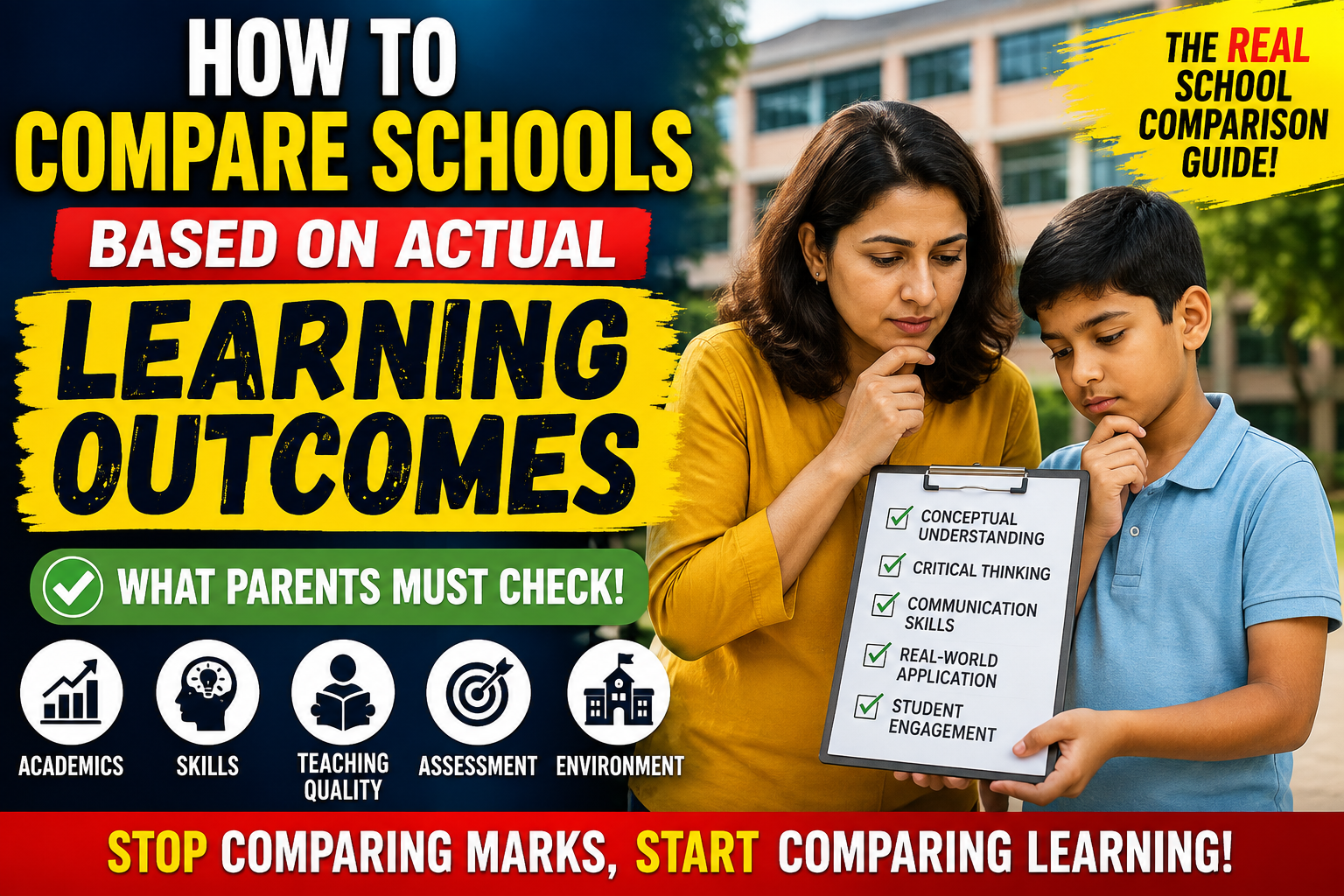
Choosing a school is one of the most important decisions parents make. Yet school comparison often begins with questions such as: Which school has the highest board results? Which school has the biggest campus? Which school is more popular? Which school has better reviews?
These questions can be useful, but they do not tell the complete story.
A school can have excellent facilities and still offer a learning experience that does not suit a particular child. Similarly, a school with modest infrastructure may provide strong classroom teaching, meaningful feedback and excellent opportunities for students to develop independent thinking.
The better question is:
What does a child actually learn after spending several years in the school?
For parents looking at schools in Mumbai, Thane, Vasai, Virar, Mira Road, Bhayandar, Nalasopara, Naigaon and other parts of Maharashtra, this approach can make school selection much more practical.
What Are Learning Outcomes?
Learning outcomes describe what students are expected to know, understand or be able to do after a learning experience.
For parents, this means looking beyond whether a child can reproduce an answer in an examination.
A strong learning outcome may involve:
- Understanding a mathematical concept
- Explaining a scientific idea in their own words
- Reading and interpreting information
- Solving unfamiliar problems
- Communicating an idea clearly
- Applying classroom knowledge to real situations
- Working effectively with others
- Thinking critically before reaching a conclusion
- Demonstrating creativity
- Becoming increasingly independent in learning
This distinction is important because marks are evidence of one part of learning, not the entire learning experience.
Why Marks Alone Are Not Enough to Compare Schools
Academic results matter. Parents should not ignore them.
However, comparing schools exclusively through examination scores can produce an incomplete picture.
Consider two hypothetical schools:
| Factor and Schools | ||
| Examination scores | Very high | High |
| Conceptual understanding | Strong | Strong |
| Project-based learning | Limited | Regular |
| Communication opportunities | Moderate | Strong |
| Student participation | Moderate | Strong |
| Feedback to students | Basic | Detailed |
| Problem-solving activities | Limited | Regular |
| Learning support | Available | Structured |
| Student independence | Moderate | Strong |
If a parent only looks at marks, School A may appear to be the obvious choice.
But a broader evaluation may reveal that School B better matches a child's needs.
The objective is therefore not to find a school with zero weaknesses.
The objective is to find a school where the overall learning environment matches the child's academic, developmental and personal needs.
8 Factors Parents Should Use When Comparing Schools
1. Conceptual Understanding
Ask whether students understand why something works, rather than simply remembering what the textbook says.
For example, in mathematics, students should ideally have opportunities to understand concepts and solve variations of a problem rather than repeatedly memorising one method.
During a school visit, parents can ask:
- How does the school check conceptual understanding?
- Are students encouraged to explain their reasoning?
- What happens when a child does not understand a topic?
- Are different learning approaches used?
A school that can clearly explain its approach to these questions gives parents more useful information than a brochure filled with promotional claims.
2. Ability to Apply Knowledge
Real learning becomes more meaningful when students can apply classroom knowledge.
Parents can look for:
- Experiments
- Projects
- Case-based activities
- Practical demonstrations
- Problem-solving exercises
- Group assignments
- Real-world examples
- Subject-related activities
For example, learning percentages becomes more meaningful when students can connect the concept with discounts, budgets or data interpretation.
The question is not simply:
“Does the school conduct projects?”
Instead ask:
“How do projects help students demonstrate what they have learned?”
3. Teaching Quality
Teaching quality is often more important than expensive infrastructure.
Parents should observe whether teachers:
- Explain concepts clearly
- Encourage questions
- Check student understanding
- Give constructive feedback
- Adapt explanations when students struggle
- Encourage participation
- Connect lessons to real situations
- Support different learning needs
A modern classroom is useful, but the quality of interaction between teachers and students remains central to learning.
4. Assessment Beyond Final Examinations
A school should ideally have more ways to understand student progress than one final examination.
Parents can ask about:
- Class tests
- Projects
- Assignments
- Presentations
- Practical activities
- Oral responses
- Continuous feedback
- Remedial support
- Student self-assessment
The important question is:
“How does the school know that a child has actually understood the lesson?”
If the answer is specific and evidence-based, parents can better understand the school's academic approach.
5. Student Progress Over Time
A single year's result does not necessarily tell you how effectively a school supports individual students.
Parents should ask how schools monitor progress from one academic stage to another.
Look for evidence such as:
- Regular academic reviews
- Individual feedback
- Learning support
- Remedial programmes
- Parent communication
- Improvement plans
- Teacher observations
A good school should not only celebrate high-performing students. It should also have a system for helping students who need additional support.
6. Communication and Critical Thinking
Future success requires more than textbook knowledge.
Parents should examine whether students get opportunities to:
- Speak confidently
- Present ideas
- Ask questions
- Participate in discussions
- Debate respectfully
- Analyse information
- Explain their reasoning
- Work collaboratively
During a campus visit, observe students if possible.
Do they appear comfortable asking questions?
Do teachers listen to them?
Are students encouraged to explain their thinking?
These small observations can reveal valuable information about classroom culture.
7. Student Engagement
A child can be physically present in a classroom without being meaningfully engaged.
Parents should therefore ask how schools encourage participation.
Possible indicators include:
- Interactive lessons
- Group activities
- Classroom discussions
- Projects
- Experiments
- Reading programmes
- Clubs
- Sports
- Arts
- Technology-supported learning
Engagement should not mean entertainment all the time.
The goal is to create an environment where students actively participate in learning.
8. Support for Different Learners
Every classroom contains students with different strengths, interests and learning speeds.
One child may understand mathematics quickly but struggle with reading. Another may excel in languages but require more support in science.
Ask schools:
- What happens when a student falls behind?
- Is additional academic support available?
- How are advanced learners challenged?
- How frequently are parents informed about concerns?
- How do teachers identify learning gaps?
This can be one of the most revealing parts of a school comparison.
School Comparison Scorecard for Parents
Parents can use a simple 100-point framework when comparing two or three shortlisted schools.
| Comparison Factor | Suggested Weight |
| Teaching quality | 20 |
| Conceptual understanding | 15 |
| Student progress | 15 |
| Assessment and feedback | 10 |
| Application-based learning | 10 |
| Communication and critical thinking | 10 |
| Learning support | 10 |
| Student engagement | 5 |
| Infrastructure and learning resources | 5 |
| Total | 100 |
This is not an official school rating system. It is a practical decision-making framework for parents.
The weights can also be changed according to the child's needs.
For example, parents of a primary-school child may give greater importance to teaching quality and classroom environment, while parents of an older student may place additional weight on subject depth, assessment and academic support.
A 5-Step School Comparison Process
Step 1: Shortlist Three to Five Schools
Do not compare ten schools in detail.
Begin with a manageable shortlist based on:
- Location
- Board
- Admission availability
- Budget
- School timings
- Transport
- Child's needs
For families in the Maharashtra urban and suburban belt, travel time should also be considered carefully.
A theoretically excellent school may not be the right choice if an excessive daily commute leaves a child tired.
Step 2: Ask Every School the Same Questions
Consistency matters.
Ask each school:
- How do you measure student learning?
- How do teachers identify learning gaps?
- How is conceptual understanding assessed?
- How much project or application-based learning is used?
- How do parents receive progress updates?
- What support is available for struggling students?
- How are advanced students challenged?
- How do students develop communication and critical-thinking skills?
Comparing identical answers is much easier than comparing different brochures.
Step 3: Look for Evidence
Do not stop at statements such as:
“We provide holistic education.”
Ask what that means in practice.
Request examples of:
- Student projects
- Assessment methods
- Classroom activities
- Learning portfolios
- Feedback systems
- Remedial support
- Student presentations
Parents should verify claims directly with the school management or official authority where appropriate.
Step 4: Speak to Teachers
A conversation with a teacher can reveal more than a school advertisement.
Ask:
“What happens when a student does not understand a topic?”
Then listen carefully.
A strong response should describe a process rather than simply saying, “We help the child.”
Step 5: Compare the Whole Child, Not Just the Report Card
Finally, consider whether the school fits your child.
Ask:
- Will my child feel comfortable here?
- Does the teaching approach suit the child?
- Is the commute practical?
- Is academic pressure appropriate?
- Are extracurricular activities available?
- Does the school communicate effectively with parents?
- Does the environment encourage curiosity?
- Can the school support the child's weaknesses and strengths?
The best school on paper may not necessarily be the best school for your child.
What Parents Should Not Overweight
Some factors deserve attention but should not dominate the entire decision.
School Ranking
Rankings can provide a starting point, but ranking methodology varies. A ranking position should never replace your own evaluation.
Campus Size
A larger campus can provide more facilities, but bigger does not automatically mean better learning.
Number of Activities
A long activity list is less useful than understanding how meaningful and accessible those activities actually are.
Marketing Claims
Words such as “world-class,” “future-ready” and “holistic” sound attractive, but parents should ask for practical examples.
One Exceptional Result
One batch of high-performing students does not automatically prove that every child receives the same learning experience.
School Comparison Decision Matrix
| If Your Priority Is... | Look More Closely At... |
| Strong academics | Teaching, assessment, conceptual understanding |
| Primary education | Teacher quality, classroom environment, foundational skills |
| Confidence building | Communication, presentations, activities |
| Academic support | Remedial systems, progress tracking, teacher feedback |
| Independent learning | Projects, research, problem-solving |
| Future skills | Critical thinking, communication, technology use |
| Balanced development | Academics, sports, arts and student wellbeing |
| Convenient schooling | Location, transport and daily travel time |
Red Flags During a School Visit
Parents should pause and investigate further if:
- The school cannot clearly explain how learning is assessed.
- Academic success is discussed only in terms of marks.
- Parents are shown facilities but not learning processes.
- Teachers appear unavailable for meaningful questions.
- Remedial support is unclear.
- Student progress is not communicated regularly.
- The school makes impressive claims without examples.
- The admission discussion focuses almost entirely on fees and facilities.
None of these points automatically means a school is poor. They are simply signals that parents should ask more questions.
The Most Important Question to Ask a School
If you ask only one question during a school visit, ask:
“How do you know that students are actually learning?”
A thoughtful answer may include assessments, classroom observations, projects, feedback, student work, progress tracking and academic support.
That answer can tell you considerably more than a ranking badge or a glossy brochure.
Frequently Asked Questions
1. How should parents compare schools in 2027?
Parents should compare teaching quality, conceptual understanding, student progress, assessment, application-based learning, communication skills, learning support, student engagement and infrastructure rather than relying only on rankings or examination results.
2. Are school marks a good indicator of learning outcomes?
Marks are useful evidence of academic performance, but they do not capture every aspect of learning. Parents should also examine conceptual understanding, problem-solving, communication, application of knowledge and progress over time.
3. What questions should I ask during a school visit?
Ask how the school measures learning, identifies learning gaps, supports struggling students, challenges advanced learners and communicates progress to parents.
4. Is school infrastructure important when comparing schools?
Yes, infrastructure matters because classrooms, laboratories, libraries, sports facilities and technology can support learning. However, infrastructure should be evaluated alongside teaching quality and actual student learning.
5. How can I compare two schools fairly?
Ask both schools the same questions and use the same criteria. A simple scorecard covering teaching, learning, assessment, student progress, skills, support and infrastructure can make the comparison more objective.
6. Should parents choose the school with the highest examination results?
Not automatically. Examination results are one important factor, but parents should also consider whether the school's teaching approach, learning environment, support systems and overall culture suit their child.
Conclusion & Parent Checklist
Choosing a school should not be a competition based only on rankings, marks or campus photographs.
The more useful question is whether the school consistently helps students understand, apply, communicate, think and grow.
For parents in Maharashtra and across India, a thoughtful school comparison can prevent an expensive admission decision based on incomplete information.
Before finalising a school, use this checklist:
- Compare teaching quality, not just school reputation.
- Ask how the school measures actual learning.
- Check whether students are encouraged to understand concepts.
- Ask how learning gaps are identified.
- Understand the school's assessment and feedback process.
- Look for application-based and project-based learning.
- Evaluate communication and critical-thinking opportunities.
- Ask how struggling students are supported.
- Consider how advanced students are challenged.
- Evaluate the child's comfort with the school environment.
- Consider travel time, transport and daily routine.
- Compare all shortlisted schools using the same criteria.
- Verify important claims directly with the school management or official authority.
The right school is not necessarily the one with the loudest claims. It is the one that can demonstrate how its students learn, progress and develop over time.
Expert Takeaway
Do not ask only, “Which school is better?”
Ask:
“Which school provides stronger evidence that children are learning well—and which learning environment is better suited to my child?”
That shift can turn school selection from a popularity contest into a more informed parent decision.
Tags:
Get Weekly Insights
Join 10k+ parents getting smarter about education.
Read Next

How to Choose the Right School Transport Option for Your Child in 2027: Safety, Cost & Convenience Guide
8/19/2026

What Makes a School Worth Paying Higher Fees For in 2027? 10 Things Parents Should Check
8/17/2026

How to Calculate the Real Cost of Sending Your Child to School in 2027: The Complete Parent Budget Guide
8/17/2026