Class 1 School Selection 2027: CBSE, ICSE or State Board?
Class 1 School Selection 2027: CBSE, ICSE or State Board?
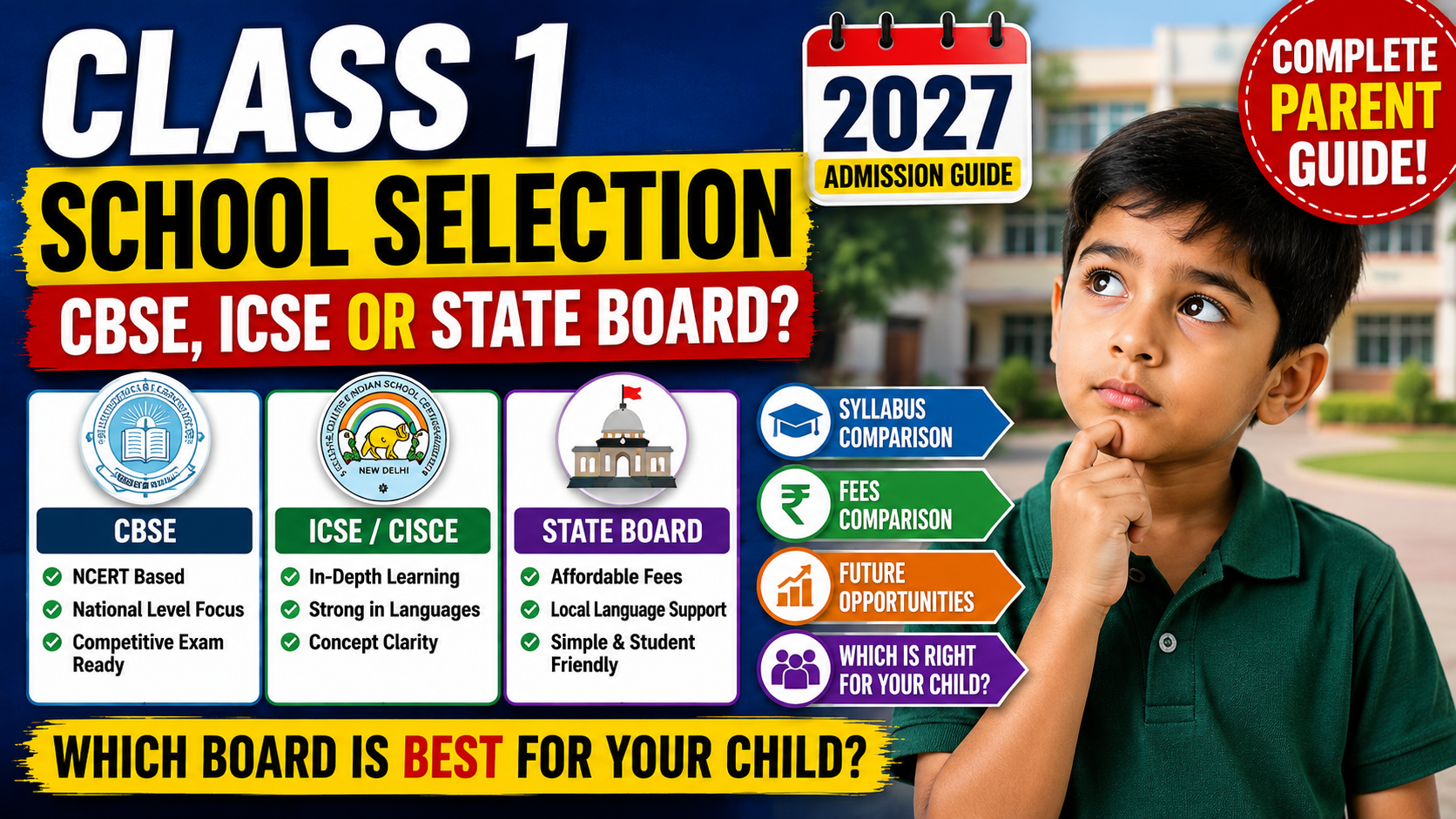
Choosing a school for Class 1 is one of the first major education decisions parents make. One of the biggest questions is often: Should I choose CBSE, ICSE or Maharashtra State Board?
The short answer is: there is no single board that is best for every child. The right choice depends on your child's learning needs, language preferences, your family's location and future plans, school quality, commute, fees and the actual teaching approach followed by the school.
For Class 1 admission 2027, parents should compare the school first and board second. A strong school with supportive teachers and an appropriate learning environment can be a better choice than selecting a board based only on its reputation.
The National Curriculum Framework for the Foundational Stage emphasizes that young children learn effectively through play, activity, exploration and interaction. CBSE schools offering the foundational stage are required to follow the recommendations of the NCF-FS 2022.
CBSE vs ICSE vs State Board: Quick Comparison
| Factor | |||
| Board body | CBSE | CISCE | Maharashtra State Education system |
| Class 1 focus | Foundational literacy, numeracy and holistic learning | Foundational learning with structured learning outcomes | State curriculum and learning outcomes |
| Language | Depends on school | Depends on school | Strong relevance to Maharashtra's language context |
| School availability | Widely available across India | Available in many cities | Particularly relevant for Maharashtra families |
| Transfer between cities | Often convenient where CBSE schools are available | Possible where CISCE schools are available | Can require greater attention to curriculum continuity outside Maharashtra |
| Best suited to | Families considering national mobility | Families looking for CISCE/ICSE pathway and language-rich education | Families prioritising Maharashtra's state curriculum and local context |
| Main decision point | School quality + learning approach | School quality + learning approach | School quality + state curriculum fit |
Note: This is a parent decision-making framework, not a ranking of the three boards. Individual schools can differ substantially in teaching quality, fees, facilities and learning environment.
What Is CBSE?
The Central Board of Secondary Education (CBSE) is a national school board with schools across India and abroad.
For young learners, CBSE's current framework is closely connected with the National Curriculum Framework for the Foundational Stage. CBSE states that schools offering foundational education to children in the 3–8 age group are required to follow the NCF-FS 2022 recommendations relating to curriculum, pedagogy and assessment.
The NCF-FS describes young children as active learners and emphasizes learning through play, activities, exploration and interaction.
Why Parents Consider CBSE for Class 1
CBSE may be attractive to families who:
- May relocate between Indian cities
- Prefer a nationally used school board
- Want continuity with the CBSE system through later classes
- Prefer a curriculum aligned with national educational frameworks
- Want access to a large network of CBSE schools
CBSE's academic resources also include foundational literacy and numeracy resources for Classes 1–3.
What Parents Should Not Assume
Choosing CBSE does not automatically mean a particular school will have excellent teaching.
Two CBSE schools can have very different:
- Teaching methods
- Teacher experience
- Class sizes
- Homework practices
- Parent communication
- Facilities
- Transport arrangements
- Fees
- Student support
So the board name should never be the only selection criterion.
What Is ICSE?
The term ICSE is commonly used by parents when referring to schools affiliated with the Council for the Indian School Certificate Examinations (CISCE).
CISCE has its own curriculum resources and learning-outcome frameworks. Its foundational literacy resources include class-wise learning outcomes covering Class 1 and subsequent primary grades.
CISCE's preschool curriculum also emphasizes the importance of developmentally appropriate early education and describes preschool as preparation for the transition to Class I.
Why Parents Consider ICSE for Class 1
Parents may consider a CISCE school if they value:
- A CISCE curriculum pathway
- Strong attention to language learning
- A structured primary-school programme
- Broader subject exposure as children progress through school
- A school that fits their child's learning style
However, these characteristics can vary from one school to another.
What Parents Should Check
Before choosing an ICSE school, ask:
- What languages are taught from Class 1?
- How much reading and writing is expected?
- How does the school introduce mathematics?
- How much homework is given?
- What classroom activities are used?
- How are young children assessed?
- What is the transition process from primary to higher classes?
The board label is useful, but the school's actual implementation matters more for a six-year-old.
What Is Maharashtra State Board?
For families living in Maharashtra, the Maharashtra State Board can be a practical option, particularly when the state curriculum and local-language context are important.
Maharashtra's SCERT publishes curriculum and learning-outcome resources for primary classes. Its current learning-outcomes section includes resources covering Classes 1 to 5.
The Maharashtra SCERT website also publishes state curriculum materials and updates relating to school education.
Why Parents Consider Maharashtra State Board
It may suit families who:
- Plan to remain in Maharashtra
- Prefer the state curriculum
- Want stronger integration with the local educational context
- Prefer a school closer to home
- Want to consider schools across different fee levels
- Value Marathi or other local-language learning opportunities
Again, parents should evaluate the individual school rather than assuming that every State Board school offers the same experience.
CBSE, ICSE or State Board: Which Is Better for Class 1?
Instead of asking "Which board is best?", ask:
"Which board and school combination is best suited to my child and our family?"
Here are some practical situations.
Choose CBSE If...
CBSE may make sense if:
- Your family may move to another Indian city.
- You want a CBSE school pathway.
- You prefer a nationally oriented curriculum.
- You have found a nearby CBSE school with a strong primary programme.
- The school's teaching approach suits your child.
Consider ICSE If...
A CISCE school may be worth considering if:
- You value its curriculum approach.
- Language learning is particularly important to your family.
- You have access to a good ICSE school nearby.
- Your child enjoys reading, language and broader academic exposure.
- The school's primary teaching approach fits your expectations.
Consider Maharashtra State Board If...
State Board may be a strong option if:
- Your family expects to remain in Maharashtra.
- You prefer the state curriculum.
- Local-language learning is important.
- You have identified a good State Board school close to home.
- The school's fees and daily routine fit your family.
These are decision factors, not universal rules. A child's individual needs and the quality of the school should remain central.
Don't Choose a Board Based Only on Future Competitive Exams
A common Class 1 admission mistake is trying to choose a board based on what parents think will happen ten years later.
At Class 1, the priority should be building strong foundations.
Children need opportunities to develop:
- Reading
- Listening
- Speaking
- Early writing
- Numeracy
- Problem-solving
- Social skills
- Curiosity
- Independence
- Confidence
The NCF-FS specifically emphasizes activity-based and play-based learning during the foundational stage.
Therefore, parents should not put unnecessary academic pressure on a Class 1 child simply because they are thinking about future examinations.
Language Is an Important Factor
Language can become an important consideration when selecting a Class 1 school.
Parents should ask:
- Which language is the primary medium of instruction?
- Which additional languages are offered?
- Is Marathi taught?
- Is Hindi taught?
- How much English communication is encouraged?
- Can the child comfortably understand classroom instructions?
The right answer depends heavily on the child's existing language exposure.
A child who is comfortable in one language may need a gradual transition when joining a school with a different language environment.
School Quality Matters More Than the Board Name
Imagine two schools:
School A: Preferred board, but long commute, large class size and limited parent communication.
School B: Different board, but nearby, supportive teachers, appropriate Class 1 teaching methods and a comfortable learning environment.
For many families, School B may be the more practical choice.
This is why parents should evaluate:
Teachers
Ask about teacher experience, stability and communication.
Classroom Environment
Observe whether young children appear comfortable, engaged and supported.
Learning Methods
Ask whether Class 1 learning includes activities, stories, practical experiences and age-appropriate exercises.
Homework
Find out how much written work is expected.
Assessment
Ask how the school monitors children's progress.
Student Support
Understand what happens when a child struggles with reading, writing or mathematics.
Parent Communication
Check how parents receive updates about their child's progress.
Compare the Total Cost, Not Just School Fees
Board selection should also be financially practical.
When comparing Class 1 schools, consider:
- Admission charges
- Tuition fees
- Annual charges
- Transport
- Books
- Uniform
- Activities
- Meals, if applicable
- Technology-related charges
- Other school-specific costs
Do not assume that all schools following the same board have similar fees.
Always request the current fee structure directly from the school.
Commute Can Change the Decision
A school located far from home may create a difficult daily routine for a six-year-old.
Consider:
- Morning travel time
- Afternoon travel time
- School bus availability
- Traffic
- Pickup arrangements
- Child's sleep schedule
- Time available for play and family activities
A good school that requires a manageable commute can be more practical than a theoretically attractive school that creates several hours of daily travel.
A Simple Class 1 School Selection Scorecard
Parents can score each shortlisted school from 1 to 5.
| Factor | |
| Teaching quality | /5 |
| Class 1 learning environment | /5 |
| Board/curriculum fit | /5 |
| Language fit | /5 |
| Distance from home | /5 |
| Total cost | /5 |
| Teacher-parent communication | /5 |
| Student support | /5 |
| Safety and transport | /5 |
| Child's comfort | /5 |
The highest score does not automatically mean the school is the right choice. Use the scorecard to structure the discussion between parents.
10 Questions to Ask Before Choosing a Class 1 School
- Which board does the school follow?
- What languages are taught in Class 1?
- How does the school approach foundational literacy and numeracy?
- How much homework is normally given?
- How are students assessed?
- What support is available if a child falls behind?
- How many students are typically in a Class 1 section?
- What is the daily school schedule?
- What are the total annual costs?
- How does the school communicate with parents?
Common Mistakes Parents Make
Mistake 1: Choosing the Most Popular Board
Popularity is not the same as suitability.
Mistake 2: Ignoring the Individual School
The board cannot tell you everything about a school's teachers, culture or classroom experience.
Mistake 3: Looking Only at Fees
A low headline fee may not represent the complete annual cost.
Mistake 4: Ignoring Language
Language comfort can significantly affect a young child's transition into Class 1.
Mistake 5: Focusing Too Much on Future Exams
Class 1 should primarily establish strong foundational learning habits.
Mistake 6: Ignoring the Child's Opinion
A child may not understand the board comparison, but they can tell parents whether they feel comfortable in a school environment.
FAQ
Is CBSE better than ICSE for Class 1?
Not universally. Both have established school systems, but the best choice depends on the individual school, child's needs, family plans, language preferences and learning environment.
Is State Board good for Class 1?
Yes, a Maharashtra State Board school can be a suitable choice when its curriculum, teaching quality, location and learning environment fit the child and family.
Which board is easiest for Class 1?
There is no reliable universal ranking of boards by difficulty for Class 1. Parents should focus on age-appropriate teaching and the child's readiness rather than looking for the "easiest" board.
Should I choose CBSE if we may relocate?
It can be a practical consideration because CBSE schools are widely available, but parents should still verify the destination school's availability, curriculum and admission requirements.
Is ICSE too difficult for a Class 1 child?
It is not appropriate to label an entire board as too difficult based only on the board name. The school's Class 1 teaching methods and expectations are more relevant to a young child.
Which board is best for Maharashtra?
There is no single best board for every Maharashtra family. CBSE, CISCE and Maharashtra State Board can each be appropriate depending on the child's needs and family circumstances.
Final Verdict
For Class 1 admission 2027, don't choose CBSE, ICSE or State Board simply because someone says one board is "best."
Instead, shortlist schools and compare:
Board + Teaching + Language + School Environment + Distance + Cost + Child's Comfort.
If your family may move frequently, CBSE may be worth considering. If you specifically prefer the CISCE pathway and find a suitable nearby school, ICSE can be considered. If you plan to remain in Maharashtra and prefer the state curriculum and local context, a strong Maharashtra State Board school may be an excellent practical option.
The most important question is not:
"Which board is best?"
It is:
"Which school will give my child the strongest, happiest and most appropriate start to primary education?"
DextroCampus Parent Tip
Shortlist 3–5 schools, visit them where possible, ask the same questions at each school, compare the total cost and commute, and then make the decision based on your child's needs—not only the board name.
Verification note: Curriculum frameworks and school-level policies can change. Parents planning Class 1 admission for 2027–28 should verify current admission rules, fees, language options and curriculum details directly with each school and the relevant official board/education authority.
Tags:
Get Weekly Insights
Join 10k+ parents getting smarter about education.