
Class 1 School Readiness Checklist 2027: 25 Things Parents Should Check
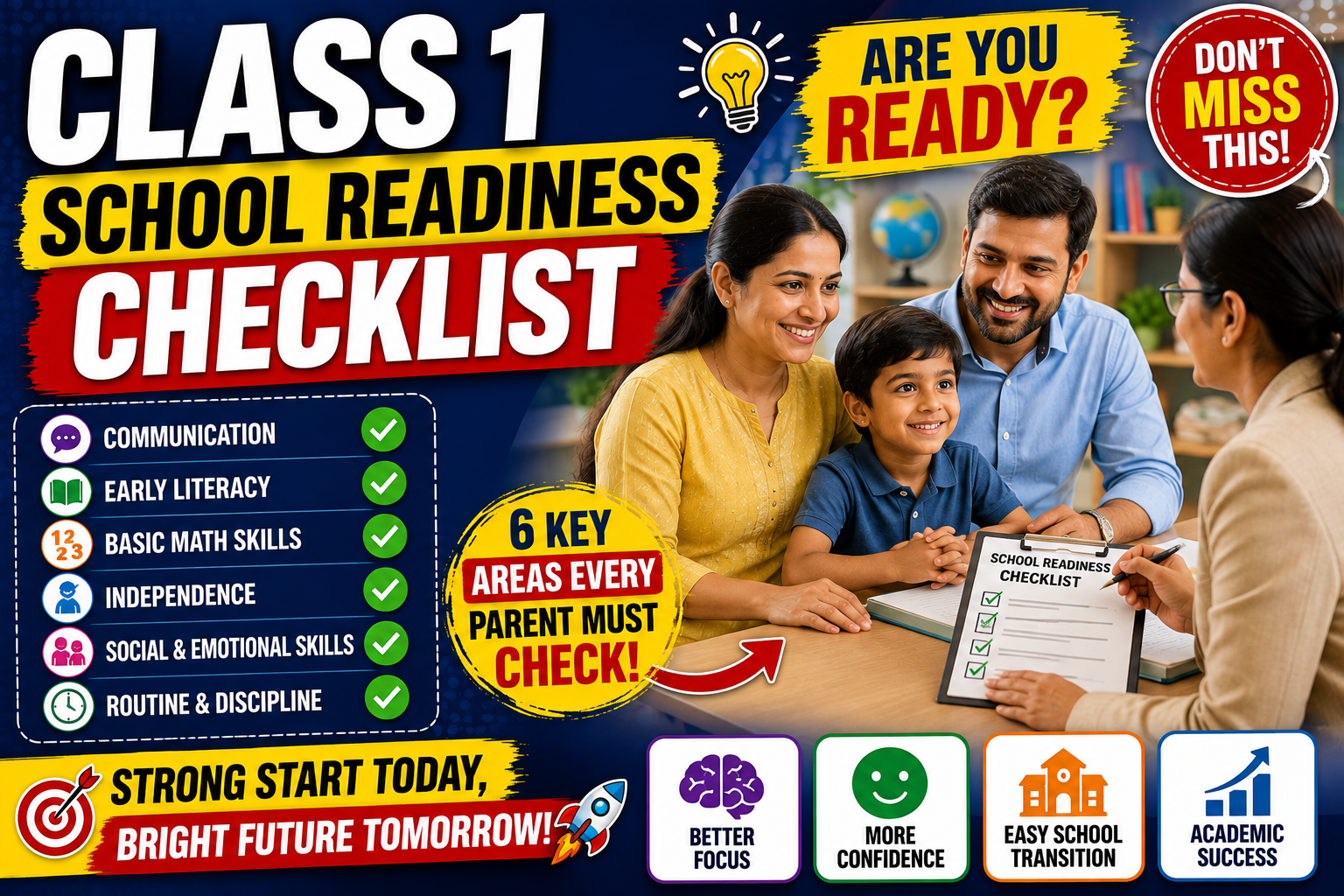
Class 1 School Readiness Checklist 2027: 25 Things Parents Should Check
Is your child ready for Class 1?
For parents planning Class 1 admission 2027, school readiness is about much more than knowing the alphabet or counting numbers. A child also needs confidence, communication skills, independence, social skills, listening ability and the ability to adjust to a new daily routine.
India's National Curriculum Framework for School Education places children aged 3–8 within the Foundational Stage and identifies physical, socio-emotional, cognitive, language and literacy, aesthetic and cultural development, along with positive learning habits, as important areas of development. It also emphasizes play-based learning and says explicit tests and examinations are inappropriate for this stage.
The Ministry of Education's Vidya Pravesh initiative was designed specifically as a three-month, play-based school-preparation module for children entering Grade 1, with activities intended to familiarize children with the school environment and build foundations in language, literacy and mathematics.
So before Class 1 begins, parents should ask a bigger question than:
“Can my child read and write?”
The better question is:
“Is my child ready to learn, communicate, participate and become more independent at school?”
This checklist will help parents evaluate that readiness.
What Does School Readiness Actually Mean?
School readiness does not mean that every child must have exactly the same skills before entering Class 1.
Children develop at different rates and come from different preschool and home-learning experiences.
A school-ready child is gradually developing the ability to:
- Communicate basic needs
- Listen to instructions
- Participate in group activities
- Manage simple personal tasks
- Handle small frustrations
- Interact with other children
- Show interest in learning
- Follow a routine
- Use basic literacy and numeracy skills
- Ask for help when needed
The NCF describes foundational learning as holistic, covering multiple developmental domains rather than academic knowledge alone.
Class 1 School Readiness Checklist
Use the following 25-point checklist as a guide, not a test.
You do not need your child to score 25/25.
The purpose is to identify areas where your child may benefit from additional practice.
1. Can Your Child Say Their Name Clearly?
Your child should be comfortable introducing themselves.
For example:
“My name is Riya.”
You can practise this naturally during family conversations.
There is no need to rehearse a long introduction.
2. Can Your Child Communicate Basic Needs?
A child entering Class 1 should gradually become comfortable communicating needs such as:
- “I need water.”
- “I need to use the washroom.”
- “I don't understand.”
- “I need help.”
- “I am feeling uncomfortable.”
Communication is more important than perfect grammar.
3. Can Your Child Follow Simple Instructions?
Try simple two-step instructions:
“Take your book and keep it on the table.”
Later, you can make the activity slightly more complex:
“Take your pencil, put it in the box and bring your book.”
Keep it playful rather than turning it into a test.
4. Does Your Child Show Interest in Books?
Your child does not necessarily need to read fluently before Class 1.
However, interest in books and stories is a useful foundation.
Encourage your child to:
- Look at picture books
- Listen to stories
- Turn pages
- Identify familiar objects
- Talk about pictures
- Ask questions about stories
The NCF gives children's literature an important role in language and literacy development during the Foundational Stage.
5. Can Your Child Recognise Familiar Letters?
Depending on their previous learning, children may have varying levels of letter familiarity.
Parents can practise:
- Letter recognition
- Letter sounds
- Matching letters
- Finding letters in books
- Identifying the first sound in familiar words
Keep these activities short and enjoyable.
6. Can Your Child Understand Basic Numbers?
Your child can gradually develop familiarity with:
- Counting
- Number recognition
- Comparing quantities
- Simple patterns
- Basic addition using objects
For example:
“We have three apples. If I add one more, how many are there?”
You can use toys, fruits or household objects instead of worksheets.
Foundational literacy and numeracy are central priorities in India's foundational learning framework.
7. Can Your Child Identify Common Shapes and Colours?
Practise everyday shapes:
- Circle
- Square
- Triangle
- Rectangle
And common colours:
- Red
- Blue
- Green
- Yellow
- Orange
- Black
- White
Make it a game.
Ask:
“Can you find something blue in the room?”
8. Can Your Child Hold and Use Basic School Supplies?
Children gradually need to become comfortable using:
- Pencil
- Crayon
- Eraser
- Colouring materials
- Books
- Simple stationery
The goal is not perfect handwriting.
The goal is becoming comfortable with basic school tools.
9. Can Your Child Open Their Lunch Box?
This may sound like a small thing, but practical independence matters.
Allow your child to practise:
- Opening the lunch box
- Closing it
- Drinking from their bottle
- Managing simple food items
- Putting belongings back
Practise before school begins rather than expecting the child to master everything on the first day.
10. Can Your Child Manage Simple Personal Belongings?
Encourage your child to:
- Keep books in one place
- Put toys away
- Carry their school bag
- Keep their water bottle in the right place
- Recognise their own belongings
This helps develop responsibility.
11. Can Your Child Ask an Adult for Help?
This is an important school-readiness skill.
Your child should know that it is okay to say:
“I need help.”
or:
“I don't understand.”
Parents should make asking for help feel normal rather than something embarrassing.
12. Can Your Child Wait for Their Turn?
Classrooms involve group activities.
Children may need to:
- Wait
- Share
- Listen
- Take turns
- Follow simple rules
Board games, group play and simple family activities can provide natural opportunities to practise these skills.
13. Can Your Child Share With Other Children?
Sharing is a social skill that develops gradually.
Parents can encourage sharing through:
- Toys
- Books
- Games
- Snacks where appropriate
- Group activities
Do not expect perfect sharing every time.
Use everyday situations to explain why taking turns matters.
14. Can Your Child Handle a Small Disagreement?
Children will sometimes disagree with classmates.
Parents can practise simple problem-solving questions:
“What happened?”
“How did you feel?”
“What could you do next?”
The objective is not to eliminate every disagreement.
It is to help children gradually learn how to respond to them.
15. Can Your Child Separate From Parents for Some Time?
Starting Class 1 can involve spending several hours away from parents.
If your child becomes anxious during separation, gradually practise short periods with trusted adults.
Avoid using fear-based statements such as:
“You have to stay alone at school.”
Instead say:
“You will have your teacher and classmates with you, and we will be there when school finishes.”
16. Can Your Child Follow a Daily Routine?
Class 1 often involves a more structured schedule.
Before school starts, gradually establish:
- Regular wake-up time
- Breakfast routine
- Getting dressed
- School preparation
- Activity time
- Outdoor play
- Bedtime
Do not change the entire routine suddenly one day before school begins.
17. Does Your Child Have a Reasonably Consistent Sleep Routine?
A predictable bedtime can make mornings easier.
Parents can create a simple evening routine:
Dinner → Quiet activity → Story/reading → Prepare school items → Bedtime
The exact sleep requirement varies by age and child, so parents should follow age-appropriate guidance from qualified health professionals where needed.
18. Can Your Child Sit and Listen for a Short Activity?
Young children should not be expected to sit still for long periods like older students.
However, gradually practise short activities such as:
- Story reading
- Puzzles
- Drawing
- Simple games
- Conversation
- Building activities
The goal is to develop attention gradually.
19. Can Your Child Describe a Picture?
Show your child a picture and ask:
“What do you see?”
Encourage them to talk about:
- People
- Objects
- Colours
- Actions
- Places
There is no single correct answer.
Picture discussion can support vocabulary, observation and communication.
20. Can Your Child Express Feelings?
Children should gradually learn to communicate emotions.
Help them use words such as:
- Happy
- Sad
- Angry
- Scared
- Excited
- Worried
- Tired
Instead of asking only:
“Why are you crying?”
try:
“Can you tell me what happened?”
This helps children connect feelings with communication.
21. Can Your Child Handle Making a Mistake?
This is an important part of school readiness.
Children will make mistakes in:
- Writing
- Counting
- Drawing
- Speaking
- Games
- Classroom activities
Teach them:
“It's okay to make a mistake. Let's try again.”
Avoid making every mistake feel like failure.
22. Does Your Child Show Curiosity?
Curiosity is a valuable learning habit.
Your child may ask:
- Why?
- How?
- What is this?
- What happens next?
- Where does this come from?
Do not feel that you need to provide a perfect answer every time.
Sometimes say:
“Let's find out together.”
The NCF emphasizes curiosity, exploration, play and activity as important aspects of learning during the Foundational Stage.
23. Can Your Child Participate in Group Activities?
Try activities such as:
- Building blocks
- Drawing together
- Simple board games
- Group storytelling
- Music and movement
- Outdoor games
These can help children practise cooperation and communication.
24. Can Your Child Follow Basic Safety Instructions?
Children should gradually understand simple instructions such as:
- Stay with the group
- Do not leave school with an unknown person
- Ask a teacher for help
- Tell an adult if something feels wrong
- Follow basic road and transport safety rules
Parents should explain these calmly rather than creating fear.
25. Is Your Child Curious and Positive About Starting School?
This may be the most overlooked question.
Ask:
“What are you looking forward to at your new school?”
Your child may say:
- “I want to play.”
- “I want to make friends.”
- “I want to see the classroom.”
- “I want to draw.”
- “I want to learn.”
That curiosity is valuable.
Class 1 Readiness: A Simple Parent Scorecard
Instead of giving your child a numerical score, divide the checklist into three categories.
| Area & Status | |
| Communication | Ready / Practising |
| Early literacy | Ready / Practising |
| Numeracy | Ready / Practising |
| Independence | Ready / Practising |
| Social skills | Ready / Practising |
| Emotional readiness | Ready / Practising |
| Routine | Ready / Practising |
| Curiosity and learning habits | Ready / Practising |
The word “Practising” is important.
It does not mean your child is failing.
It simply identifies an area where you can provide more opportunities.
What If My Child Is Not Ready in Every Area?
Do not panic.
School readiness is developmental, and children do not all reach every milestone at exactly the same time.
If you notice a persistent concern about your child's development, communication, hearing, vision, behaviour or learning, discuss it with the child's teacher and an appropriately qualified professional.
The purpose of a readiness checklist is to spot areas for support, not to label a child.
What Parents Should Not Do
Don't Compare Your Child With Other Children
Avoid:
“Your friend can already read, so why can't you?”
Children develop differently.
Don't Turn the Checklist Into an Exam
Do not sit your child down and test all 25 points in one afternoon.
Instead, observe them naturally.
Don't Overload Your Child With Tuition
More classes do not automatically mean better school readiness.
Play, conversation, reading and everyday experiences are also important.
Don't Focus Only on Academics
A child who can read but cannot communicate a basic need or ask for help may still need support in other areas of school readiness.
Don't Create Fear About Class 1
Avoid statements such as:
“Class 1 is very difficult.”
or:
“Your teacher will be strict.”
Instead:
“You are going to learn many new things and meet new people.”
A 4-Week Class 1 Readiness Plan
Parents who want a simple structure can use this four-week approach.
Week 1: Communication
Focus on:
- Daily conversations
- Story reading
- Picture description
- Asking and answering questions
Week 2: Independence
Practise:
- Lunch box
- Water bottle
- Shoes
- School bag
- Personal belongings
- Asking for help
Week 3: Early Learning
Include:
- Counting
- Shapes
- Colours
- Letter games
- Storytelling
- Simple puzzles
Week 4: Social and Routine Skills
Practise:
- Taking turns
- Sharing
- Following instructions
- Morning routine
- Bedtime routine
- Short independent activities
Keep the activities enjoyable.
The Role of Play in Class 1 Readiness
Parents sometimes worry that their child is “only playing” instead of studying.
For young children, that distinction can be misleading.
The NCF for the Foundational Stage places play at the centre of learning and recommends a balance between individual learning and group activities. It also emphasizes concrete materials such as toys, puzzles, picture books and manipulatives in the early years.
The Ministry of Education's Vidya Pravesh framework similarly uses play-based activities to help children become familiar with school and develop foundational language, literacy and mathematics skills.
So a child building with blocks, playing a counting game or telling a story may be developing useful school-readiness skills.
Class 1 Admission 2027: The Final Parent Checklist
Before your child begins Class 1, ask:
- Can my child communicate basic needs?
- Can my child introduce themselves?
- Can my child follow simple instructions?
- Does my child enjoy stories and books?
- Does my child recognise some familiar letters?
- Can my child count and recognise basic numbers?
- Can my child identify common shapes and colours?
- Can my child use basic school supplies?
- Can my child manage a lunch box and water bottle?
- Can my child manage simple belongings?
- Can my child ask an adult for help?
- Can my child wait for a turn?
- Can my child participate in group activities?
- Can my child handle small disagreements with guidance?
- Can my child separate from parents for some time?
- Does my child follow a reasonably consistent routine?
- Can my child listen to a short story or activity?
- Can my child describe a simple picture?
- Can my child express basic emotions?
- Can my child handle small mistakes?
- Does my child show curiosity?
- Can my child cooperate with other children?
- Does my child understand basic safety instructions?
- Is my child gradually becoming more independent?
- Does my child feel reasonably positive about starting school?
Frequently Asked Questions
What is school readiness for Class 1?
School readiness means developing the skills and habits that help a child participate comfortably in school. It includes communication, early literacy, numeracy, independence, social skills, emotional development, attention and routine.
Does my child need to read fluently before Class 1?
Not necessarily. Children enter Class 1 with different levels of prior learning. Parents should focus on building interest in books, language and early literacy rather than creating excessive pressure.
What maths should a child know before Class 1?
Basic counting, number recognition, simple comparisons, shapes and patterns can be useful foundations. Exact expectations can vary by school and previous learning experience.
How do I know if my child is emotionally ready for Class 1?
Look for gradual abilities such as communicating feelings, separating from parents for reasonable periods, asking for help, handling small frustrations and trying again after mistakes.
Should I use this checklist as an admission test?
No. It is a parent guide, not an admission test or professional developmental assessment.
What if my child cannot complete the checklist?
Do not panic. Use the checklist to identify areas that can be practised through everyday activities. If you have ongoing developmental concerns, speak with the child's teacher or an appropriately qualified professional.
When should I start preparing my child for Class 1?
Preparation can begin gradually several months before school starts. Everyday activities such as reading, conversation, play, counting and independent tasks can become part of the child's routine.
Conclusion
A successful transition to Class 1 is about more than academic preparation.
Your child does not need to know everything before entering the classroom.
Instead, aim to build five important qualities:
Confidence. Communication. Independence. Curiosity. Willingness to learn.
Use this Class 1 School Readiness Checklist 2027 as a guide rather than a test.
Read together. Play counting games. Encourage your child to solve small problems. Let them manage simple belongings. Practise conversations. Build a predictable routine. Give them opportunities to interact with other children.
Most importantly, remember that school readiness is a process.
You are not preparing your child to pass a test. You are preparing your child to begin a new stage of learning with confidence.
Verification note: Educational frameworks and individual school requirements can change. Parents planning Class 1 admission for 2027–28 should verify the school's current admission, age, assessment and documentation requirements directly with the school and relevant education authority.
Tags:
Get Weekly Insights
Join 10k+ parents getting smarter about education.