
Class 1 Admission Interview 2027: 25 Questions Parents Should Know
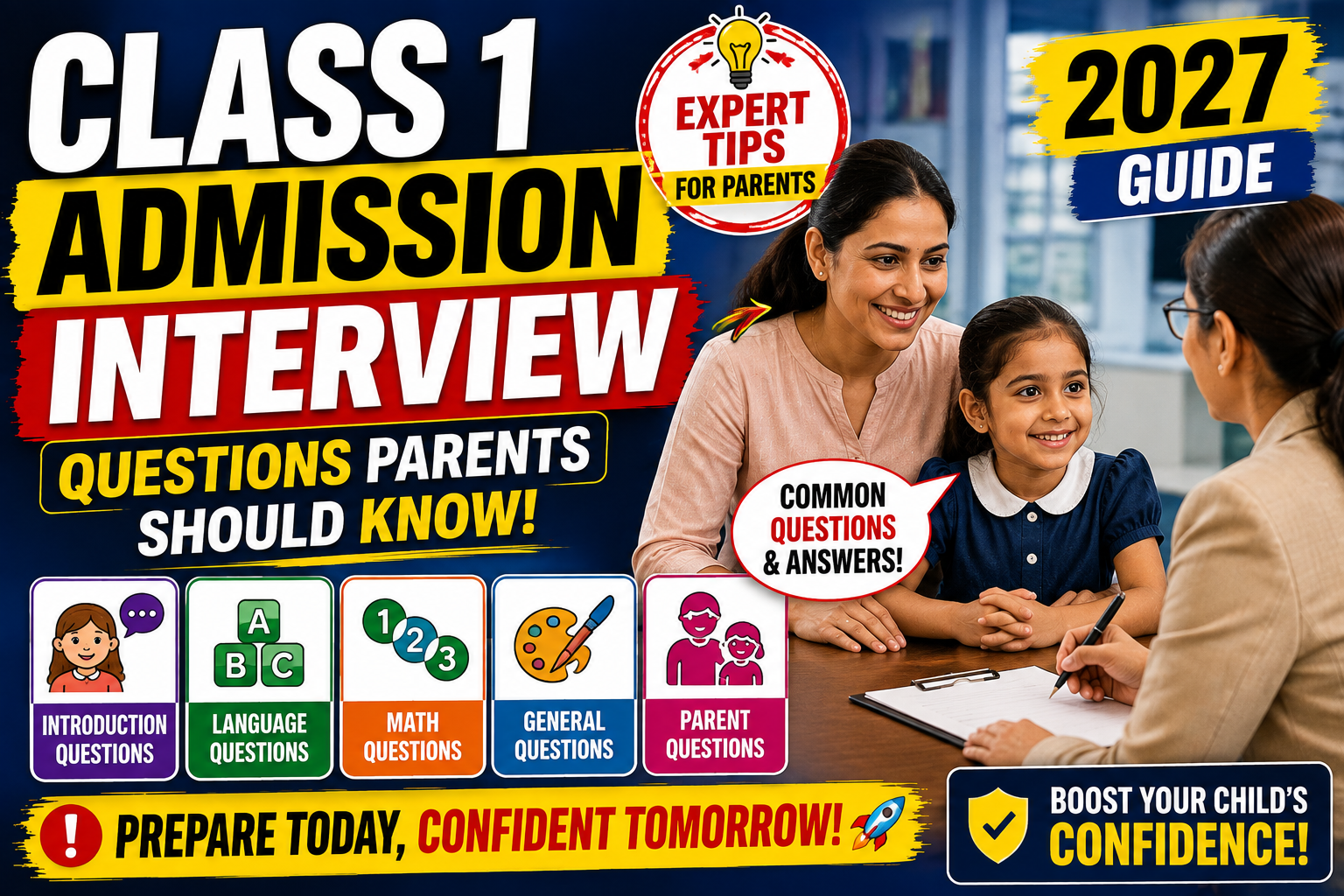
Class 1 Admission Interview 2027: Questions Parents Should Know
The words “Class 1 admission interview” can make many parents nervous.
What will the school ask?
Will the child have to take a test?
Should parents arrange special coaching?
What if the child does not answer a question?
The good news is that parents do not need to turn Class 1 admission preparation into an intensive examination programme.
If a school includes a child interaction, assessment or admission interview in its process, the best preparation is usually to build confidence, communication, listening skills, basic literacy and numeracy, social skills and school readiness.
There is no single Class 1 interview format followed by every school. Admission procedures can vary between schools, so parents should always check the individual school's official admission instructions for the 2027–28 session.
The goal of preparation should not be to make a child memorise perfect answers.
It should be to help the child communicate naturally and confidently.
What Can Be Asked in a Class 1 Admission Interview?
The exact questions depend on the school, but parents can prepare their child around these broad areas:
- Personal introduction
- Family
- Communication
- Basic language skills
- Numbers
- Shapes and colours
- General awareness
- Picture description
- Listening
- Simple problem-solving
- Social behaviour
- Everyday knowledge
Important: The questions below are examples for preparation. They should not be treated as an official question paper for every school.
25 Class 1 Admission Interview Questions
1. What Is Your Name?
This is one of the simplest questions a child may encounter.
Practise natural responses such as:
“My name is Aarav.”
The child does not need to give a long introduction unless asked.
2. How Old Are You?
The child should be comfortable stating their age.
Parents can practise this naturally during everyday conversations rather than repeatedly testing the child.
3. Tell Me Something About Yourself.
This gives the child an opportunity to talk about themselves.
A simple response could be:
“My name is Aarav. I am six years old. I like drawing and playing with my friends.”
Do not force the child to memorise a fixed paragraph. Let the answer reflect their personality.
4. What Are Your Parents' Names?
The child should be familiar with basic family information.
Parents can practise this through normal family conversations.
5. What Do You Like to Do?
There is no single correct answer.
A child might say:
- “I like drawing.”
- “I like reading.”
- “I like playing.”
- “I like cycling.”
- “I like dancing.”
The important part is being able to communicate comfortably.
Language-Based Questions
6. Can You Identify These Letters?
A school may use familiar letters or simple learning activities during an interaction.
Parents can practise through:
- Alphabet cards
- Storybooks
- Letter games
- Picture books
- Everyday objects
Keep these activities short and enjoyable.
7. Can You Name Something That Starts With B?
For example:
B → Ball
Parents can use familiar objects around the house to make this a simple game.
8. Can You Describe This Picture?
A child may be shown a picture and asked:
“What do you see?”
Encourage the child to describe what they observe.
For example:
“I can see a boy playing in the park.”
Picture description can naturally practise vocabulary, observation and communication.
9. Can You Tell Me a Short Story?
Parents can read stories with their children and then ask:
- What happened first?
- Who was in the story?
- What happened next?
- Which part did you like?
The child does not need to memorise the story word-for-word.
Encourage them to retell it in their own words.
Basic Maths Questions
10. Can You Count From 1 to 20?
Counting can be practised using:
- Toys
- Blocks
- Fruits
- Books
- Household objects
Turn counting into a game instead of a formal test.
11. Which Number Comes After 7?
Simple number-sequence activities can help children become comfortable with numbers.
Parents can practise with number cards or everyday objects.
12. Which Is Bigger: 5 or 3?
Comparison can be easier when children can see actual objects.
For example:
5 blocks vs 3 blocks
Ask:
“Which group has more?”
13. How Many Objects Are There?
Show the child a few familiar objects and ask them to count.
For example:
“How many pencils are on the table?”
This makes basic mathematics part of everyday life.
14. Can You Identify These Shapes?
Practise common shapes such as:
- Circle
- Square
- Triangle
- Rectangle
Connect shapes with real objects.
For example:
Clock → Circle
Book → Rectangle
This makes learning easier to remember.
General Awareness Questions
15. What Colour Is This?
Children can practise identifying common colours such as:
- Red
- Blue
- Green
- Yellow
- Orange
- Black
- White
Use clothes, toys, fruits and household objects to practise.
16. Where Do You Live?
The child should have a basic understanding of their locality or city.
Parents do not need to make a child memorise an unnecessarily detailed address unless the school specifically requires relevant information.
17. What Is the Name of Your School?
If the child is currently attending preschool or another school, they can practise saying its name naturally.
18. What Do You Do When You Don't Understand Something?
This is a useful confidence-building question.
A positive response could be:
“I will ask my teacher for help.”
Children should understand that asking questions is a normal part of learning.
Social and Behaviour Questions
19. What Will You Do If Your Friend Has No Pencil?
Instead of teaching one “perfect” answer, discuss different possibilities:
- Share if possible
- Ask the teacher
- Help the friend
The objective is to encourage social thinking and problem-solving.
20. What Will You Do If You Make a Mistake?
A useful mindset is:
“I will try again.”
Parents should help children understand that mistakes are a normal part of learning.
21. What Will You Do If You Need Help in Class?
The child should know that they can approach their teacher.
A simple answer could be:
“I will ask my teacher.”
Questions Parents May Be Asked
Depending on the school's admission process, parents may also be asked questions about their expectations and their child's learning.
Again, the exact process is school-specific.
22. Why Did You Choose This School?
Parents should answer honestly.
For example:
“We liked the school's location, learning environment and approach to primary education.”
There is no need to exaggerate or make unsupported claims.
23. What Are Your Expectations From the School?
Parents can discuss practical expectations such as:
- Strong foundational learning
- Good communication
- A safe environment
- Appropriate academic support
- Balanced development
24. How Does Your Child Learn Best?
Answer based on the child's actual personality and learning habits.
For example:
“She enjoys learning through stories, activities and hands-on tasks.”
25. How Do You Support Learning at Home?
Parents can mention everyday activities such as:
- Reading together
- Conversations
- Educational games
- Drawing
- Counting activities
- Regular routines
Parents do not need to prove that their child studies for several hours every day.
The Biggest Mistake: Making Children Memorise Answers
One of the biggest mistakes parents can make is turning the admission interview into a memorisation exercise.
A child may memorise:
“My favourite hobby is drawing.”
But if the interviewer asks:
“What do you enjoy doing after school?”
the child may become confused.
Instead, practise conversation rather than scripts.
For example:
Adult: What is your name?
Child: My name is Riya.
Adult: What do you like?
Child: I like drawing.
Adult: Tell me about your picture.
Child: This is my house and this is my dog.
The objective is confidence and communication, not a rehearsed performance.
How to Prepare Your Child Without Creating Anxiety
Use Everyday Conversations
During breakfast or playtime, ask simple questions:
- What did you do today?
- What did you enjoy?
- What colour is this?
- How many apples are there?
- What would you like to do?
These conversations naturally build communication skills.
Use Storybooks
After reading a story, ask:
- Who was in the story?
- What happened?
- What happened next?
- Which character did you like?
- What would you have done?
Let the child answer in their own words.
Try a Pretend Interview
One parent can act as the interviewer.
Keep it short and fun.
Parent: Good morning! What is your name?
Child: My name is Riya.
Parent: What do you like?
Child: I like drawing.
Parent: Can you tell me about this picture?
Child: This is a house.
Then reverse the roles.
Let the child become the interviewer.
This makes the activity feel like a game rather than an examination.
Don't Correct Every Answer Immediately
Suppose the child says:
“I like play.”
Instead of saying:
“Wrong. Say it again.”
respond naturally:
“Oh, you like to play? What do you like to play?”
This gives the child the correct language model without making them afraid of making mistakes.
What If Your Child Is Shy?
Being shy around an unfamiliar adult does not automatically mean that a child is unprepared for school.
Some children simply need more time to become comfortable.
Parents can:
- Practise simple introductions
- Encourage conversations with familiar adults
- Give the child time to answer
- Avoid forcing eye contact
- Avoid interrupting every answer
- Introduce new social situations gradually
Most importantly, avoid repeatedly saying:
“Don't be shy in the interview!”
That can actually increase pressure.
Instead say:
“If you don't understand the question, you can politely ask the teacher to repeat it.”
What If the Child Doesn't Know an Answer?
This is important.
A child will not know every answer.
Teach them that it is perfectly acceptable to say:
“I don't know.”
or:
“Can you please tell me again?”
Parents should not teach children to panic whenever they do not know something.
The ability to ask for help is itself an important school-readiness skill.
Should Parents Send Their Child for Admission Coaching?
There is no universal need for Class 1 admission coaching.
First understand the school's actual admission process.
If the school includes an interaction or assessment, parents can practise age-appropriate areas such as:
- Reading
- Conversation
- Basic numbers
- Shapes
- Colours
- Listening
- Picture description
- General awareness
- Confidence
For many children, these skills can be developed naturally through reading, play and everyday conversations.
7-Day Class 1 Interview Preparation Plan
Parents who want a simple preparation routine can use the following approach.
Day 1 — Introduction
Practise:
- Name
- Age
- Family
- Likes and dislikes
Day 2 — Language
Practise:
- Letters
- Sounds
- Vocabulary
- Picture description
Day 3 — Numbers
Practise:
- Counting
- Number recognition
- Bigger/smaller
- Shapes
Day 4 — General Awareness
Discuss:
- Family
- School
- Animals
- Colours
- Common objects
Day 5 — Social Skills
Discuss:
- Sharing
- Helping
- Asking for help
- Taking turns
Day 6 — Mock Interaction
Conduct one short and relaxed mock interaction.
Day 7 — No-Test Day
Read a story.
Play a game.
Talk.
Let the child relax.
The final day before an admission interaction should not become a pressure day.
Class 1 Admission Interview Checklist for Parents
Before the interaction, ask yourself:
- Does my child know their name and basic personal information?
- Can my child communicate basic needs?
- Can my child follow simple instructions?
- Does my child have basic number familiarity?
- Can my child identify common colours and shapes?
- Can my child listen to a short story?
- Can my child describe a familiar picture or activity?
- Does my child know how to ask for help?
- Can my child participate in simple social situations?
- Has my child practised talking to an unfamiliar adult?
- Does my child understand that mistakes are okay?
- Have I checked the school's actual admission instructions?
What Parents Should Avoid Before the Interview
Don't Say: “You Must Get Selected”
Instead say:
“Just be yourself and try your best.”
Don't Compare
Avoid:
“Your friend knows more than you.”
Every child develops differently.
Don't Threaten
Avoid:
“If you don't answer, we'll be very angry.”
This can create unnecessary anxiety.
Don't Over-Practise
A child does not need hours of mock interviews every day.
Don't Teach Fake Answers
Let the child speak naturally.
Don't Make the Interview Sound Scary
Instead of:
“Tomorrow is your interview.”
try:
“Tomorrow you will meet some teachers and talk to them.”
What Should Parents Carry on the Day?
The exact document requirements depend on the school.
Parents should follow the school's official admission instructions and keep the requested documents ready.
Depending on the school's process, these may include:
- Application confirmation
- Child's birth certificate
- Previous school records
- Photographs
- Parent identification documents
- Address proof
- Other school-specific documents
Do not assume this list applies to every school.
Always check the school's current 2027–28 admission instructions before the appointment.
FAQs
Is a Class 1 admission interview compulsory?
Not universally. Schools can have different admission processes. Parents should check the individual school's official admission information.
What questions are asked in a Class 1 interview?
Possible areas include introduction, family, language, basic numbers, shapes, colours, picture description, general awareness and simple social situations. Exact questions vary by school.
Should my child memorise interview answers?
No. Natural communication is preferable to memorised scripts.
How many days should I prepare my child?
There is no fixed number. Short, regular activities over several weeks can be more useful than intensive preparation immediately before the interaction.
What if my child is shy?
Give the child time to become comfortable. Practise simple conversations with familiar adults and gradually introduce new situations without pressure.
Should I hire a tutor for a Class 1 admission interview?
Not automatically. First understand what the particular school actually expects. Many foundational skills can be developed through everyday conversations, reading and play.
What if my child doesn't answer a question?
Teach the child that it is okay to say they don't know or politely ask the adult to repeat the question.
Final Takeaway
Class 1 admission interview preparation should build confidence — not fear.
Parents do not need to turn a six-year-old into a perfect interview candidate.
Instead, help your child:
Speak → Listen → Think → Try → Ask → Learn.
Practise basic language and numbers. Read stories together. Play games. Encourage independence. Talk about school positively.
And remember:
The goal is not to make your child give the “perfect” answer.
The goal is to help your child feel comfortable enough to communicate naturally in a new environment.
For Class 1 admission 2027, always check the individual school's official admission process because interview, interaction and assessment requirements can differ from one school to another.
DextroCampus Parent Tip
One relaxed 10-minute conversation every day can be a better preparation habit than turning the week before admission into an intensive interview-coaching programme.
Tags:
Get Weekly Insights
Join 10k+ parents getting smarter about education.