
Class 1 Admission 2027: Complete Parent Guide for Parents
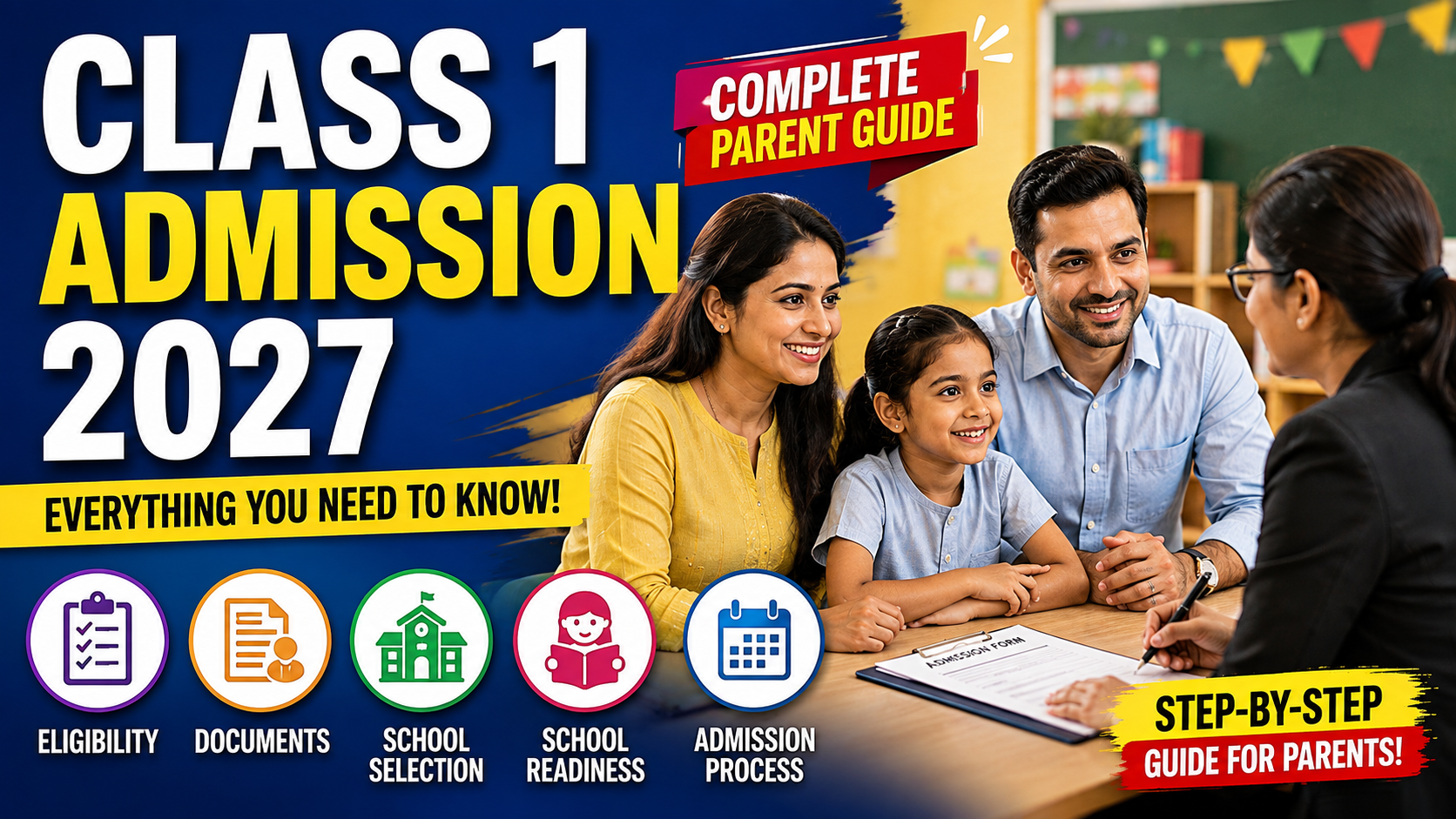
Class 1 Admission 2027: Complete Parent Guide for Parents
Class 1 admission is an important transition for both children and parents. The move from pre-primary education to formal primary schooling brings new questions about age eligibility, school selection, admission forms, documents, school readiness, curriculum and fees.
For parents planning Class 1 admission in 2027, the first step should not be rushing to fill forms. Start by checking the applicable age rule, identifying suitable schools, understanding each school's admission process and preparing your child's transition gradually.
This guide explains the major things parents should consider before applying for Class 1 admission.
Important: Admission dates, age cut-offs, documents and selection procedures can differ by school and may change for a particular academic year. Parents should always confirm the final requirements directly with the school and the applicable education authority.
Class 1 Admission 2027: What Should Parents Do First?
A simple Class 1 admission plan can be divided into six steps:
- Check your child's age eligibility.
- Shortlist schools based on your family's priorities.
- Check the school's board and curriculum.
- Understand the admission process and timeline.
- Keep documents ready.
- Prepare your child for the transition to Class 1.
Starting early gives parents more time to compare schools instead of making a decision only because a particular school has an early deadline.
Class 1 Age Eligibility in 2027
Age eligibility is one of the most important factors parents should check before applying.
India's National Education Policy framework places Grades 1–2 within the Foundational Stage, which covers children from approximately ages 3 to 8 and emphasizes age-appropriate, play- and activity-based learning. The Ministry of Education's foundational-stage framework states that children should begin Grade 1 at around six years of age.
In Maharashtra, the December 31 cut-off has been used for school admission age eligibility. The state had earlier moved the common cut-off date from September 30 to December 31, including for Class 1 admissions.
For parents planning 2027 admission, however, do not assume that an older school's website or a previous year's admission notice automatically applies to the 2027–28 session.
Check:
- The child's date of birth
- The applicable age as of the prescribed cut-off date
- The school's 2027–28 admission notice
- Any updated Maharashtra education department instructions
- Whether the school follows additional board-specific requirements
For example, schools publishing their own admission information commonly state Class 1 eligibility as six years by December 31 of the relevant admission year.
What Is the Right Age for Class 1?
As a general planning principle, parents should expect Class 1 to begin around the age of six.
For a child applying for the 2027–28 academic year, parents should calculate eligibility using the official cut-off applicable to that admission cycle rather than relying only on the child's age on the first day of school.
If your child's birthday falls close to the cut-off date, confirm eligibility directly with the school before submitting an application.
Class 1 Admission 2027: Documents Parents Should Prepare
Schools may ask for different documents, so there is no universal list that applies identically to every institution.
Commonly requested documents can include:
- Child's birth certificate
- Previous school or preschool records
- Previous report card, where applicable
- Passport-size photographs
- Parent or guardian identification documents
- Address or residence proof, where required
- Transfer or school-leaving certificate, where applicable
- Medical or other forms specified by the school
- Category or eligibility documents, if applicable
Keep both scanned and physical copies where practical.
Why the Birth Certificate Matters
The child's date of birth is particularly important because age eligibility is linked to the applicable admission cut-off.
CBSE's admission rules also require schools to follow the age requirements determined by the relevant State/UT Government and recognize a birth certificate as proof of date of birth.
Parents should therefore check that the child's name and date of birth are consistent across important documents.
How to Choose a School for Class 1
Class 1 is not simply about finding a school with a good-looking campus.
Parents should evaluate whether the school is a practical and educational fit for the child.
1. Understand the Board
Check whether the school follows:
- CBSE
- CISCE/ICSE
- Maharashtra State Board
- Another recognized curriculum
Do not choose a board only because other parents recommend it. Consider the child's learning style, the family's future plans and the school's actual approach to teaching.
2. Look at the Learning Environment
For a child entering Class 1, the classroom environment matters significantly.
Ask:
- How are young children introduced to formal learning?
- Is learning activity-based?
- How much attention is given to reading and numeracy?
- How does the school support children who learn at different speeds?
- How are teachers expected to communicate with parents?
The National Curriculum Framework for the Foundational Stage emphasizes play, activity and inquiry-based learning and highlights physical, cognitive, socio-emotional, language and literacy development.
3. Check the Daily Travel Time
A school may look excellent on paper but become difficult if the daily commute is excessive.
Consider:
- Distance from home
- School bus availability
- Pickup and drop-off timing
- Traffic conditions
- Travel time during the actual school day
- Whether the child can comfortably manage the routine
For younger children, a manageable daily routine can be more useful than choosing a school solely because it is farther away.
4. Understand the Total Cost
Do not compare schools using only the headline annual fee.
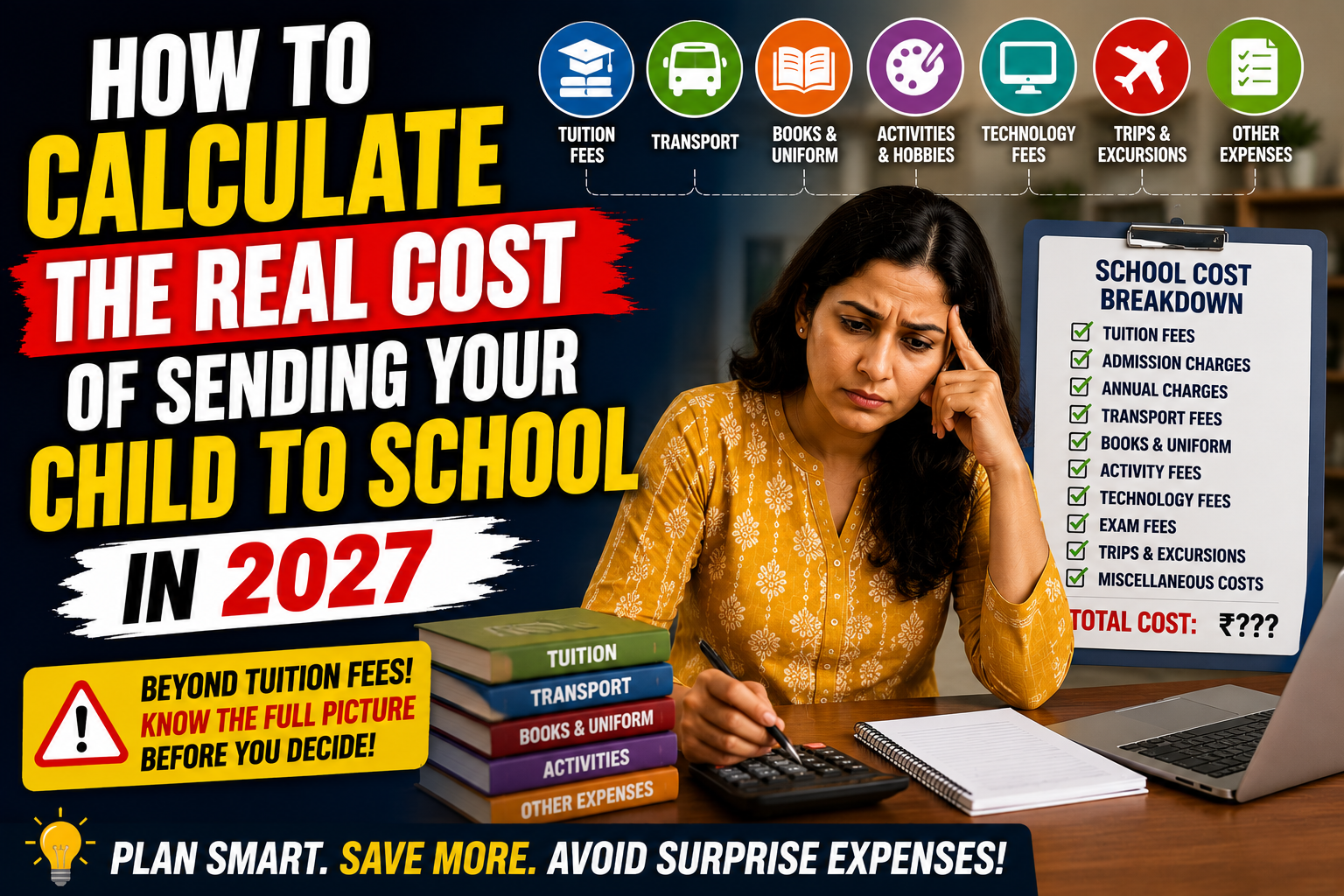
Ask for the applicable fee structure and check whether there are separate charges for:
- Tuition
- Annual charges
- Transport
- Books
- Uniform
- Activities
- Technology or digital services
- Meals, where applicable
- Other school-specific charges
Never assume a charge exists—or does not exist—without checking the school's current fee information.
How the Class 1 Admission Process May Work
Every school can structure admissions differently, but a typical process may include:
Enquiry → Application → Document submission → Interaction/assessment where applicable → Selection/offer → Fee payment → Admission confirmation
Parents should not assume that every school uses an entrance test or interview.
The admission procedure must be checked against the school's own current rules.
For CBSE schools, admission requirements include eligibility for the relevant class, applicable age requirements and supporting academic/identity documents.
Should Parents Prepare Children for a Class 1 Admission Interview?
Preparation should focus on confidence and familiarity, not memorizing scripted answers.
If a school has an interaction or assessment as part of its process, parents can gently practise everyday situations such as:
- Introducing themselves
- Saying their name and age
- Recognizing common objects
- Listening to simple instructions
- Identifying colours and shapes
- Talking about family members
- Looking at a picture and describing it
- Basic number recognition
- Simple language and communication activities
Avoid turning preparation into an intensive coaching programme.
A six-year-old should not feel that admission is an examination of their worth.
Class 1 School Readiness: What Should a Child Know?
Parents often ask whether their child needs to read fluently, write sentences or perform advanced mathematics before Class 1.
There is no single universal checklist that applies to every school.
Instead of focusing only on academic performance, look at broader readiness.
Communication
The child should gradually be able to:
- Express basic needs
- Listen to instructions
- Ask questions
- Participate in simple conversations
- Communicate when something is difficult
Early Literacy
Useful foundations include:
- Interest in books and stories
- Recognition of familiar letters or words
- Listening to stories
- Ability to communicate ideas
- Developing vocabulary
Early Numeracy
Children can gradually develop:
- Number recognition
- Counting
- Comparing quantities
- Understanding simple patterns
- Recognizing common shapes
Social and Emotional Readiness
This is equally important.
A child entering Class 1 may need to practise:
- Waiting for a turn
- Sharing
- Following classroom routines
- Asking a teacher for help
- Working with other children
- Managing small frustrations
- Separating from parents for the school day
The foundational-stage framework emphasizes that children learn through concrete experiences, collaboration and developmentally appropriate activities, rather than through academic pressure alone.
How Parents Can Prepare Their Child for Class 1
Preparation can begin several months before school starts.
Build a Consistent Routine
Gradually establish regular times for:
- Waking up
- Breakfast
- Getting dressed
- Reading
- Play
- Homework or quiet learning
- Bedtime
The objective is to make the school routine familiar.
Encourage Independence
Give the child opportunities to:
- Pack simple belongings
- Wear and remove shoes
- Open a lunch box
- Keep books in their place
- Use the washroom independently, where developmentally appropriate
- Ask adults for help when necessary
Read Together
Regular reading can help build vocabulary, listening skills and interest in stories.
Parents do not need expensive resources. Age-appropriate storybooks, picture books and conversations about everyday experiences can provide useful practice.
Don't Turn Preparation Into Pressure
Avoid repeatedly telling a child:
"You have to be very smart for Class 1."
Instead, use messages such as:
- "You are going to learn many new things."
- "It is okay to ask your teacher for help."
- "You don't have to know everything on the first day."
- "We can practise together."
Class 1 Admission 2027 Checklist for Parents
Before submitting an application, review this checklist:
- Confirm the applicable age eligibility.
- Note the school's official admission dates.
- Check the board and curriculum.
- Read the school's admission instructions.
- Verify the document requirements.
- Keep the child's birth certificate ready.
- Compare the total cost of schooling.
- Check transport options.
- Visit or virtually explore the school where possible.
- Ask about the Class 1 learning environment.
- Understand how parent communication works.
- Confirm the final admission terms before paying fees.
Common Mistakes Parents Should Avoid
Choosing Only Because of Reputation
A popular school may not automatically be the right fit for every child.
Ignoring the Commute
Daily travel affects the child's routine and the family's schedule.
Waiting Until the Last Moment
Some schools may have limited seats or specific application windows. Parents should monitor official announcements early.
Preparing Only for Academics
School readiness also includes communication, independence, social interaction and emotional adjustment.
Assuming 2026 Rules Automatically Apply to 2027
Previous admission information is useful for planning, but the final 2027–28 requirements should be verified when the school publishes them.
Frequently Asked Questions
What is the usual age for Class 1 admission?
The general framework places Grade 1 around age six. In Maharashtra, parents should check the applicable December 31 cut-off and the school's official admission notice for the relevant academic year.
What documents are usually required for Class 1 admission?
A birth certificate and previous school records are commonly relevant, but the exact list depends on the school. Parents should use the school's current document checklist.
Is an entrance test compulsory for Class 1?
There is no single admission process followed by every school. Whether an interaction, assessment or other selection step exists must be confirmed from the individual school's current admission policy.
Should my child know reading and mathematics before Class 1?
Children benefit from strong foundational language and numeracy skills, but parents should not assume that advanced academic preparation is necessary. Foundational education emphasizes age-appropriate, activity-based learning.
When should parents start preparing for Class 1 admission 2027?
Starting several months ahead is sensible. It gives parents time to research schools, check eligibility, prepare documents and understand admission requirements without unnecessary last-minute pressure.
Conclusion
Class 1 admission 2027 should be approached as a school-selection and child-readiness decision, not simply as a form-filling exercise.
Parents should first verify age eligibility, then compare schools based on curriculum, learning environment, location, total cost, communication and the child's individual needs. Official admission information should always take priority over old websites, social-media posts or informal advice.
Most importantly, prepare the child for learning and independence, not just for admission. A positive transition into Class 1 can help children begin primary school with greater confidence and curiosity.
DextroCampus tip: Keep a simple admission folder containing the child's birth certificate, school records, identification documents and application details. Update it whenever a school releases its official 2027–28 requirements.
Tags:
Get Weekly Insights
Join 10k+ parents getting smarter about education.
Read Next

How to Choose the Right School Transport Option for Your Child in 2027: Safety, Cost & Convenience Guide
8/19/2026

What Makes a School Worth Paying Higher Fees For in 2027? 10 Things Parents Should Check
8/17/2026
How to Calculate the Real Cost of Sending Your Child to School in 2027: The Complete Parent Budget Guide
8/17/2026