
Changing Schools Before Class 1: Good Decision or Risky Move? A Parent's Guide
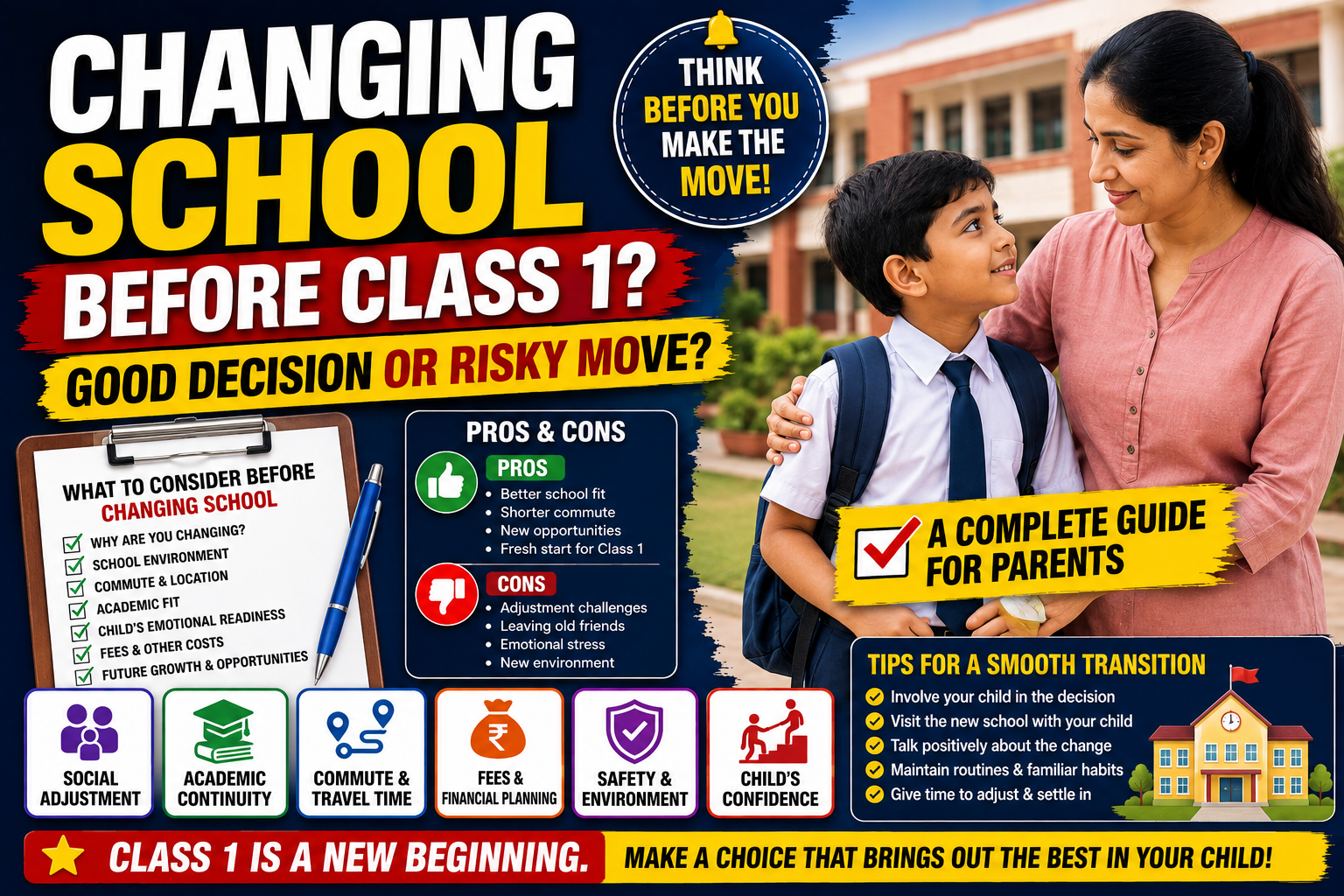
Changing Schools Before Class 1: Good Decision or Risky Move? A Parent's Guide
Starting Class 1 is already a major transition for a child. But what happens when your child is also moving to a new school at the same time?
For many parents, this can be a difficult decision.
Perhaps your current preschool does not continue until Class 1. Maybe your family has moved to a new location. You may be concerned about the commute, learning environment, school routine or overall suitability of the current school.
Or perhaps you have found another school that appears to be a better fit.
So, should you change schools before Class 1?
Sometimes, yes. But the decision should be based on your child's needs and your family's circumstances — not simply on which school looks more impressive.
There is no universal rule that says a child should stay in the same school or must move before Class 1.
For young children, the quality of the learning environment, emotional comfort, routine, relationships and opportunities to learn all matter. The National Curriculum Framework for the Foundational Stage also emphasizes a developmentally appropriate, play-based and supportive approach to learning.
For parents planning Class 1 admission 2027, this guide explains when changing schools can make sense, what to compare and how to make the transition easier.
Should You Change Schools Before Class 1?
The short answer is:
Consider changing schools if the new school clearly offers a better overall fit for your child and family.
A school change may make sense when:
- The current school does not offer Class 1.
- Your family has moved to another area.
- The current commute is too long.
- The school's approach no longer suits your child.
- Parents have genuine concerns about the learning environment.
- The child's needs have changed.
- The new school offers a more suitable routine.
- The current school cannot provide the next stage of education you are looking for.
However, changing schools simply because another school is more popular, has a larger campus or appears more prestigious may not automatically benefit your child.
The better question is:
“Why would this change be better for my child?”
7 Common Reasons Parents Change Schools Before Class 1
1. The Current School Does Not Offer Class 1
This is one of the most straightforward reasons.
Some children attend a preschool or early-years programme that ends before primary school.
If your current school does not continue to Class 1, moving to another school is naturally part of the transition.
Parents should begin researching new options early enough to understand:
- Admission eligibility
- Application process
- Required documents
- School timings
- Fees
- Transport
- School environment
Always verify the latest information directly with the school.
2. Your Family Has Moved to a New Location
Relocation can completely change the practicality of a school.
A school that was convenient before may become difficult after moving because of:
- Longer travel time
- Traffic
- Transport costs
- Early morning travel
- Difficult pickup and drop-off
- Less time for sleep and play
For a young child, the daily journey should be part of the school-selection decision.
A school that is academically suitable but creates an exhausting daily commute may not be the best practical choice.
3. The Current School Is No Longer the Right Fit
A preschool environment and a primary-school environment may have different expectations.
As your child moves into Class 1, parents may want to consider:
- Learning approach
- Classroom routine
- Language environment
- Homework expectations
- Activities
- Assessment approach
- Opportunities for interaction
- Overall school culture
Do not assume that one board, teaching method or school format is automatically better for every child.
The right question is:
“Which environment will help my child learn comfortably and confidently?”
4. The Daily Commute Is Too Long
This factor is easy to overlook.
Parents often compare schools based on:
- Reputation
- Fees
- Facilities
- Board
- Activities
But daily travel can have a major impact on family life.
Think about:
Wake-up time → getting ready → breakfast → travel → school → return journey → homework/activities → dinner → bedtime
If the journey takes a large part of the day, consider how it may affect your child's routine.
A shorter commute can sometimes make a significant difference to the family's daily schedule.
5. Your Child's Needs Have Changed
Children develop quickly during the early years.
The school that worked well during preschool may not necessarily be the ideal environment for the next stage.
Parents can consider whether their child now needs:
- More independence
- More structured learning
- More opportunities for play
- Additional language support
- More interaction with peers
- A different classroom environment
- A different daily routine
This should be based on your child's actual needs rather than comparisons with other children.
6. Parents Have Genuine Concerns About the Current School
Sometimes the reason for changing schools is not academic.
Parents may have ongoing concerns about:
- Communication
- School routine
- Safety procedures
- Teacher-parent communication
- Excessive academic pressure
- Classroom environment
- Activities
- Transport
- General family-school coordination
If you have concerns, first try to understand whether they can be resolved through communication with the school.
If the concerns are serious, persistent and unlikely to improve, exploring alternatives may be reasonable.
7. You Found a School That Is a Better Overall Fit
Sometimes the simplest reason is that another school better matches your family's priorities.
That can be a valid reason to change.
However, compare both schools objectively.
Do not ask only:
“Which school is better?”
Ask:
“Which school is better for our child?”
That distinction can prevent parents from making decisions based only on reputation or social pressure.
The Advantages of Changing Schools Before Class 1
A school change can have several potential benefits.
A Fresh Start
Class 1 is naturally a new stage in a child's education.
Starting at a new school can give your child a fresh beginning with new teachers, classmates and routines.
Better School-Child Fit
A different school may provide an environment that better matches your child's personality, learning needs or family situation.
A More Practical Commute
If the new school is significantly closer or easier to reach, the entire family routine may become more manageable.
New Learning Opportunities
A new school may provide programmes, activities or learning experiences that better match your family's priorities.
However, parents should verify these offerings directly rather than relying only on advertisements or online claims.
The Possible Disadvantages of Changing Schools
Changing schools is not automatically a positive decision.
There can also be challenges.
1. A New Environment
Your child may need to adjust to:
- New teachers
- New classmates
- New classroom
- New rules
- New timetable
- New routines
2. Emotional Adjustment
Some children may feel nervous about entering an unfamiliar environment.
They may worry about:
- Making friends
- Finding their classroom
- Talking to a new teacher
- Being away from parents
- Understanding new rules
Parents should take these concerns seriously.
3. Leaving Familiar Friends
If your child is strongly attached to their current classmates, leaving them can be emotionally difficult.
Instead of saying:
“Don't worry, you will make new friends.”
first acknowledge the feeling:
“I know you will miss your friends. It is okay to feel sad about that.”
Then help your child think about the new opportunities ahead.
4. Adjusting to New Expectations
Different schools can have different:
- Routines
- Homework practices
- Classroom expectations
- Communication systems
- Activity schedules
Your child may need time to adjust.
Stay or Change? Compare Both Schools Carefully
Before making the decision, create a simple comparison.
| Factor you should check | ||
| Class 1 availability | Check | Check |
| Distance | Check | Check |
| Travel time | Check | Check |
| Learning environment | Evaluate | Evaluate |
| School routine | Check | Check |
| Child's comfort | Observe | Assess |
| Activities | Verify | Verify |
| Fees | Verify | Verify |
| Transport | Verify | Verify |
| Admission process | Check | Check |
| Long-term suitability | Consider | Consider |
This makes the decision more objective.
10 Questions Parents Should Ask Before Changing Schools
Before making the final decision, ask yourself:
1. Why are we changing schools?
Write down the actual reason.
2. What problem are we trying to solve?
Be specific.
3. Does the new school actually solve that problem?
Do not assume it does.
4. How will the commute change?
Calculate the actual daily travel time.
5. How will our child's routine change?
Consider sleep, meals, play and family time.
6. What is the new school's Class 1 admission process?
Check the current official information.
7. What will the total cost be?
Consider applicable school, transport and other charges.
8. How will our child adjust socially?
Think about friends and classroom environment.
9. Can we visit the school?
If the school allows visits or orientation, take advantage of the opportunity.
10. Have we discussed the decision with our child?
Even a young child deserves an age-appropriate explanation.
How to Tell Your Child About Changing Schools
Do not suddenly announce:
“You are changing schools next year.”
Instead, introduce the idea gradually.
You could say:
“You are going to Class 1 next year, and we are looking at schools where you can learn, play and make new friends.”
If your child asks:
“Why can't I stay here?”
give a simple and honest explanation.
For example:
“Your current school was a good place for your preschool years, and now we are looking for a school for Class 1.”
Avoid speaking negatively about the current school in front of your child.
Children can become confused when adults criticize an environment they previously trusted.
What If Your Child Does Not Want to Change?
Do not immediately dismiss the concern.
Ask:
“What makes you worried about the new school?”
The answer may reveal the real issue.
Your child may be worried about:
- Leaving friends
- Meeting new teachers
- A new uniform
- A new classroom
- Getting lost
- Being away from parents
- Not knowing anyone
Once you know the concern, you can address it.
Visit the New School With Your Child
If the school permits visits, take your child with you.
Pay attention to:
- Classroom environment
- Student behaviour
- Teacher interaction
- Entry and exit arrangements
- Safety procedures
- Cleanliness
- Playground
- Transport arrangements
- Overall atmosphere
Do not judge the school only by the size of its building.
A larger campus does not automatically mean a better educational fit.
Should You Change Schools If Your Child Is Already Happy?
This is an important question.
If your child is:
- Happy
- Comfortable
- Learning well
- Socially settled
- Emotionally secure
and the current school meets your family's needs, there may be no strong reason to change.
Ask:
“What specific benefit will the new school provide?”
If you can identify a meaningful benefit, compare it against the disruption of moving.
If the only reason is:
“The other school is more famous.”
take more time before deciding.
When Changing Schools May NOT Be the Best Choice
Consider staying if:
- Your child is thriving in the current school.
- The reason for changing is mainly social pressure.
- You have not researched the new school properly.
- The new school creates a significantly longer commute.
- The change would seriously disrupt your child's routine.
- You are relying only on online opinions.
- You have not compared the total costs.
- The supposed advantages of the new school have not been verified.
What About Changing Schools Because of Friends?
Friends are important to young children.
However, friendship alone should not determine the school decision.
If your child's best friend is moving to another school, ask whether that school is also suitable in terms of:
- Learning environment
- Commute
- Cost
- Routine
- Admission process
- Long-term fit
At the same time, do not reject a suitable school simply because your child does not know anyone there.
Children can build new friendships with time and support.
How Long Does It Take a Child to Adjust?
There is no fixed adjustment period.
Some children settle quickly.
Others may need several weeks or longer.
Adjustment can depend on:
- Personality
- Previous school experience
- Family circumstances
- Classroom environment
- Teacher support
- Social opportunities
- How prepared the child feels
Parents should focus on how the child is progressing rather than expecting immediate comfort.
How Parents Can Support the Transition
Keep Familiar Routines
Continue familiar:
- Bedtime routines
- Reading
- Family activities
- Mealtimes
- Weekend activities
Familiarity can help make the new environment feel less overwhelming.
Talk Positively About School
Avoid creating fear.
Instead of:
“You have to behave properly or your new teacher will be angry.”
say:
“You will meet your new teacher and learn new things.”
Let Your Child Ask Questions
Your child may have many small concerns.
Answer them honestly.
If you do not know something, say:
“We will find out.”
Stay Patient During the First Few Weeks
Your child may be more tired or emotional than usual after starting a new school.
That does not automatically mean the decision was wrong.
Give them time to adjust.
A Simple Stay-or-Change Decision Framework
If you are still unsure, use three steps.
Step 1: Identify the Problem
Write down exactly why you are considering a school change.
Step 2: Identify the Expected Benefit
Write down what the new school is expected to improve.
Step 3: Compare the Cost of Change
Consider:
- Money
- Travel
- Time
- Routine
- Emotional adjustment
- Admission requirements
- Family logistics
If the expected benefits clearly outweigh the disruption, changing schools may be reasonable.
If the benefits are uncertain, gather more information before making the final decision.
Class 1 School Change Checklist
Before finalizing the move:
- We have a clear reason for changing schools.
- We have compared the current and new school.
- We have checked the new school's Class 1 admission requirements.
- We have considered total costs.
- We have considered the daily commute.
- We understand the new school's routine.
- We have discussed the change with our child.
- We have considered the child's emotional response.
- We have checked transport arrangements.
- We have verified important information directly with the school.
- We have a plan to help the child adjust.
- We are making the decision based on our child's needs rather than comparison or pressure.
FAQs
Is it okay to change schools before Class 1?
Yes. Changing schools before Class 1 can be a reasonable decision when the new school is a better fit for the child's educational, emotional or practical needs.
Is changing schools stressful for a child?
It can be. A new teacher, classroom and group of classmates may take time to adjust to. Parents can reduce stress by preparing the child gradually and maintaining familiar routines.
Should I change schools if my child is happy in the current school?
Not necessarily. If your child is comfortable and the current school meets your family's needs, there may be no strong reason to change simply because another school looks more attractive.
Is it better to start Class 1 with old friends?
Familiar friends can make the transition easier, but they are only one factor. The overall suitability of the school should also be considered.
How should I tell my child about changing schools?
Explain the change calmly and honestly. Tell the child why the family is considering the move and give them opportunities to ask questions.
What if my child refuses to go to the new school?
First understand the reason. Your child may be worried about leaving friends, meeting new teachers or entering an unfamiliar environment. Address the specific concern rather than immediately treating the refusal as misbehaviour.
Should I choose a new school because it has better facilities?
Facilities can matter, but they should not be the only deciding factor. Consider the learning environment, commute, safety, routine, costs and overall fit.
When should parents start looking for a new Class 1 school?
Start early enough to understand the school's admission process, eligibility, documents, fees and timelines. Avoid waiting until the final weeks if a school change is already likely.
Conclusion
Changing schools before Class 1 is neither automatically a good decision nor a bad one.
It depends on why you are changing, what the new school offers and how well it fits your child and family.
If the current school ends before Class 1, your family has relocated, the commute is impractical, or the new school genuinely offers a better fit, changing schools may make sense.
But if your child is happy, comfortable and learning well, do not make the decision simply because another school appears more impressive.
Before making the final choice, compare:
School fit → Child's comfort → Learning environment → Commute → Costs → Routine → Long-term suitability
Most importantly, remember that Class 1 is a new beginning.
Your child does not need to enter the new school already knowing everyone or feeling completely confident.
With preparation, patience and support, a school change can become an exciting new chapter rather than a stressful disruption.
Verification note: Admission requirements, age criteria, fees, transport arrangements and school-specific policies can change. Parents planning Class 1 admission for 2027–28 should verify current information directly with the individual school before making a final decision.
Tags:
Get Weekly Insights
Join 10k+ parents getting smarter about education.