CBSE Exam Changes 2026: Why Rote Learning Will Now Fail Your Child
.png?alt=media&token=f0c6e193-c27f-41bf-aaab-22046d6daf8f)
Did you know that for the upcoming CBSE board exams, a staggering 50% of the questions will be competency-based? If you are a parent who grew up measuring academic success by how perfectly you could memorize a textbook chapter, this single statistic changes everything.
For decades, the Indian education system rewarded a very specific skill: rote learning. Students who could memorize entire textbooks and reproduce them word-for-word on answer sheets were the ones who became school toppers. But the landscape is shifting dramatically under the National Education Policy (NEP) 2020 and the National Curriculum Framework (NCF) 2023. The Central Board of Secondary Education (CBSE) has drawn a line in the sand. The days of cramming are officially over.
But what does this actually mean for your child sitting at their study desk right now? Let’s decode this massive shift and figure out how you can help them navigate it.
What Exactly is a "Competency-Based" Question?
Think of rote learning as knowing that a tomato is a fruit. Competency is knowing not to put a tomato in a fruit salad.
In the old system, a typical science question might ask: "What are the laws of reflection?" A student could easily score full marks by memorizing the two bullet points from their NCERT textbook.
A competency-based question flips the script. It tests whether a student actually understands the concept enough to apply it to a real-world scenario. The new question might look like this: "Rohan is standing in a trial room with two mirrors placed parallel to each other. How many reflections will he see, and what scientific principle explains this? If one mirror is tilted by 10 degrees, what happens to the reflections?"
This requires critical thinking, analytical skills, and genuine comprehension. If a student has only memorized the definition of reflection without understanding how it works in the physical world, they will struggle to score.
Why the Shift? The Need for Future-Ready Minds
According to recent ASER (Annual Status of Education Report) data, while school enrollment in India is at an all-time high, foundational learning and critical reading skills have often lagged. Industry leaders from NASSCOM to global tech giants have echoed a similar concern: our schools produce excellent test-takers, but not enough independent problem-solvers.
CBSE’s move to increase case-study, source-based, and assertion-reasoning questions is a direct remedy to this problem. The board is actively trying to design exams that are "cram-proof." The goal is to prepare Indian students not just for college cut-offs, but for a global workforce that values innovation and adaptability over pure memory.
At DextroCampus, we speak to thousands of parents every month who are anxious about these sudden changes. The fear is natural. You want the best for your child, and when the rules of the game change midway, it feels unfair. But once you understand the why behind the change, you can change the how of their daily preparation.
4 Ways Parents Can Help Children Adapt to the 2026 Pattern
As a parent, you are your child's first mentor. You don't need to know the physics or math syllabus, but you can definitely shape their study habits. Here is how you can help them pivot from rote to competency:
1. Stop Celebrating Pure Memorization When you test your child at home, stop asking them to recite answers. Instead, ask them to explain the concept to you like a story. If they are studying the French Revolution, ask them: "If you were a poor farmer in France during that time, why would you be angry?" Emphasize the "why" and "how" over the "what" and "when."
2. Introduce Case Studies into Daily Life Competency questions are essentially real-world problems. You can build this muscle outside of textbooks. If you are reading a news article about a local drought, ask your teenager how they would solve the water crisis using the science they learned in Class 10. Connect the syllabus to the newspaper.
3. Shift from "10-Year Papers" to Conceptual Workbooks While past papers are great for time management, relying on them to predict questions is now a dangerous strategy. Encourage your child to solve the latest sample papers released directly by CBSE on their official portal, which heavily feature the new MCQs and source-based formats.
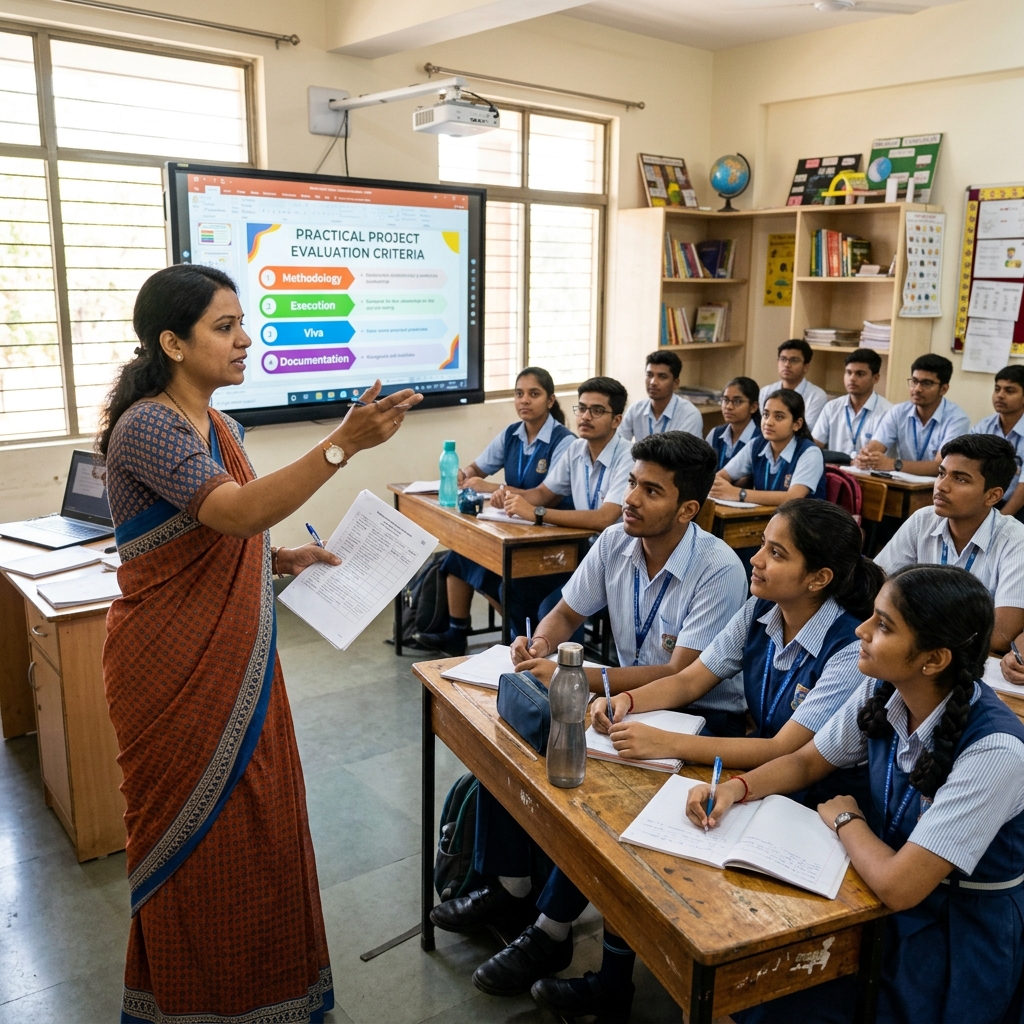
4. Choose the Right School Environment This is perhaps the most critical step. Is your child's school actually updating its teaching methods, or are the teachers still just reading from the textbook? Schools that focus on experiential learning, modern science labs, and interactive discussions are going to produce the top performers in this new era.
If you feel your current school is still stuck in the rote-learning era, it might be time to evaluate your options. Finding a progressive school that aligns with the new NCF 2023 guidelines doesn't have to be a blind guess.
Confidently Navigate Your Child's Future
The shift from rote learning to competency is not a hurdle; it is an incredible opportunity for your child to actually enjoy learning rather than fearing exams. It removes the immense pressure of memorizing thousands of pages and replaces it with the joy of understanding how the world works.
If you are a parent feeling overwhelmed by board exam changes, curriculum shifts, or choosing the perfect school that actually focuses on competency-based learning, you don't have to do it alone.
Ready to find a school that truly prepares your child for the future? Explore top-rated, forward-thinking schools in your city, compare curriculums, and get expert admission guidance today at dextrocampus.com. Let’s make education a journey of discovery, not a test of memory.
Tags:
Get Weekly Insights
Join 10k+ parents getting smarter about education.