Big School vs Small School: Which Is Better for Your Child in 2027?
Introduction
When parents start looking for a school, one question often appears surprisingly late in the decision-making process:
Should we choose a big school or a small school?
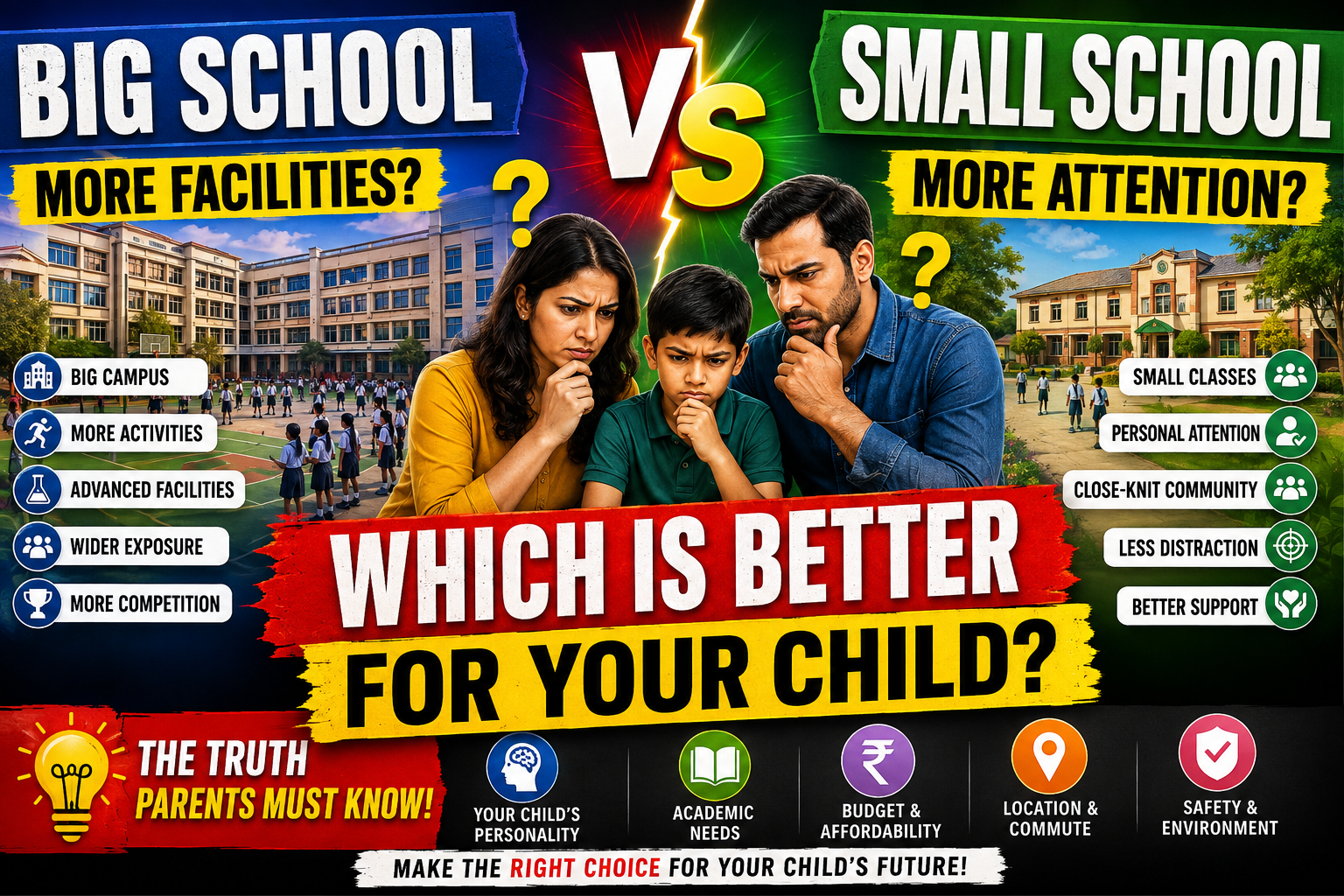
A large school may have a huge campus, multiple laboratories, sports facilities, large libraries, many teachers and dozens of extracurricular options.
A smaller school may offer fewer facilities but provide a more close-knit environment where teachers know students personally.
So which one is better?
The answer is not as simple as choosing the school with the larger campus or the smaller class size.
For families searching for schools in Mumbai, Thane, Vasai, Virar, Mira Road, Bhayandar, Nalasopara, Naigaon and other parts of Maharashtra, the better approach is to compare what each school can actually provide for your particular child.
The goal is not to find the biggest school or the smallest school.
The goal is to find the right learning environment.
What Is a Big School?
There is no universal definition of a "big school."
In general, parents use the term for schools with:
- A large student population
- Multiple sections per grade
- A larger teaching team
- A sizeable campus
- Multiple academic facilities
- More extracurricular programmes
- Larger sports infrastructure
- A broader range of activities
A big school may serve hundreds or even several thousand students across different grades.
Because of its scale, it may have more resources and specialised departments.
However, size alone does not guarantee better education.
What Is a Small School?
A small school generally has a lower student population and fewer sections in each grade.
It may offer:
- Smaller classes
- Closer teacher-student interaction
- A more familiar school community
- Greater visibility of individual students
- Fewer but more focused activities
- A quieter environment
Again, smaller does not automatically mean better.
The quality of teaching, leadership, safety, academic support and school culture still matters.
Big School vs Small School: Key Comparison
| Student population | Usually larger | Usually smaller |
| Class sections | More | Fewer |
| Facilities | Often wider range | May be more limited |
| Extracurricular options | Usually more | Often fewer |
| Competition | Can be higher | May be moderate |
| Individual attention | Depends on class size and systems | Often easier to provide |
| Teacher familiarity | May vary | Often stronger |
| Student exposure | Broad | More focused |
| School community | Large and diverse | Close-knit |
| Academic support | May have specialised systems | May offer more direct interaction |
| Campus | Often larger | Usually smaller |
| Fees | Can vary widely | Can vary widely |
| Best fit | Independent, outgoing students may enjoy the scale | Students seeking closer support may prefer it |
This table is a starting point—not a verdict.
A well-managed large school can provide excellent individual support, while a small school can also have crowded classes or limited resources.
Parents should verify the actual situation.
Advantages of a Big School
1. More Facilities
Large schools may have access to a wider range of facilities such as:
- Science laboratories
- Computer laboratories
- Libraries
- Sports grounds
- Swimming facilities
- Performing arts spaces
- Music rooms
- Activity centres
- Technology-enabled classrooms
However, parents should ask an important question:
“How often will my child actually use these facilities?”
A long facility list is useful only when students have meaningful access to it.
2. Wider Extracurricular Exposure
A large school may have enough students and staff to support a wide variety of activities.
Children may get opportunities in:
- Football
- Cricket
- Basketball
- Athletics
- Music
- Dance
- Theatre
- Art
- Debate
- Public speaking
- Robotics
- Clubs
- Competitions
This can be particularly valuable for children who are still discovering their interests.
3. More Peer Diversity
Large schools often bring together students with different interests, personalities, backgrounds and abilities.
This can expose children to:
- Different viewpoints
- Different communication styles
- Teamwork
- Competition
- Leadership opportunities
- Larger peer networks
For some children, this can be an important part of personal development.
4. More Competition
Competition can be both an advantage and a challenge.
A motivated child may enjoy being surrounded by peers who are academically strong or highly active in sports and competitions.
It may encourage the child to set goals.
However, parents should also consider whether excessive competition could create unnecessary pressure.
The right question is:
“Does competition motivate my child or overwhelm my child?”
Advantages of a Small School
1. Potentially Greater Individual Attention
One of the biggest attractions of a small school is the possibility of closer teacher-student interaction.
Teachers may find it easier to:
- Know students personally
- Notice changes in behaviour
- Identify learning difficulties
- Follow up on academic concerns
- Understand individual strengths
- Communicate directly with parents
However, parents should verify the actual class size rather than assuming that every small school provides individual attention.
2. Stronger Sense of Community
A smaller school can feel more familiar.
Students may know more teachers and staff members personally.
Parents may also find it easier to communicate with school representatives.
This can create a stronger sense of belonging.
For younger children or children who are naturally shy, such an environment may sometimes feel more comfortable.
3. Potentially Lower Social Pressure
A smaller environment can reduce the feeling of being one student among hundreds.
Students may have more opportunities to participate because the school community is smaller.
However, this depends heavily on the school's culture and teaching approach.
4. Easier Visibility of Student Progress
When there are fewer students, teachers may find it easier to notice:
- Academic improvement
- Behavioural changes
- Participation patterns
- Social difficulties
- Strengths and interests
Again, this should be verified rather than assumed.
A small student population does not automatically mean strong monitoring.
Big School vs Small School: Which Is Better for Different Children?
A Big School May Suit Your Child If...
- Your child is independent.
- Your child enjoys meeting many people.
- Your child likes competition.
- Your child wants many extracurricular choices.
- Your child enjoys sports or performance activities.
- Your child is comfortable asking teachers for help.
- You value a wide range of facilities.
- Your family can manage the school's commute and overall cost.
A Small School May Suit Your Child If...
- Your child benefits from closer adult guidance.
- Your child is shy or takes time to adjust socially.
- Your child learns better in smaller groups.
- Your child needs closer academic monitoring.
- You prefer a close-knit school community.
- Your child values personal relationships with teachers.
- You prefer a less overwhelming school environment.
- The school provides sufficient facilities for your child's needs.
These are general indicators, not fixed rules.
A confident child can thrive in a small school, and a shy child can thrive in a large school.
The individual school environment matters more than the label.
The Most Important Factor: Class Size
Parents often confuse school size with class size.
They are not the same thing.
A large school may have small classes.
A small school may still have relatively large classes.
Therefore, ask:
- How many students are in each class?
- How many sections are there per grade?
- How many teachers are assigned to the class?
- How much individual feedback do students receive?
- How does the school handle students who need additional help?
Classroom experience matters much more than the total number of students in the entire school.
Big School vs Small School: Facilities Comparison
| Facility / Opportunity | Big School | Small School |
| Large sports ground | More likely | Depends on campus |
| Multiple laboratories | More likely | May be limited |
| Large library | Often available | May be smaller |
| Wide activity selection | Usually stronger | May be narrower |
| Specialised teachers | Potentially more | Depends on school |
| Technology resources | Varies | Varies |
| Individual attention | Depends on systems | Potentially stronger |
| Student exposure | Broad | More focused |
Do not make the mistake of assuming that a large school automatically uses its facilities better.
Ask to see the facilities and understand how students access them.
Big School vs Small School: Academic Comparison
Academic quality depends primarily on teaching and learning systems, not the size of the campus.
Parents should ask both types of schools:
Teaching
- How do teachers explain difficult concepts?
- How are questions encouraged?
- How is classroom understanding checked?
Assessment
- How frequently are students assessed?
- What happens when a child performs poorly?
- How is feedback provided?
Learning Support
- Are remedial classes available?
- How are learning gaps identified?
- How are advanced learners challenged?
Progress
- How do parents receive academic updates?
- How does the school monitor individual progress?
These questions are more useful than simply asking whether a school is big or small.
What About Fees?
Parents should not assume that:
Big school = expensive
or
Small school = affordable
Both assumptions can be wrong.
Fees depend on factors such as:
- School board
- Location
- Facilities
- Transport
- Activities
- School management
- Grade
- Services provided
Parents should request a complete fee structure directly from the school.
This should include recurring and applicable additional charges.
Parents should verify current fees directly with the school management before making an admission decision.
Big School vs Small School: Student Wellbeing
Student wellbeing deserves serious attention.
Ask:
- How does the school handle bullying?
- How easily can students approach teachers?
- Is counselling support available?
- How does the school respond to emotional concerns?
- Are students encouraged to speak about problems?
- How does the school handle discipline?
A school should be a place where children feel safe enough to ask questions, make mistakes and learn.
The best size is the one that creates the right environment for your child's wellbeing.
7 Questions Parents Should Ask Both Schools
When comparing a big school and a small school, ask exactly the same questions.
1. What is the average class size?
This helps you understand the actual classroom environment.
2. How does the school support struggling students?
Look for a clear process rather than a general promise.
3. How much individual attention do teachers provide?
Ask for practical examples.
4. What activities can my child actually participate in?
Do not evaluate activities based only on the brochure.
5. How does the school communicate student progress?
Understand the frequency and quality of communication.
6. What happens when a child has a problem?
Ask about academic, emotional and behavioural support.
7. What makes your school suitable for a child like mine?
This final question can reveal how well the school understands individual needs.
Decision Matrix: Big School or Small School?
| Your Priority | Potentially Better Fit |
| More facilities | Big school |
| More extracurricular options | Big school |
| Large peer network | Big school |
| More competition | Big school |
| Personal attention | Small school may have an advantage |
| Close-knit environment | Small school |
| Strong teacher familiarity | Small school may have an advantage |
| Smaller community | Small school |
| Specialised activities | Big school may offer more |
| Individual academic monitoring | Depends on actual systems |
| Child confidence | Depends on school culture |
| Academic quality | Depends on teaching quality |
| Safety | Depends on school systems |
| Best overall fit | Depends on the child |
The 10-Point Parent Decision Framework
Before making a final decision, score each school from 1 to 10 on:
| Factor | School A | School B |
| Teaching quality | ||
| Class size | ||
| Individual attention | ||
| Academic support | ||
| Facilities | ||
| Activities | ||
| Safety | ||
| Student wellbeing | ||
| Parent communication | ||
| Child's comfort |
Do not allow one impressive feature to dominate the decision.
A school with a spectacular campus but weak parent communication may not be the best fit.
Similarly, a small school with excellent teachers but inadequate facilities may not meet the needs of a child who is passionate about sports or specialised activities.
Common Mistakes Parents Make
Mistake 1: Assuming Bigger Means Better
A larger campus does not automatically mean better education.
Mistake 2: Assuming Smaller Means More Attention
Small size creates the possibility of closer attention, but parents must verify how the school actually operates.
Mistake 3: Comparing Only Facilities
Facilities matter, but teachers and learning quality matter more.
Mistake 4: Ignoring the Child's Personality
Parents sometimes choose a school based entirely on reputation.
The child's temperament should also be considered.
Mistake 5: Ignoring Travel Time
A school that takes a very long time to reach every day can affect sleep, homework, play and family time.
For families in the Mumbai Metropolitan Region and Maharashtra suburbs, commute should be part of the school decision.
Frequently Asked Questions
1. Is a big school better than a small school?
Not necessarily. Big schools may provide more facilities, activities and exposure, while small schools may provide a closer community and potentially more individual attention. The right choice depends on the child's needs and the actual quality of the school.
2. Are small schools better for shy children?
A small, supportive environment may be comfortable for some shy children, but personality alone should not determine the decision. Parents should observe how teachers support participation, confidence and social development.
3. Do big schools provide less individual attention?
Not always. Individual attention depends on class size, teacher availability, academic support systems and school management. A large school can still provide strong individual support.
4. Are small schools cheaper than big schools?
Not necessarily. School fees depend on the board, location, facilities, management and services provided. Parents should compare the complete fee structure directly with each school.
5. What matters more: school size or teaching quality?
Teaching quality should generally receive greater importance. A school of any size needs effective teachers, meaningful assessment, academic support and a positive learning environment.
6. How should parents choose between a big and small school?
Compare class size, teaching quality, individual attention, facilities, activities, student support, safety, communication, commute and your child's personality and learning needs. Visiting both schools can make the decision easier.
Conclusion & Parent Checklist
There is no universal winner in the big school vs small school debate.
A big school can provide greater exposure, more facilities, broader extracurricular choices and a larger peer network.
A small school can provide a closer community, potentially stronger teacher familiarity and a more personal environment.
But school size should never be the only deciding factor.
Before choosing, parents should:
- Visit both big and small schools personally.
- Check the actual class size.
- Ask about teacher-student interaction.
- Evaluate teaching quality.
- Understand academic support systems.
- Check how student progress is monitored.
- Compare extracurricular opportunities.
- Check which facilities students actually use.
- Evaluate safety and student wellbeing.
- Understand parent-school communication.
- Compare the complete fee structure.
- Consider transport and daily travel time.
- Think about your child's personality and learning style.
- Ask how the school supports children who struggle.
- Verify important claims directly with the school management or relevant official authority.
Expert Takeaway
Do not ask, “Is a big school better than a small school?”
Ask:
“Which school gives my child the right combination of teaching quality, attention, opportunities, safety, support and personal growth?”
The best school is not necessarily the biggest.
It is not necessarily the smallest either.
It is the school where your child can learn confidently, feel supported and grow into a capable and happy student.
Tags:
Get Weekly Insights
Join 10k+ parents getting smarter about education.