
From Sci-Fi to School Science Fair: 5 Awesome AI Projects for Indian Students
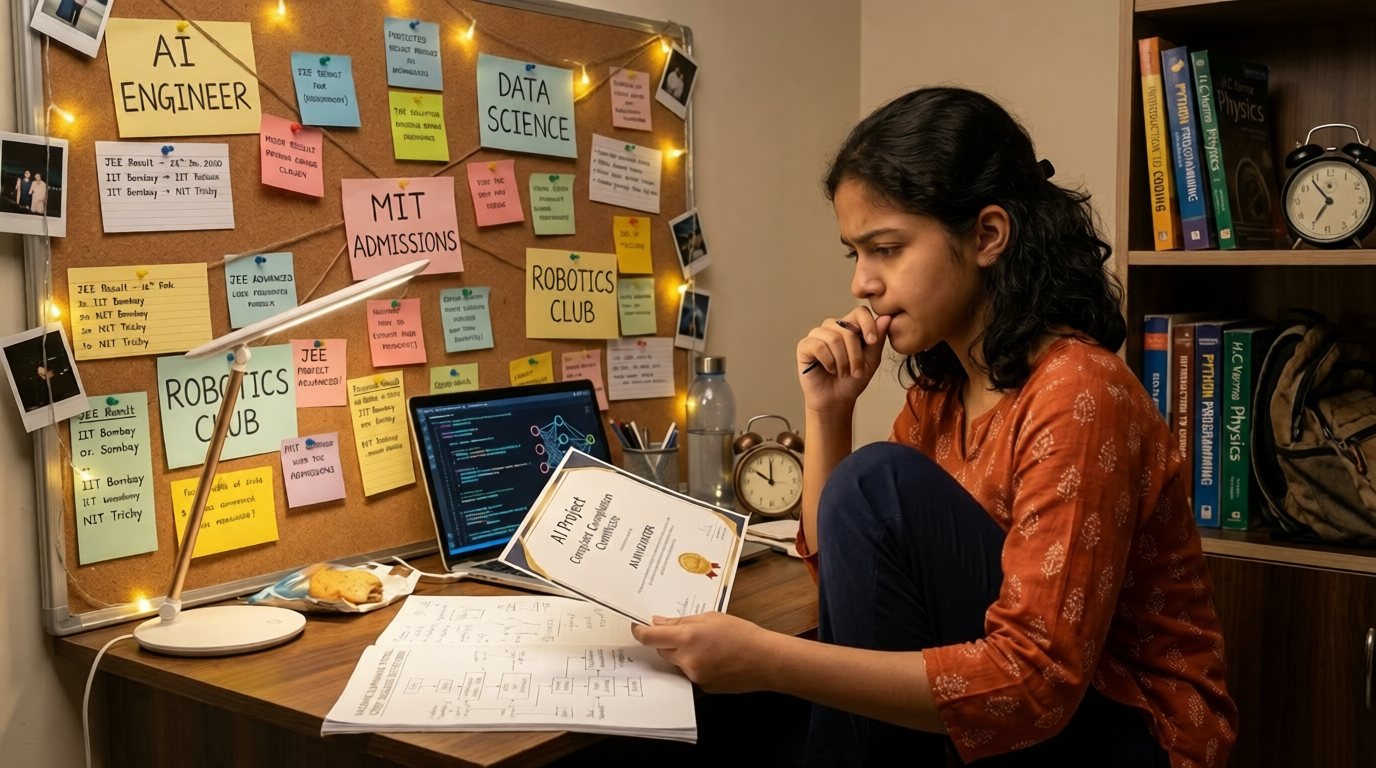
Is Artificial Intelligence (AI) just the stuff of futuristic movies or heavy tech industry work? Not anymore. Today, it’s closer to your child's classroom than you think. According to recent reports and national education discussions, introducing AI concepts early is becoming essential for preparing students for the future workforce. But let's be honest: just reading about AI isn't going to get many students excited. The real magic, and the real learning, happens through doing.
Parents are often caught between two extremes: wanting their kids to be tech-savvy but being overwhelmed by complex jargon and coding languages. You see terms like "Machine Learning," "Neural Networks," and "Deep Learning" and might think, "That's for college kids, not my 12-year-old."
That's simply not true. At DextroCampus, where we help you find the best schools and educational pathways, we're seeing an increasing number of institutions incorporate basic AI and coding into their curricula (especially with the push from NEP 2020 and CBSE directives).
The goal of a school AI project shouldn't be to create a superhuman robot. The real goals are:
- To understand the basics: How do computers "learn"? How is data used?
- To solve problems: Can AI help make a process faster or better?
- To have fun: If they aren't engaged, they won't remember the concepts.
For students who want structured learning beyond the classroom, DX Coaching (dx-coaching.web.app) offers quality online courses designed to help Indian students build real academic and tech skills.
Project 1: The AI Art Generator
This is a fantastic entry-level project that requires zero coding.
How it Works: Students can use free, web-based tools that use AI algorithms (like Deep Dream Generator or simplified versions of DALL-E) to combine different styles and images. For instance, you could take a simple photo of your pet and "paint" it in the style of Vincent van Gogh.
The Learning: The core concept here is Data Pattern Recognition. Students can learn that the AI "looked" at thousands of Van Gogh's paintings, learned the specific patterns, brushstrokes, and color schemes that make them unique, and is now applying those learned patterns to a new dataset (your photo).
Project 2: Building a Simple Chatbot
This sounds complicated, but there are platforms designed exactly for kids to do this.
How it Works: Using "no-code" or low-code platforms (like SCRATCH with extensions or simple bot-building interfaces), students can create a text-based chatbot for a specific purpose. It could be an "Admission Bot" for their school website that answers FAQs ("When is the last day to submit the application?" "What is the fee for Class 5?") or a friendly "History Facts Bot."
The Learning: This introduces the crucial AI field of Natural Language Processing (NLP). Students must figure out how to structure queries (intent) and teach the bot possible responses. They will quickly learn that the AI needs lots of data (example sentences) to understand a user’s meaning correctly.
Project 3: A Smart Waste Sorter
This is a wonderful project that combines AI with a real-world social cause.
How it Works: Using a smartphone camera and a pre-trained image recognition model (platforms like Teachable Machine by Google are perfect for this), a student can create a system that identifies different types of household waste. They would first "train" the model by taking multiple photos of plastic bottles, aluminum cans, and paper, labeling each category. When shown a new, unlabeled item, the AI will predict (often accurately) which category it belongs to.
The Learning: This is a clear, hands-on example of Machine Learning (Specifically, Image Classification). The students are the "teachers," showing the computer what a "plastic bottle" looks like from various angles and under different lighting. The larger and more diverse the training data, the more accurate the AI becomes.
Project 4: Music Mood Classifier
Does your child love music? This project is for them.
How it Works: This is similar to the waste sorter but uses audio data. Students can train a model to recognize the "mood" of a song. They would collect short audio clips of "happy" songs (upbeat, fast tempo, bright instruments) and "sad" songs (slower, acoustic, minor key). The AI learns the subtle differences in frequency and tempo.
The Learning: This project demonstrates Audio Classification, another vital branch of Machine Learning used in everything from speech recognition to music recommendations on Spotify. It's a great way to show how subjective concepts like "emotion" can still be analyzed by data patterns.
Project 5: Plant Disease Detector
This has fantastic practical implications for agriculture and home gardening.
How it Works: A student can create an app or web tool that uses image recognition to identify common plant diseases. They would need to gather or find a public dataset of photos of healthy plant leaves and leaves with common diseases (e.g., tomato leaf blight or rose black spot). The AI is trained to recognize the distinct visual signs of each condition. A user could then snap a photo of their sick plant leaf, and the AI would provide a preliminary diagnosis.
The Learning: This is another powerful application of Machine Learning and Computer Vision, showing how technology can solve real-world problems in fields like agriculture. It connects science (plant biology) with computer science.
Making AI Fun and Accessible
The most important takeaway for your child from any of these projects is that AI is a tool—a powerful, complex tool, but one that they can understand and control. You don't need a PhD to get started. You need curiosity and a willingness to explore.
At DextroCampus (dextrocampus.com), we want to make sure you have the information and resources you need to support your child’s educational journey, from selecting the right school to exploring the future skills that will make them successful.
For students who are passionate about diving deeper into these technologies and developing a structured skillset, explore the curated online courses at DX Coaching. Their platform is designed to provide high-quality learning tailored for Indian students who want to build real academic and digital proficiency.
Ready to help your child start their first AI adventure? Choose a project, gather some data, and see what you can create!
Talk to Us!
Has your child already tried an AI or coding project? Which of these ideas sounds like the most fun? Share your thoughts and questions in the comments below! If you are searching for a school that encourages this kind of future-ready learning, let DextroCampus help you find the perfect fit.
🧠 STEP A — EXTRACT THE SOUL OF THE BLOG (5 MANDATORY QUESTIONS)
- THE SCENE — [J] THE CAREER WALL Matches topic of future-ready skills (AI projects) and career paths. Moment: A focused Class 10 student (aged 15) is at her bedroom career pinboard, holding an AI course completion certificate, her other hand pinning a sticky note that reads "AI ENGINEER" to a cluster of career ideas. She is deep in thought, head tilted, looking at the possibilities. Textbooks like "Introduction to Coding" and "AI for Beginners" are stacked on the desk beside her. A string of fairy lights hangs loosely. Warm evening desk lamp light casts a glow.
- WHO — FACE C FACE C: Young oval face, bright curious eyes, slightly chubby cheeks, light brown skin, hair with natural waves — student aged 14-16 Role: Student | Age: 15 | Skin tone: light brown | Build: slim | Hair: shoulder-length, natural waves, slightly loose bun.
- WHERE — home study corner (late evening) objects: [Object 1]: Corkboard pinboard with colorful sticky notes, a few pinned paper certificates, and small photos (15 inches wide, prominent in upper left frame) [Object 2]: Stack of books (3 books total), clearly titled: "CODING basics," "AI FOR BEGINNERS," "SCHOOL SCIENCE PROJECT" (3 inches thick, sitting on desk) [Object 3]: Desk lamp (black metal, goose-neck, casting a focused warm pool of orange light on the desk and student) (7 inches tall, sitting to the right of the books)
- CLOTHING — ROTATION A ROTATION A: Rust orange cotton kurta with small white block print + dark navy trousers (Prompt text: Rust orange cotton kurta with small white block print fabric texture. Dark navy cotton trousers.)
- EXACT EXPRESSION — SURGICAL PRECISION REQUIRED "Eyes slightly narrowed, upper eyebrows lifted, lower lip pulled in slightly as if biting it gently — the face of deep, determined concentration. Hand holding the pin on the board is steady, body is slightly tilted, angled towards the corkboard."
Tags:
Get Weekly Insights
Join 10k+ parents getting smarter about education.